Björn Ulvaeus used to be a bon vivant, who only thought about having fun, someone who could hardly keep himself on the right track. Anyone who talks to him now will see a whole new Björn.
ABBA manager Stig Anderson and Björn have known each other since 1963. At that time Björn made his first succesful steps in pop music with the Hootenanny Singers.
Stig: "He may have been the musical motor of that group, but in fact the other boys always functioned as the spokesperson. Björn was a bon vivant who only thought about having fun and partying. He hated official engagements. At the time he regularly partied until the small hours."
The past few years there have been some changes in that respect. Björn has become more and more interested in the organizational side of show business and rather suddenly he lost his wild oats. Now he knows exactly how record companies work and he works closely together with Stig on choosing agents, publishers, promoters and record producers.
Björn mostly functions as the group's spokesperson and the organization of ABBA is his responsibility. Thanks to an outstanding judgement of human nature he is able to keep the group on the right track. It's understandable that a group like ABBA is exposed to all kinds of tensions: Björn is always the one who talks the problems away.
Apart from that he is very cautious about spending money, he has a flair for languages and he's very intelligent.
The success hasn't gone to his head. He's very reserved about it all and talks in a modest and honest way about the popularity he has achieved. Due to this reservedness you don't get the impression that you are dealing with a world famous pop artist.
Björn: "Oh well, all four of us have been in this business for such a long time and that has enabled us to slowly get accustomed to our success. In my optimistic moods I think that we can go on like this just as long. But when we stop enjoying ourselves, we will definitely quit."
Showing posts with label 1977. Show all posts
Sunday, 1 February 2015
Saturday, 31 January 2015
1977: Finally the ABBA-baby has arrived! Congratulations!
Sweden's supergroup has had an addition to the family. In a Stockholm hospital blonde Agnetha gave birth to a healthy baby after a ten month pregnancy. Here are the first pictures of the happy parents with their baby.
ABBA's latest hit weighs exactly grams and measures already a proud 54 centimeters. After a ten month pregnancy blonde Agnetha finally gave birth to her baby at the Danderyd hospital in Stockholm.
"Actually the birth was pre-estimated to take place at the beginning of November," the ABBA girl says, "but when it turned out that the baby allowed itself plenty of time I was getting very anxious."
Her doctor in charge: "A rare occurence." But the baby is as fresh as a daisy, healthy and cheerful.
"A strong little boy," beams husband Björn who didn't leave his wife's side during the delivery.
"I was very happy that Björn was there because the delivery took about eighteen hours and was very, very difficult," Agnetha reveals and Björn adds: "It was more difficult than ten concerts - for me too -, but a thousand times better. Now we are just very happy that everything went well."
In the meantime, Agnetha and her son have returned to the beautiful mansion on the outskirts of Stockholm. Anxiously awaited by their little daughter Linda to whom the little ABBA brother seemed like a personified Baby Jesus.
"The next few months I will be staying at home, to take care of myself," Agnetha fends off all hopes of a speedy performance of the Swedish supergroup in Germany. "My health and my family are more important to me than my career. I hope everyone will understand that."
ABBA's latest hit weighs exactly grams and measures already a proud 54 centimeters. After a ten month pregnancy blonde Agnetha finally gave birth to her baby at the Danderyd hospital in Stockholm.
"Actually the birth was pre-estimated to take place at the beginning of November," the ABBA girl says, "but when it turned out that the baby allowed itself plenty of time I was getting very anxious."
Her doctor in charge: "A rare occurence." But the baby is as fresh as a daisy, healthy and cheerful.
"A strong little boy," beams husband Björn who didn't leave his wife's side during the delivery.
"I was very happy that Björn was there because the delivery took about eighteen hours and was very, very difficult," Agnetha reveals and Björn adds: "It was more difficult than ten concerts - for me too -, but a thousand times better. Now we are just very happy that everything went well."
In the meantime, Agnetha and her son have returned to the beautiful mansion on the outskirts of Stockholm. Anxiously awaited by their little daughter Linda to whom the little ABBA brother seemed like a personified Baby Jesus.
"The next few months I will be staying at home, to take care of myself," Agnetha fends off all hopes of a speedy performance of the Swedish supergroup in Germany. "My health and my family are more important to me than my career. I hope everyone will understand that."
Sunday, 23 March 2014
Hitkrant, 1977: ABBA doesn't get it for free!
So ABBA has made the giant step: from a recording act to a touring group. Their successful concert in Amsterdam was followed by a tour in the United Kingdom and that was the start of a somewhat risky venture. There have been several pop groups that sold millions of records, but that were completely exposed when they took to the stage. But ABBA didn't fail!
Still the British music journalists weren't completely ecstatic about ABBA's London performance: although they didn't have much criticism about the Swedish quartet's musical achievements, the show itself was deemed cold and distant. The audience on the other hand was overwhelmed, not least due to the fact that ABBA proved to be able to recreate their hits note by note on stage. Without any tricks.
Björn and Benny were very nervous before the tour started. Indeed, a lot was depending on it; ABBA wants to achieve a breakthrough in the US and the tour has done a lot of good in that respect. The show had been carefully thought out, whereby the mini-musical 'The Girl With The Golden Hair' was an important segment. Manager Stig Anderson didn't leave anything to chance and once again that meant an organization that seemed to resemble a military operation. Everything that ABBA does, is done with ultimate care.
It's not just the fact that Stig (meanwhile he is called ABBA's fifth member already), Björn and Benny are such excellent composers, lyric writers and producers, or that Agnetha and Frida are looking great and the group as a whole is delivering such perfect records that for instance in the UK every tenth family owns an ABBA record; apart from that there is a complete machine that's running flawlessly behind the scenes.
In the meantime, ABBA is indeed turning into a living legend. But Björn, Benny, Frida and Agnetha surely don't get it for free: the fact that 'Dancing Queen' stormed into the American top ten a couple of weeks ago is the result of tremendous hard work, endless rehearsals, writing, rewriting and a lot of talking. "We simply want to try to come up with something new every time," says Stig. "Hence that mini-musical, hence the movie that we are working on and for which the first recordings have been made in London already. And furthermore, we think everything is terribly exciting in the music business."
And so ABBA goes on! With making records, writing, performing and coming up with new things. In between all these proceedings Frida still has a complete solo career on the side: she is recording her own records that are unfortunately only released in Sweden and are extremely successful over there. One of them - 'Frida Ensam' - is filled with Swedish-language cover versions of world famous songs like 10CC's 'Wall Street Shuffle' and 'Life On Mars' by David Bowie. In comparison, that album is just as successful in Sweden as the ABBA albums are all over the world!
Once again: the group has to work hard for it. But the quartet doesn't mind that. "Two years ago, no one could have imagined that such a sensation could come from Sweden," says Stig Anderson. "But it turns out that good music is not restricted to a certain country. In this business anything can happen..."
Tuesday, 18 February 2014
Libelle, 1977: Frida, after years of bad luck and sadness: "Not ABBA, but Benny is the best thing that ever happened to me"
A couple of times, just for a second, they stepped out of character. All of a sudden their smiles didn't go with the glances they exchanged any longer. Those glances were cold and snappy. Ever more often after that they started turning their backs to each other during their acts. That way it should be less conspicuous that they actually couldn't look each other in the eyes any longer. They were asked about it in interviews. What was going on with Anna and Frida? The blonde girl replied astutely: "Apart from the performances we are obviously not always as thick as thieves. We see a lot of each other and that's when little things can become a little irritating. That's all." She would liked to have said that nothing's the matter. That those spiteful glances were nothing more than stage fright. But too many people would not have believed an answer like that. So the truth was disguised by an explanation that anyone could have made up. Frida tried to be a little more honest: "Actually, it has annoyed me that Anna always put herself in the foreground. She was the eye-catcher of the cameramen. The boys Benny and Björn can hardly be seen on the screen in close-up and I very rarely. And I didn't like that very much, although it actually isn't her fault. She simply comes across as being more sympathetic than me. She is more spontaneous, she smiles a lot and is more open to other people. I have a more inhibited personality. That's why I look arrogant on television, but I can't help it."
This was a very daring statement coming from someone from ABBA. None of the four group members is very open-hearted about their personal lives. This is not Swedish rigidity but a mutual agreement that should protect the group's slick popularity against scratches and dents. The four group members should always be beaming with happiness, and not just on stage. That's the way it should be when everyone likes you. They always have to look like four Sunday's children who - after a smooth childhood - don't want to do anything else than make music that can be enjoyed by the young and the old. Only then millions of people will keep buying their records. And that's the most important thing to Anna, Björn, Benny and Frida who seem to beat all the Beatles' records after only three years of popularity. Soon they will have sold more records and be richer than the British quartet.
Anyone who ever thought that something like Beatlemania would never occur again, knows now that he was wrong. Everywhere where ABBA appears, thousands of fans are waiting for them. The venues wherein they perform, no matter how big, are packed to capacity. The ABBAmania is only a little quieter, just like their music. It's not real pop, raw and with lots of beating drums. The Swedish foursome is bringing something different to the table: melodic songs, that are even liked by children. Father is pleased to look at the girls, who have the right amount of sexiness without crossing the line. And mother is interested in "what will they be wearing this time". It's a show for the entire family. An enjoyable unity, wherein there is no room for difficulties that everyone has to go through at some time. That's why the quartet has all the reason in the world to be not too open-hearted.
The happiness that they radiate should not be overshadowed by the true story about the tensions between the girls. That's why Frida's words were rather daring, too open-hearted for a group about which no bad word may be spoken. In the eyes of the public, the girls are meant to be close friends who confide in each other with their deepest secrets over their morning coffee. While the boys are working in the studio, composing, deliberating, taking care of business, they should be inseperable and tell each other about the spats with their husbands or the most intimate happiness they have experienced. But anyone who takes the trouble to put together the pieces of Frida's life like a jig-saw puzzle, knows this can't be the case. Her life was too different from Anna's. After everything she has been through, it's no surprise that - to Anna - the dark-haired girl will always remain the odd one out in the group's harmony. She - Anna, who's actual name is Agnetha - is the youngest group member and she has always had a life that was running smoothly. Her father was active in the show business and he made good money from it. With his help, his talented and pretty daughter just had to reach out and grab her success. The only scandal in her career was that her pants once fell down while she was on stage, but at the time she was only six years old. The audience just couldn't stop laughing. The most horrible thing she experienced as a teenage singer immediately turned into a commercial success: her engagement came to an end and inspired by so much sadness, she wrote a song that moved the entire country and brought in a lot of money. After that she met the piano player Björn, married him and joined ABBA. Together with the other three group members she won the Eurovision Song Contest in 1974 which made her, together with her husband and child, even richer than she already was.
How different was Frida's life! Her road to a little happiness was long and bumpy, and every now and then rather dark. She didn't have a rich dad who took care of things for her. She was born on 15 November 1945 in Bjorkaasen, a small village near Narvik in Norway. In the civil register she was named Anni-Frid Lyngstad. It was made up of her grandmother's first name and her mother's last name. Perhaps it was all for the better that little Anni-Frid didn't carry her father's last name. He was a man named Alfred Haase, an officer in the German army, that occupied Norway during the war. Her mother was nineteen when she met him and fell in love with him. Shortly after it became clear that she was pregnant, he was called back to Germany. The war was coming to an end. And Synni - that was her name - was scorned in the village because she was expecting a German baby. This hurt her very much but she found comfort in the thought that he would return. That's what he had promised. In silence and without being too happy about it all she gave birth to her baby and she raised her together with grandmother. And while little Anni-Frid was making her first noises, got her first teeth and learned how to say 'mama', Synni waited, the entire cold and lonely winter long. The war was over, but Alfred did not return. She started having doubts. Did he just say this to get rid of her and to make their goodbye less painful? Another winter came. Anni-Frid was taking her first steps and Synni bought shoes for her, but her father didn't come. And she was too sad to fight for her life when she became seriously ill. She was twenty-one and Anni-Frid two when she died. And grandmother, who was left with the child, understood that the little girl wouldn't get a fair chance in the village. To everyone who knew her, she would remain a child of the despised occupant. That's why she decided to move to Sweden, a country that remained impartial during the war. That's where people would be less dismissive about her origins than in Norway.
Even before ABBA existed, Anni-Frid once told about how she tried to find her father: "All traces turned out to be a dead end. The only thing they could tell me in Germany was that he probably died at sea. The cargo-boat that carried the troops was scuttled by an allied torpedo near the coast of Denmark. I'm positive that he would have returned otherwise. Thankfully I still had my grandmother. She was really a sweet human being. She encouraged me in everything I did and during the long winter nights she taught me old folk songs. That's how I got my first singing lessons from her."
Still, Frida doesn't have a lot of wonderful memories of her childhood. It was a difficult time. In the Swedish city Eskilstuna, grandmother tried to make a living by working hard as a seamstress. Frida spent a lot of time on her own. Then she would sit at home, singing to herself, all the songs she had learned. These were good exercises, because at school she wasn't particularly good at anything, except singing. When she was eleven, she performed for the first time as a singer and when she was thirteen she joined a local band. But to be able to join that band, she had to lie about her age and tell them she was sixteen. This wasn't very difficult for her, because she made a very independent impression. And with that band, she performed at a restaurant.
Life started to look up for her. And in this excited state of mind, within a day she fell in love with the leader of the band, the bass player Ragnar Fredriksson. He had a second job on the side as a furniture salesman and that's how he managed to make enough money to start living together with Frida. It was all very romantic and she didn't know any better than to think that this was it. But in reality she didn't have any clue what she was doing with her young life. When she was sixteen, they got their first child, son Hans. Three years later, daughter Lise-Lotte was born. But this second child didn't seal a happy marriage. Soon afterwards, she and Ragnar separated. With pain. They had been happy in their childlike way, but when Frida started discovering herself, she realised she already had a whole life behind her before her actual life had begun. She wanted to move forward, achieve something, become famous. She talked about this for days with Ragnar. When he offered to raise the children, she felt that anything was still possible. That there was still a way out of the dead end road she had found herself in. And she made the hardest decision that a mother could make: "At the time I was known as a happy little singer, but that was just a charade. The reality behind it was utterly sad. It's a pity I have to say this, but when I decided to leave Ragnar and the children, there were people that were very cruel to me. And they really should have known better. They said I simply didn't care about the children. And that wasn't true at all. I only knew that Ragnar could take better care of them than I could. That's why I let them go. Don't let anybody think that's an easy thing to do. You hurt yourself and you keep feeling that, all those years that follow."
That's how they went their separate ways. Without holding a grudge, alone, but very sad about their failure. The doubts whether it would have been better to give it a second chance remained. Frida's only comfort was that she became very successful soon after her divorce. She was lucky with her very first television performance. That night, Swedish traffic would change from left to right. The authorities had advised everybody to stay at home so that they would have enough time to move all the traffic signs to the other side of the road. The entire country saw her talent that evening. That's how she became famous, long before ABBA was even in the picture. And one day, there was Benny, another celebrity from the Swedish show business.
This Benny Andersson also had a peculiar life behind him already when they met each other in a club in Malmö, where they coincidentally both had to perform that same evening. Of course she knew about his history. Who didn't in Sweden? The papers had been full of stories about him. Before he became famous, he had been a somewhat dreamy boy, who had to be forced to go to school by his dad every morning. The lessons in school didn't interest him at all. Two years after he graduated he still didn't know exactly what he wanted to do with his life. He wanted to become someone in music. At some point, he had had two piano lessons and that was sufficient to be able to get music out of every instrument he laid his hands on from then on. By coincidence, he was asked to fill in with the Hep Stars, a rather well-known group in Sweden at the time. It was the time of the Beatles and Beatle hairdos, but he came in dressed neatly in a suit-jacket with tie. One month later, he had completely turned around, with long hair and jeans. The Hep Stars didn't let him go and he made a lot of money during that time. Still, he and his colleagues went bankrupt after a while. They had not taken care properly of their easily earned money. Benny hardly got the chance to work himself out of his financial problems. His fiancée took care of that. For years he had been living with her in secrecy: a girl named Christine Grönvall, his former girlfriend from school. Together they had two children. But all this time this had been kept secret from the fans. And just when the Hep Stars went their separate ways, Benny and Christine's adolescent love was over too. Shortly after the break-up, she was so full of resentment that she blurted out to the press: "You can write that this handsome, popular Benny has been living together with me for years. You just write that on behalf of me and his children, for whom he didn't have any room in his little glitter world. If he talked to them at all, it was always about the Hep Stars' records. Once, I was allowed to go on tour with them, but I couldn't travel along with them. I was kept hidden and during the shows I was sitting backstage on a stool."
That's how Benny was exposed in public. As a father and as a pop idol. He learned his lesson: "My experiences with Christine are the reason that I never tell anybody anything about my personal life. After that, I have had a very hard time getting any work. And my children? I can only think about them with nostalgia."
Only after four years of slaving away to get rid of his debts, Benny was able to think about the future again. He met Björn and realised that they got along really well. The good times of getting to work and making music seemed to return. And then he met Frida in this club in Malmö. He already knew her as that little singer, who sang those delicate, serious songs. Their conversation started out about their job, about the differences between her songs and his and Björn's repertoire. But then they discovered how wonderful their talk was. And before they realised they were listening to each other's life story full of interest. After that first meeting they kept thinking about each other. Their experiences with their adolescent loves and with the children, who they didn't see any longer, seemed similar. Then they knew that they had both met someone who understood them. Not long after that they ran into each other in a radio studio and they made an appointment. Since then they have been inseparable.
Meanwhile, Benny and Björn kept working on their musical plans and the idea of ABBA was born. The boys would compose and perform the music and the girls would be the faces of the group and sing. Everything seemed to be in the right place, but Frida remained an outsider. She was having difficulties in adjusting to the ABBA formula of 'oh, how happy we all are'. Despite the success, she couldn't simply forget about Alfred Haase, Ragnar, Synni and the children. But Anna and Björn didn't really feel like dragging along all those difficulties from the past. They thought they should be forgotten. Only Benny understood. That's why Frida once said: "Not ABBA, but Benny is the best thing that ever happened to me." And she showed it, even on stage. Now everything has been cleared up between the four of them. The acts and the dance moves have been adjusted. Frida is getting her share in the foreground as well. The girls are singing less in unison and more and more they are taking turns. The millions that the quartet have earned together with their manager Stig Anderson, are safe again. The quarrels have been talked out.
"It's all peaceful now," says Frida. They keep their private lives as separate as possible, but they still spend their summers together on the island they have bought together. And Frida's son Hans is welcome there as well. Perhaps she and Benny will finally get some peace to start thinking about marriage. Until now, Frida is still not in favour of such a thing: "We don't know if that would be a wise decision. So much has happened. Although we would love to have a baby, but since we are ABBA, that will be very difficult. That's why we say to each other: "We are happy with the children that we've got."
Sunday, 17 November 2013
1977: ABBA - The Album album review
As might have been expected: yet another great accomplishment by ABBA. Full of exciting melodies refined with lots of musical influences. Superbly sung (especially by the girls) and brilliantly played and produced (of course by the boys). Indeed, it's virtually impossible to dislike this well-diversified album (that - apart from a three-movement mini musical - includes the already bygone single hit 'The Name Of The Game' as well!
Hitkrant, 1977: Ring Ring
And now let's cut to the chase: the ABBA album 'Ring Ring' has not, we repeat: not, been released in the Netherlands. The many readers that have written to us about this subject in the past few months can stop writing now: one of our readers has sorted it all out in detail, at the expense of several phone calls to England and Sweden. 'Ring Ring' (and now we are talking about the song) is included on 'ABBA's Greatest Hits'. The album 'Ring Ring' has only been released in Sweden by Polar Music. Satisfied?
Tuesday, 25 June 2013
Mix, 1977: ABBA left the president of the United States out in the cold
ABBA could play in sold-out venues or make lucrative television shows every day. But they are not able to do this because of time constraints. But the fact that they never appear on television in their home country Sweden has a totally different, peculiar reason... This week the last part of Agnetha, Björn, Benny and Anni-Frid's breathtaking success adventure."In Sweden, we can hardly become more famous than we already are," manager Stig Anderson said after ABBA's phenomenal success in England: winning the Eurovision Song Contest. "That's why we have to explore the international market right now. But," he continues, "we are going to play it safe. We've received tempting offers from America, but for the time being we will restrict ourselves to Europe and Australia. It turns out that there's an extraordinary interest in our music in these territories. Where America is concerned: first our record sales will have to take off over there."
After a speedy visit to Hamburg, where ABBA performed in a television show, the famous quartet returned to Sweden to enjoy a couple of days of well-earned rest on their small island on the Stockholm coast, their beloved place of refuge where they can find new inspiration.
But their return to their home country was attended with several problems. All of Sweden wanted to see and hear the triumphant quartet and way before 'Brighton' a tour of the Swedish folk parks had been scheduled in the summer of 1974. But the offers that ABBA received from all parts of the world were so interesting that Stig Anderson felt obliged from a business point of view to let the Swedish fans down. The national interests had to make way for the international opportunities and that's how ABBA made a victory march that summer past radio and television studios in England, France, the Netherlands, Germany, Belgium and Luxemburg. Only the following year it was Sweden's turn.
The flood to the Swedish folk parks was enormous and to their astonishment the concerts were not only attended by teenagers. Fathers and mothers were enjoying what ABBA had to offer as well. The song 'Waterloo' was doing extremely well by then. In England, 'Waterloo' even reached number two in the charts. All experts agreed that the pop scene had never experienced such an enormous success since the Beatles. 'Waterloo' sold more than five million singles and three million albums.
"When you look at the international sales figures it really makes your head spin," Stig Anderson admits. "At this moment ABBA has sold more than forty million records. In Holland we have already surpassed the Beatles. In America 'Waterloo' is number seven in the charts and as soon as we have some time we will go over there to do a couple of television shows."
ABBA's tours only underligned their enormous popularity again. In Australia their television special was watched by 58 percent of all people who owned a television set. At the launch of their new album 'Arrival' in London, BBC DJ Simon Bates presented the group with no less than 32 platinum, gold and silver discs.
If they wanted to, they could perform somewhere in Europe in a sold-out venue every day of the year. But they were down-to-earth enough to not go down that road. They simply couldn't clear their schedule because at home, in the studio, they had to work hard on making new records and preparing new songs.
When the German president Walter Scheel invited them to do a concert on the occasion of the American president Gerald Ford's visit, they had to reply regretfully: "Sorry, but we really don't have the time."
ABBA was the first Western pop group that performed in Poland. The Polish teenagers, that had listened to their records via German broadcasts, put such pressure on the authorities that the performance could be arranged eventually. Foreign currencies were even made available to import ABBA records, and this had never happened before. Meanwhile, 800.000 ABBA records have been sold in Poland and even in Russia - again something unheard of - 25.000 records have been sold.
All in all, ABBA's records have made a bigger profit than the records by Elton John, Rod Stewart and the Bay City Rollers. And nobody is in doubt that ABBA will eventually equal the worldwide success of the Beatles.
And no one should think that this astounding success has come easily. ABBA is a very hard-working group, that operates in a strictly professional way.
"When we are asked why we never appear on Swedish television, I always reply that we are never asked," Björn said recently. "In 1975, we only performed once. And do you know why? Because the other group, that had been invited first, was unable to attend due to health problems!"
Indeed, in Sweden things are a little difficult. In this country, radio and television are controlled by the State. And the State thinks that all broadcasts should contain political messages and that in the world of pop music a song has to carry out the political ideals of the Swedish State as well. It hasn't been said in so many words officially, but it is clear that ABBA is blamed for its capitalistic sense.
They think that the group's professional conduct and their commercial way of making money don't correspond with the social values of the Swedish government. ABBA - that's where it boils down to - should actually propagandize the Swedish socialistic welfare state.
"That's baffling," Benny sighs. "The only thing we want to do is cheer up the people with the kind of music they like to listen to. Is a pop group really the appointed medium to convey a political message or propagandize social ideas? Come on. Anyway, I think we are doing enough already for the Swedish State. Do you know our tax system? 85 percent of our income goes straight to taxes."
Silver Bramstedt, a music critic at Dagens Nyheter wrote vigorously: "ABBA is looking at the people who buy their records from behind the glass of their helicopter. As if they want to emphasize how inaccesible they are."
Mia Gerdis from the same paper said: "I've seen them move but I don't believe they are really alive. Björn's music is nothing else but plastic." Her colleague Anders Klintevall didn't have anything good to say about ABBA either. "Their music is only good to dance to. It's just boom-boom-boom... always the same quadruple time. It sounds mechanical and it's outright annoying. They say that the audience simply wants to hear this. Well, I wonder how long that will last."
When the Eurovision Song Contest took place in Stockholm in 1975, ABBA wasn't able to get any tickets. And when the fans requested if ABBA at least could hand over the prizes, that turned out to be impossible as well.
Buyers from television companies who come to Stockholm begging for ABBA footage are able to get films from the Swedish landscape or islands. There is nothing in stock about ABBA.
Björn, Benny, Anni-Frid and Agnetha remain unconcerned by all this teasing. Sometimes, when it all gets too much for them, they get on their boat that takes them to their small island, where they can swim, go fishing or simply lie in the sun.
There, far from all the noise and bitter criticism, new ideas are being born in the heavenly surroundings of their holiday cottage. Björn has his piano there and Benny his guitar. And furthermore, they have each other. And that's all they need to surprise the world time and time again with an unrelenting chartbuster.
Saturday, 22 June 2013
Rocky, 1977: Partner switch with ABBA
The guy is called Ashley, he is an Australian DJ and lately a moviestar as well. His part gives him the opportunity to get very close to two Swedes who usually have a clean reputation: Agnetha Fältskog and Anni-Frid Lyngstad. Both ladies are the leading contributors to the Swedish major enterprise called ABBA. About this 'company', a movie is being made that will be screened next year in German cinemas and that will surely attract millions of viewers. Its title is plain and gripping: 'ABBA - The Movie'.
Its title is as plain as its story, that revolves around the Scandinavian success group. Robert Hughes, a professional reporter, is dreaming about an exclusive interview with ABBA. Hughes, played by Ashley, goes through all kinds of amusing experiences during his hunt for the group. Encounters between the screen hero and the ABBA members are taking place primarily in Hughes' bed: indeed, he is dreaming them up. That's how the movie runs along for ninety minutes, highlighted with plenty of music, a bit of drollery and of course a happy end.
The entertainment film will once more prove the incredible popularity of the Swedish hit group. The soft rockers are looking back on more than a dozen million sellers and their aim is to keep their ABBA enterprise this prosperous. Agnetha Fältskog, Anni-Frid Lyngstad, Björn Ulvaeus and Benny Andersson were forced to take a break this year to take care of a couple of personal obligations: Agnetha gave birth to her baby and Anni-Frid found her long-lost father.
This breathing space was a good opportunity for the quartet to think about the progress of their tumultuous career and come up with new hit supplies. The Swedish ABBA factory has an extreme shortage of staff.
That's how the business-minded Swedes are taking all the raisins out of the show cake and produce hit singles and albums that turn into gold even before they are released, and they are shooting a movie.
It's clear to ABBA that a successful world career can also be pure hell. "After all, we can't tear ourselves up and be in America, Germany, England, Japan, Scandinavia and everywhere where our songs become hits, at the same time," Björn Ulvaeus said in an interview. "ABBA is running like a freight train but we are running out of breath."
Apart from that, the phenomenon of the registered ABBA trademark is linked to vast amounts of money, so that the Swedish state would have to put up with a sensitive drawback in its balance of payments if ABBA's stream of foreign exchange would dry up one day. If the four world famous stars want to end up with any money at all from their success and not work exclusively for the tax office, they have to invest in new ventures. That's also the reason that there will be more products with the ABBA trademark in the future.
Because the four clean Swedes have long turned into an institution and little time is left for a 'human touch', the question is discussed ever more often if other musicians will be able to come into the name and success of ABBA...
Its title is as plain as its story, that revolves around the Scandinavian success group. Robert Hughes, a professional reporter, is dreaming about an exclusive interview with ABBA. Hughes, played by Ashley, goes through all kinds of amusing experiences during his hunt for the group. Encounters between the screen hero and the ABBA members are taking place primarily in Hughes' bed: indeed, he is dreaming them up. That's how the movie runs along for ninety minutes, highlighted with plenty of music, a bit of drollery and of course a happy end.
The entertainment film will once more prove the incredible popularity of the Swedish hit group. The soft rockers are looking back on more than a dozen million sellers and their aim is to keep their ABBA enterprise this prosperous. Agnetha Fältskog, Anni-Frid Lyngstad, Björn Ulvaeus and Benny Andersson were forced to take a break this year to take care of a couple of personal obligations: Agnetha gave birth to her baby and Anni-Frid found her long-lost father.
This breathing space was a good opportunity for the quartet to think about the progress of their tumultuous career and come up with new hit supplies. The Swedish ABBA factory has an extreme shortage of staff.
That's how the business-minded Swedes are taking all the raisins out of the show cake and produce hit singles and albums that turn into gold even before they are released, and they are shooting a movie.
It's clear to ABBA that a successful world career can also be pure hell. "After all, we can't tear ourselves up and be in America, Germany, England, Japan, Scandinavia and everywhere where our songs become hits, at the same time," Björn Ulvaeus said in an interview. "ABBA is running like a freight train but we are running out of breath."
Apart from that, the phenomenon of the registered ABBA trademark is linked to vast amounts of money, so that the Swedish state would have to put up with a sensitive drawback in its balance of payments if ABBA's stream of foreign exchange would dry up one day. If the four world famous stars want to end up with any money at all from their success and not work exclusively for the tax office, they have to invest in new ventures. That's also the reason that there will be more products with the ABBA trademark in the future.
Because the four clean Swedes have long turned into an institution and little time is left for a 'human touch', the question is discussed ever more often if other musicians will be able to come into the name and success of ABBA...
Saturday, 9 February 2013
Hitkrant, 1977: ABBA's film début
Good news for the ABBA fans! Anni-Frid, Agnetha, Benny and Björn are going to play the leading parts in a feature film!
This news reached us this week through a telephone conversation with Stig Anderson, their manager. He told us that it's going to be an acted documentary with - among other things - scenes from the recent world tour, the tour that paid a visit to Amsterdam as well. The music in this film will be composed and performed by ABBA and the soundtrack will be available in the shops in the middle of October. By doing this, ABBA is completely following the Beatles' example who also made a movie like this in 1964, called 'A Hard Day's Night'.
There are also plans in the direction of a musical. The spectators at the Jaap Eden concert have already been able to get a preview of this modern day fairytale. If this music is going to be put on record too, there will be plenty of new stuff to enjoy in the near future. Long live ABBA!
This news reached us this week through a telephone conversation with Stig Anderson, their manager. He told us that it's going to be an acted documentary with - among other things - scenes from the recent world tour, the tour that paid a visit to Amsterdam as well. The music in this film will be composed and performed by ABBA and the soundtrack will be available in the shops in the middle of October. By doing this, ABBA is completely following the Beatles' example who also made a movie like this in 1964, called 'A Hard Day's Night'.
There are also plans in the direction of a musical. The spectators at the Jaap Eden concert have already been able to get a preview of this modern day fairytale. If this music is going to be put on record too, there will be plenty of new stuff to enjoy in the near future. Long live ABBA!
Sunday, 13 January 2013
1977: Swedish movie premiere for ABBA
Saturday, 15 December 2012
Das Freizeit-Magazin, 1977: ABBA is taking a baby break
Since four months, ABBA has retained a mysterious radio silence: after 'Knowing Me, Knowing You', there has been no new hit single by the four Swedes, they didn't do any television shows and no performances. Now, ABBA has made their secret public. "I'm going to have a baby," revealed blonde Agnetha (27) in an exclusive interview with the Freizeit-Magazin. "That's why we are taking a break, that is going to last until November. With my little daughter Linda, the pregnancy was already very difficult. That's why I have to take it easy the coming months."
The baby break is coming exactly at the peak of ABBA's career. Was it a planned child? "We really didn't plan it," Agnetha admits. "Though Björn and I have always wanted a second child, but not so soon. For health reasons, I'm not taking the pill, and that's why it can always happen. I was a little afraid to tell Björn about it. After all we didn't reckon with a baby in our extremely busy schedule. But Björn was overwhelmed with joy from the first moment on and he is really looking forward to our second child. The way that Anni-Frid and Benny are looking after me is touching as well. I believe all four of us are glad to have some peace and quiet for a while."
In the coming four months Agnetha - who has become a little fuller in her face already - still has to be in front of a camera. "In Stockholm, we are shooting the last few scenes for our movie that should be released in the cinemas in December, simultaneously with our new album and single," says Agnetha. "It's going to be a crazy, hilarious movie in which we will be seen during concerts as well as in our private lives."
When will Agnetha's baby be born? "I must have become pregnant somewhere in March and the doctors have calculated that the baby will be born between 10 and 20 November," Agnetha reveals. "Anyhow, Björn and I really hope it's going to be a boy. Then Linda will finally get her long-awaited little brother."
The baby break is coming exactly at the peak of ABBA's career. Was it a planned child? "We really didn't plan it," Agnetha admits. "Though Björn and I have always wanted a second child, but not so soon. For health reasons, I'm not taking the pill, and that's why it can always happen. I was a little afraid to tell Björn about it. After all we didn't reckon with a baby in our extremely busy schedule. But Björn was overwhelmed with joy from the first moment on and he is really looking forward to our second child. The way that Anni-Frid and Benny are looking after me is touching as well. I believe all four of us are glad to have some peace and quiet for a while."
In the coming four months Agnetha - who has become a little fuller in her face already - still has to be in front of a camera. "In Stockholm, we are shooting the last few scenes for our movie that should be released in the cinemas in December, simultaneously with our new album and single," says Agnetha. "It's going to be a crazy, hilarious movie in which we will be seen during concerts as well as in our private lives."
When will Agnetha's baby be born? "I must have become pregnant somewhere in March and the doctors have calculated that the baby will be born between 10 and 20 November," Agnetha reveals. "Anyhow, Björn and I really hope it's going to be a boy. Then Linda will finally get her long-awaited little brother."
Sunday, 25 November 2012
Joker, April 1977: ABBA intimate: "We are slaves to our career"
ABBA, the pop miracle of the seventies. A lot has been said already about this group - a lot of nonsense too. The rise of these four Swedes, that has outstripped the Beatles already today, has nurtured rumours often enough. In the glare of the spotlights, no one wanted to believe that doubt, fears, affection, sometimes even hatred has played a part in this fantastic career.
Harry Edington, a British reporter, and his friend and colleague Peter Himmelstrand from Sweden have observed the group when they were taking their first steps on the international scene. They are the ones who really know how everything started and what's going on behind the scenes. Here's the truth about ABBA.
Anni-Frid, the girl with the German father.
The young Norwegian girl had lost all of her friends. Others pointed at her with their fingers or spit on the street before her. Her misdoing? She had fallen in love with a German officer and was expecting his baby. This happened in 1945 in Narvik in northern Norway. The German occupants were hated and feared by the native population. But when Synni Lyngstad, an innocent 19-year-old, met this Alfred Haase, he seemed different from all the others. At the end of the war Alfred was commanded back to Germany. Before he left he promised Synni to come back and marry her. But he never came back.
Her child, a daughter, was born on 15 November 1945 and named Anni-Frid after her grandmother. It was the coldest winter in Europe since years. But even the ice was warmer than the feelings of the inhabitants of Narvik towards Synni and her daughter. For two years, the mother and daughter waited for their loved one and father. Anni-Frid's grandmother had to witness how her daughter withered away in her loneliness. Synni died when she was only 21. The grandmother realised that little Anni-Frid with the abusive name 'German child' was facing a difficult childhood in Narvik. She left Norway and moved to the Swedish town Torshälla, where Anni-Frid grew up. She called her grandmother 'mamma' and she still does today. Anni-Frid: "I've tried to find my father. It was impossible. It is believed that his ship went down in Denmark. Otherwise, he definitely would have returned. It was good that I still had my grandmother. She was always very sweet to me and she encouraged me in everything that I did. On long, cold winter evenings she taught me old folk songs from our home country. She also encouraged me to start singing."
When she was 10, Anni-Frid found herself on stage for the first time. Three years later, she lied to an organizer that she was already 16 and this way she got a job as a singer in a restaurant. Her first band was called 'The Anni-Frid Four'. She was especially fond of the bass player and band leader, Ragnar Frederiksson, who was also a furniture salesman on the side. Things happened as expected: the both of them fell in love, got engaged and started living together.
When she was 16, she gave birth to a son: Hans, they got married and then came the second child: Lise-Lotte. Anni-Frid had to choose between her family and her career. Her career took precedence. Anni-Frid: "Although I had the smiling image of a happy singer, behind the mask I was very unhappy. Unfortunately I have to say today that people who really should have known better were very rude to me. They said that I didn't care about the children. They couldn't have been more wrong. Ragnar was there for them and they could not have been raised better." It was the painful decision between a marriage falling apart and the start of a career that introduced Anni-Frid as a regular visitor of the Swedish bestseller charts, although critics thought that her music was only appealing to a small part of the audience. A performance on the popular Swedish TV show 'Hyland's Corner' guaranteed her increasing popularity and helped her to become one of Sweden's first female singers.
Benny, who is often craving for his children.
Whenever someone wants to ask the friendly, bearded and somewhat chubby Benny Andersson about his education, he has a smile and a reply ready: "I have a driver's licence." It's a polite description of his barely succcessful schooldays. The only subject that he liked more or less was English.
He was born in a suburb of Stockholm on 16 December 1946. Benny got through his schooldays with a drowsy indifference, something that is still apparent today when he has to occupy himself with something that he isn't interested in at all. He left school when he was 15 without any exams or certificate and he concentrated completely on his music.
Benny: "My grandfather and father were exactly like me. They tried every, and I mean every, instrument that they could find." Two years after he had left school Benny was still trying to find out which part of the business world could be of use to him. The time in between was filled with thinking about his future and occasional performances with a band.
One day, the group had to go out of town for a guest appearance, which was unusual. Usually, no one wanted them. Svenne Hedlund, singer of the group Hep Stars, helped out with his truck. Svenne: "Benny is a good musician. When our organ player quit, Benny joined us. He turned up wearing a neck tie, a couple of months later he had long hair and looked like us." The Hep Stars turned into a top group.
A big distress for Benny: "We couldn't show our faces in any restaurant anymore, we were harassed everywhere." Along with their increasing popularity, their income increased as well, but Benny never seemed to be interested in money. The Hep Stars started taking care of their own releases and business matters, to market their songs. But their company 'Hep House' went bankrupt. The biggest flop that ever happened to Benny.
Another problem was waiting for Benny: in the summer of 1966 he broke his four-year-long engagement to Christina Grönvall. A pretty, red-haired girl that he had met in school. They lived together and had two children: Peter and Helena. This romance was kept top secret from the group's fans. A couple of months after the long impending break up, Christina confronted Benny in an interview: "Tell everyone about me and the children. The family that doesn't have a place in his glittering world as a pop idol. The only contact of the children with their father is through the records of the Hep Stars. I once joined them on tour, but I always had to travel separately. And during the show I was hidden away."
Benny was amazed that this story caused so much turmoil. He was also disappointed that strange people wanted to get into his private life. By the way, today he still has the same opinion. He has learned from his experience with Christina. But he often thinks about his children yearningly.
Björn, who forgot to smile on stage.
Björn Ulvaeus was born in the last days of the war on 25 April 1945 on the west coast of Göteborg. When he was 11 his family moved to the east coast town Vastervik - a name that means something like west bay. He got acquainted with guitars, boating and the raw folk music, that was flooding the world around this time.
When he was 17, Björn got together with three of his friends and he said to them that he wanted to start a Dixieland group. The aim was to get public performances in order to increase their pocket money. Today he says: "It wasn't a serious venture, although I gave that impression to some people. I was just bragging when I talked to the boys about jazz and things like that. I didn't know much about it and so our music was more like American folk music in the style of the Kingston Trio." One day, Björn's mother brought home a form to enter the talent competition 'Opportunity Knocks'. The group's name had to be entered as well and since there wasn't any name yet, mother Ulvaeus came up with The West Bay Singers. Björn: "I was astounded when I found out that she had entered us into that competition. At first I wanted to withdraw, but then I thought, why would I?"
A preview of the programme indicated that The West Bay Singers would sing songs in Swedish and English. This was read by Bengt Bernhag, a well-known talent scout. He was a trouper in the music business with a real instinct for up-and-coming talents. He liked the group and especially the simple and honest presentation and he recommended them to the boss of his company, a single-minded and energetic music publisher called Stig Anderson. He asked Björn for a demo tape. Björn: "That was an exciting day for us all." The first thing that Stig Anderson did for the group was change their name. That's how they turned into The Hootenanny Singers. Their first record was perfect: 'I'm Waiting At The Charcoal Kiln', a sad song about the people who were working in the forests. It became a big success.
Stig: "I noticed that there were opportunities for this group. They looked good and the blonde, handsome Björn was the centre of attention on stage. None of us had expected to become so successful this fast."
Stig's trust and Bengt's fatherly advice persuaded Björn how to pursue his future. And the conditions couldn't have been better for him. Bengt was a skilled music technician and he taught him everything that he knew. Bengt always treated Björn as his son. Without this connection, Björn would probably never have turned into a superstar. One of Björn's friends: "Stig was always a business man, and Björn was exactly right for him. Björn is someone who can analyze accurately and meticulously. When you look at him while he is working you can almost hear his brains working as a precision machine. Because he attacks everything with his intellect, he has to force himself on stage to smile at his fans sometimes."
Agnetha, who often fears to get in front of a microphone.
Agnetha Fältskog, born on 5 April 1950 in Jönköping (Sweden), is the daughter of an enterprising father, who produced shows for domestic use at the local cultural centre. Agnetha: "I will never forget my first official performance. In the middle of a show for elderly people, my pants went down and the audience burst into laughter. I was six years old at the time." When she was 15, she got her own piano. Reason enough for the musical offspring to try out her own melodies. She also wrote her own lyrics to these melodies, starting with a first draw about two dwarfs. At 15, Agnetha was a singer in a dance band. Two years later, she joined another band - that's how her voice turned up on the desk of producer Little Gerhard of the record company CBS, whose cousin worked as the second singer in the same band. He asked Agnetha to send him an entire tape.
Her favourite song around this time was 'I Was So In Love', a song about a girl mourning about her lost love. She was that girl. She wrote the song because she was so unhappy when her romance with Björn Lillia came to an end. "I was sitting at the piano and tried to forget. The melody was ready within half an hour. I didn't feel any better but I had a great song." The producer had the same opinion. Agnetha said goodbye to her family and went on a train to Stockholm to record the song.
"It was the most exciting moment of my life. My heart was beating in my throat. I had to force myself to get inside the studio. On stage I still have that same feeling sometimes. Then I heard that the musicians were practising my melody. Suddenly I was floating on a cloud." Within a week the record was at number one.
Little Gerhard: "Agnetha was very critical from the start - when it came to her job as well." Her straightforward way of dealing with problems made the transition from the country to the city very difficult. Behind her self-confidence, a considerable amount of shyness was hidden. She said things that she didn't mean to say like that and often came across as being impolite. A friend says: "I'm convinced that she sometimes didn't realize what she was doing and that the words simply came out because she felt insecure. But when she talked to people privately, she was sweet, polite and honest. I understand that she is still driving reporters crazy these days. They don't get anything more out of her than a simple 'yes' or 'no'. I believe that she understands that it's better to say nothing at all than to make a blunder all the time."
But nothing could stop Agnetha's career. She started to perform in TV shows and went on tour in the inevitable folk parks. A German record company tried to get her under contract. She refused, but still her popularity in Germany was increasing - for a short period of time she was engaged to the German lyricist Dietrich Zimmermann. The critics followed all of her moves. Her song 'Gypsy Friend' was called racialistic and heavily criticized. Agnetha: "It's a pity that people see it like that. I just wrote a song, that's all."
Harry Edington, a British reporter, and his friend and colleague Peter Himmelstrand from Sweden have observed the group when they were taking their first steps on the international scene. They are the ones who really know how everything started and what's going on behind the scenes. Here's the truth about ABBA.
Anni-Frid, the girl with the German father.
The young Norwegian girl had lost all of her friends. Others pointed at her with their fingers or spit on the street before her. Her misdoing? She had fallen in love with a German officer and was expecting his baby. This happened in 1945 in Narvik in northern Norway. The German occupants were hated and feared by the native population. But when Synni Lyngstad, an innocent 19-year-old, met this Alfred Haase, he seemed different from all the others. At the end of the war Alfred was commanded back to Germany. Before he left he promised Synni to come back and marry her. But he never came back.
Her child, a daughter, was born on 15 November 1945 and named Anni-Frid after her grandmother. It was the coldest winter in Europe since years. But even the ice was warmer than the feelings of the inhabitants of Narvik towards Synni and her daughter. For two years, the mother and daughter waited for their loved one and father. Anni-Frid's grandmother had to witness how her daughter withered away in her loneliness. Synni died when she was only 21. The grandmother realised that little Anni-Frid with the abusive name 'German child' was facing a difficult childhood in Narvik. She left Norway and moved to the Swedish town Torshälla, where Anni-Frid grew up. She called her grandmother 'mamma' and she still does today. Anni-Frid: "I've tried to find my father. It was impossible. It is believed that his ship went down in Denmark. Otherwise, he definitely would have returned. It was good that I still had my grandmother. She was always very sweet to me and she encouraged me in everything that I did. On long, cold winter evenings she taught me old folk songs from our home country. She also encouraged me to start singing."
When she was 10, Anni-Frid found herself on stage for the first time. Three years later, she lied to an organizer that she was already 16 and this way she got a job as a singer in a restaurant. Her first band was called 'The Anni-Frid Four'. She was especially fond of the bass player and band leader, Ragnar Frederiksson, who was also a furniture salesman on the side. Things happened as expected: the both of them fell in love, got engaged and started living together.
When she was 16, she gave birth to a son: Hans, they got married and then came the second child: Lise-Lotte. Anni-Frid had to choose between her family and her career. Her career took precedence. Anni-Frid: "Although I had the smiling image of a happy singer, behind the mask I was very unhappy. Unfortunately I have to say today that people who really should have known better were very rude to me. They said that I didn't care about the children. They couldn't have been more wrong. Ragnar was there for them and they could not have been raised better." It was the painful decision between a marriage falling apart and the start of a career that introduced Anni-Frid as a regular visitor of the Swedish bestseller charts, although critics thought that her music was only appealing to a small part of the audience. A performance on the popular Swedish TV show 'Hyland's Corner' guaranteed her increasing popularity and helped her to become one of Sweden's first female singers.
Benny, who is often craving for his children.
Whenever someone wants to ask the friendly, bearded and somewhat chubby Benny Andersson about his education, he has a smile and a reply ready: "I have a driver's licence." It's a polite description of his barely succcessful schooldays. The only subject that he liked more or less was English.
He was born in a suburb of Stockholm on 16 December 1946. Benny got through his schooldays with a drowsy indifference, something that is still apparent today when he has to occupy himself with something that he isn't interested in at all. He left school when he was 15 without any exams or certificate and he concentrated completely on his music.
Benny: "My grandfather and father were exactly like me. They tried every, and I mean every, instrument that they could find." Two years after he had left school Benny was still trying to find out which part of the business world could be of use to him. The time in between was filled with thinking about his future and occasional performances with a band.
One day, the group had to go out of town for a guest appearance, which was unusual. Usually, no one wanted them. Svenne Hedlund, singer of the group Hep Stars, helped out with his truck. Svenne: "Benny is a good musician. When our organ player quit, Benny joined us. He turned up wearing a neck tie, a couple of months later he had long hair and looked like us." The Hep Stars turned into a top group.
A big distress for Benny: "We couldn't show our faces in any restaurant anymore, we were harassed everywhere." Along with their increasing popularity, their income increased as well, but Benny never seemed to be interested in money. The Hep Stars started taking care of their own releases and business matters, to market their songs. But their company 'Hep House' went bankrupt. The biggest flop that ever happened to Benny.
Another problem was waiting for Benny: in the summer of 1966 he broke his four-year-long engagement to Christina Grönvall. A pretty, red-haired girl that he had met in school. They lived together and had two children: Peter and Helena. This romance was kept top secret from the group's fans. A couple of months after the long impending break up, Christina confronted Benny in an interview: "Tell everyone about me and the children. The family that doesn't have a place in his glittering world as a pop idol. The only contact of the children with their father is through the records of the Hep Stars. I once joined them on tour, but I always had to travel separately. And during the show I was hidden away."
Benny was amazed that this story caused so much turmoil. He was also disappointed that strange people wanted to get into his private life. By the way, today he still has the same opinion. He has learned from his experience with Christina. But he often thinks about his children yearningly.
Björn, who forgot to smile on stage.
Björn Ulvaeus was born in the last days of the war on 25 April 1945 on the west coast of Göteborg. When he was 11 his family moved to the east coast town Vastervik - a name that means something like west bay. He got acquainted with guitars, boating and the raw folk music, that was flooding the world around this time.
When he was 17, Björn got together with three of his friends and he said to them that he wanted to start a Dixieland group. The aim was to get public performances in order to increase their pocket money. Today he says: "It wasn't a serious venture, although I gave that impression to some people. I was just bragging when I talked to the boys about jazz and things like that. I didn't know much about it and so our music was more like American folk music in the style of the Kingston Trio." One day, Björn's mother brought home a form to enter the talent competition 'Opportunity Knocks'. The group's name had to be entered as well and since there wasn't any name yet, mother Ulvaeus came up with The West Bay Singers. Björn: "I was astounded when I found out that she had entered us into that competition. At first I wanted to withdraw, but then I thought, why would I?"
A preview of the programme indicated that The West Bay Singers would sing songs in Swedish and English. This was read by Bengt Bernhag, a well-known talent scout. He was a trouper in the music business with a real instinct for up-and-coming talents. He liked the group and especially the simple and honest presentation and he recommended them to the boss of his company, a single-minded and energetic music publisher called Stig Anderson. He asked Björn for a demo tape. Björn: "That was an exciting day for us all." The first thing that Stig Anderson did for the group was change their name. That's how they turned into The Hootenanny Singers. Their first record was perfect: 'I'm Waiting At The Charcoal Kiln', a sad song about the people who were working in the forests. It became a big success.
Stig: "I noticed that there were opportunities for this group. They looked good and the blonde, handsome Björn was the centre of attention on stage. None of us had expected to become so successful this fast."
Stig's trust and Bengt's fatherly advice persuaded Björn how to pursue his future. And the conditions couldn't have been better for him. Bengt was a skilled music technician and he taught him everything that he knew. Bengt always treated Björn as his son. Without this connection, Björn would probably never have turned into a superstar. One of Björn's friends: "Stig was always a business man, and Björn was exactly right for him. Björn is someone who can analyze accurately and meticulously. When you look at him while he is working you can almost hear his brains working as a precision machine. Because he attacks everything with his intellect, he has to force himself on stage to smile at his fans sometimes."
Agnetha, who often fears to get in front of a microphone.
Agnetha Fältskog, born on 5 April 1950 in Jönköping (Sweden), is the daughter of an enterprising father, who produced shows for domestic use at the local cultural centre. Agnetha: "I will never forget my first official performance. In the middle of a show for elderly people, my pants went down and the audience burst into laughter. I was six years old at the time." When she was 15, she got her own piano. Reason enough for the musical offspring to try out her own melodies. She also wrote her own lyrics to these melodies, starting with a first draw about two dwarfs. At 15, Agnetha was a singer in a dance band. Two years later, she joined another band - that's how her voice turned up on the desk of producer Little Gerhard of the record company CBS, whose cousin worked as the second singer in the same band. He asked Agnetha to send him an entire tape.
Her favourite song around this time was 'I Was So In Love', a song about a girl mourning about her lost love. She was that girl. She wrote the song because she was so unhappy when her romance with Björn Lillia came to an end. "I was sitting at the piano and tried to forget. The melody was ready within half an hour. I didn't feel any better but I had a great song." The producer had the same opinion. Agnetha said goodbye to her family and went on a train to Stockholm to record the song.
"It was the most exciting moment of my life. My heart was beating in my throat. I had to force myself to get inside the studio. On stage I still have that same feeling sometimes. Then I heard that the musicians were practising my melody. Suddenly I was floating on a cloud." Within a week the record was at number one.
Little Gerhard: "Agnetha was very critical from the start - when it came to her job as well." Her straightforward way of dealing with problems made the transition from the country to the city very difficult. Behind her self-confidence, a considerable amount of shyness was hidden. She said things that she didn't mean to say like that and often came across as being impolite. A friend says: "I'm convinced that she sometimes didn't realize what she was doing and that the words simply came out because she felt insecure. But when she talked to people privately, she was sweet, polite and honest. I understand that she is still driving reporters crazy these days. They don't get anything more out of her than a simple 'yes' or 'no'. I believe that she understands that it's better to say nothing at all than to make a blunder all the time."
But nothing could stop Agnetha's career. She started to perform in TV shows and went on tour in the inevitable folk parks. A German record company tried to get her under contract. She refused, but still her popularity in Germany was increasing - for a short period of time she was engaged to the German lyricist Dietrich Zimmermann. The critics followed all of her moves. Her song 'Gypsy Friend' was called racialistic and heavily criticized. Agnetha: "It's a pity that people see it like that. I just wrote a song, that's all."
Sunday, 28 October 2012
1977: ABBA, Swedish supergroup
The amount of money that ABBA is making at the moment simply can't be estimated any longer. Indeed, this quartet and their manager Stig Anderson have total contral over their own businesses: the production of their records, the publishing of their music, their tours, films, rights to book publishing, you name it. This means that they are making as much money as possible themselves. Not too long ago, the group signed a major deal with the American giant in the record industry WEA and the amount of money they received as an advance payment is not even known by the CIA.
Besides, they just have to make an enormous amount of money to be able to afford themselves so much luxury in a country where the tax collector is claiming up until 93 percent of their yearly income. Among other things, ABBA has invested in houses, apartments, their own production company (and they are about to build a studio that might very well become the most advanced studio in the whole world!).
Among other things, the foursome has a fast sports car, an amazing sailing yacht and an island, where they find the much-needed peace and quiet. But they are obliged to make their most important investment in the Swedish government.
Besides, they just have to make an enormous amount of money to be able to afford themselves so much luxury in a country where the tax collector is claiming up until 93 percent of their yearly income. Among other things, ABBA has invested in houses, apartments, their own production company (and they are about to build a studio that might very well become the most advanced studio in the whole world!).
Among other things, the foursome has a fast sports car, an amazing sailing yacht and an island, where they find the much-needed peace and quiet. But they are obliged to make their most important investment in the Swedish government.
Hitkrant, 1977: ABBA: trading music for oil
To that purpose, ABBA has set up a company, together with a Swedish trading company called Beijerinvest. That company, Sannes Trading, is going to transfer the income from record sales in Eastern European countries into assets from these countries. Then these assets are going to be sold in Western European countries for a lot of money. And where these assets are concerned, they are mainly thinking about oil.
With this set-up, the limitations on import of records that these Eastern European countries are utilizing can be by-passed as well.
"In Poland, only 800.000 records from the West were allowed to be imported last year. That quantity was completely confiscated by ABBA. And to think that we could have sold millions of records over there," according to ABBA manager Stig Anderson.
Except for Poland, ABBA is also very popular in Czecho-Slovakia and East Germany. The shortage on ABBA records over there is such, that there's an enormous black market in ABBA albums.
Stig expects that this project is going to enable a larger distribution of ABBA records in Eastern European countries and on top of that an increase of trading activities for their business partner Beijerinvest. It is expected that this new project is going to make about 25 million Dutch guilders per year. Ka-ching!
Saturday, 27 October 2012
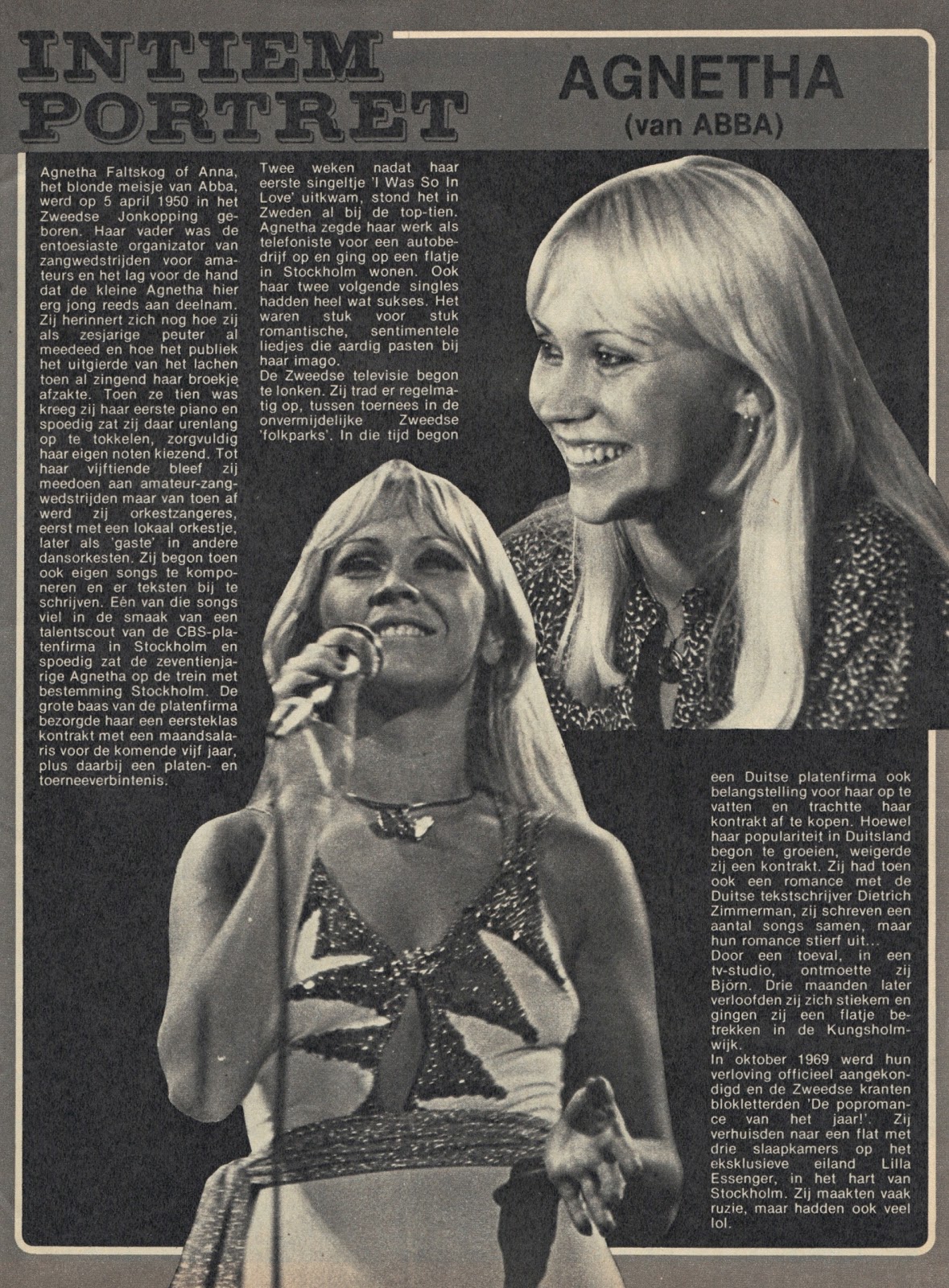
Popshop, June 1977: Intimate portrait, Agnetha (from ABBA)
Agnetha Fältskog or Anna, the blonde girl from ABBA, was born on April 5 1950 in Jönköping Sweden. Her father was the enthusiastic organizer of singing contests for amateurs and it was only natural that little Agnetha started competing in one of these at a very young age. She still remembers how she competed as a six-year-old kid and how the audience was screaming with laughter when her pants fell down while singing. When she was ten she got her first piano and soon she was playing that instrument for hours on end, carefully choosing her own notes. Up until she was fifteen she kept entering amateur singing contests, but from then on she became a singer with a dance band, first with a local orchestra, later on as a 'guest' with other dance orchestras. At that time she also started composing her own songs and writing lyrics. One of these songs caught the attention of a talent scout at the CBS record company in Stockholm and soon the seventeen-year-old found herself on a train to Stockholm. The big boss of the record company got her a first class contract with a monthly salary for the coming five years and a deal for records and tours.
Two weeks after her first single 'I Was So In Love' was released it was already in the Swedish top ten. Agnetha quit her job as a telephone operator with a car firm and moved to a small apartment in Stockholm. Her next two singles were very successful too. They were all romantic, sentimental songs that fitted her image nicely.
The Swedish television started to get interested. She regularly performed on screen, in between her tours in the inevitable folk parks. Around that time, a German record company became interested in her as well and tried to buy off her contract. Although her popularity in Germany started to increase, she refused a contract. She also had a romance with the German lyricist Dietrich Zimmerman. They wrote a couple of songs together, but their romance faded out...
By coincidence, in a television studio, she met Björn. Three months later they secretly got engaged and moved in together in a small apartment in the Kungsholm area.
In October 1969 they announced their engagement officially and the Swedish newspapers headlined 'the pop romance of the year'. They moved to a three-bedroom apartment on the exclusive island Lilla Essenger, in the heart of Stockholm. They argued a lot, but they also had a lot of fun.
On July 6 1971, she married Björn, who had teamed up already with Benny and together they went on a couple of summer tours. But the time wasn't right yet for ABBA and Agnetha kept writing and recording her own songs. 'If Tears Were Gold' became a huge success.
Agnetha also starred as Mary Magdalene in the musical 'Jesus Christ Superstar' and the well-known song 'I Don't Know How To Love Him' was put on record, together with other songs from her folk park repertoire.
In 1973, everyone thought that this would be the year for Benny, Björn, Agnetha and Anni-Frid, who had become Benny's fiancée in the meantime. They entered the Swedish preselection for the Eurovison Song Contest with the song 'Ring Ring'. Agnetha was pregnant at the time and the baby was due in February 1973, around the time of the final. The quartet was prepared for everything and there was even a version of their song to perform as a trio, in case Agnetha would have to miss the final. But she made it through and managed to get to that final, but the song only finished in third place. Four days after the Swedish final, little Linda was born. From then on, Agnetha would devote her time completely to Linda and ABBA, in that order.
Tell us something more about your first love?
"I must have been around seventeen. His name was Björn Lilja, no, not ABBA's Björn, but a local boy from the neighborhood in Jönköping. It was a teenage romance. But after the romance had ended, I remember that I tried to forget about my sorrow behind the piano and that I composed a melody, very sentimental and sad, really something for young girls. The melody didn't put me in a better mood, but it was a very nice and moving piece. And it's exactly that song that gave me a record deal in Stockholm. Now I'm grateful to Björn Lilja because without that romance I probably would never have written that song. Actually we never really argued. We are still friends. And apparently he is very proud because he inspired me to write that song. When it became a hit in Sweden, he came over to congratulate me. He wanted to give me a hug but he couldn't. He had just broken both his arms in a traffic accident and they were healing in a plaster!"
What are your thoughts about your parents?
"Very positive. I owe everything to my dad. To his patience for instance. He spent hours and hours teaching me how to play the piano. He never stopped encouraging me..."
It is said that you can be very candid, but also that you are very shy. So what is it?
"In essence I am shy. I'm the country girl that made it big and the past few years I've had some difficulties with that. I tried to hide that inborn insecurity behind a mask of self-confidence. It was claimed that my behaviour was influenced by that. That I made a lot of mistakes because of that. But people exaggerate too. It was said at the time that I couldn't even handle a spoon in a restaurant and things like that. Just imagine! Of course I have made mistakes. Put yourself in my place. A seventeen, eighteen-year-old girl with all these snobs from the record industry, my language probably wasn't polished all the time. Anyone who got to know me a little better would admit that I always tried to be gentle, honest and soft. Even to journalists. But when they are not to my liking, I keep it short..."
What have been the most exciting moments in your life?
"There are a lot of them! When it comes to intensity I can't put them in any particular order. Chronologically maybe? When I walked into a recording studio in Stockholm for the first time as a seventeen-year-old girl and I heard all those musicians rehearse that first little melody that I had composed, preparing themselves for the actual recording... When I met Björn and we got engaged. I remember an engagement holiday on the sunny island Cyprus where we could do what we wanted without being recognized... The day that I got married, it was lovely!... When Linda was born... And when we won the Eurovision Song Contest with 'Waterloo'! And there are plenty more. I repeat: I've been lucky in life!"
How did you meet Björn? Was he the love of your life right away?
"You bet! I had seen him before with the Hootenanny Singers and at one time we found ourselves in the same TV studio. I walked up to him and said: 'Hello, Björn. I'm glad that I finally get to meet you. I think you are the best and I love your music!'. I really did like their music but I thought that Björn, their lead guitarist and singer was something else. I had never seen him in real life, but I remember that he looked even more handsome than on the little TV screen!"
What was so special about your wedding day?
"Everything! I know that's what every girl says but the entire day was one surprise after the other. As our venue, we had chosen an old, gothic church in a fairy-like little village. In Sweden you can get married wherever you like. In my white wedding gown I was taken to the church in an open carriage, the whole village was cheering me on. Swedish hymns were being sung and while entering the church, Benny was playing Mendelssohn's wedding march on the organ, followed by his own hit 'Wedding'. It was a short ceremony. After we were married there was some kind of uproar when we came out of the church. A police officer lost control over his horse and the animal stepped on my foot. A doctor was even called in but luckily it wasn't all that bad. He put a bandage around my ankle and it was okay. The entourage went to a tavern called White Horse for the wedding dinner. There were 39 guests and one dog - Ada, our French bulldog - and we danced to the music of Benny and his Hep Stars. Outside, hundreds of people were calling out our names, they wanted to see us once again before they headed home. So we decided to wave to them from the balcony, just like royalty. I will keep remembering every minute of that day. Even when I'm an old lady, I won't forget my happiness!"
Is it true that little Linda means everything to you?
"The birth of Linda was the proudest moment of my life. Since then, something has changed in my life. I keep making an effort to be and remain a one hundred percent member of ABBA, but my marriage and Linda now come first. I couldn't care less if the show business would turn its back on us or me. I would simply withdraw and devote myself completely to playing the part of a wife and mother. Especially when we're on tour, I miss Linda terribly. Every second away from her is real torture..."
Are you really as superstitious as is often claimed?
"We really are. Björn's secret weapon is his guitar, designed and shaped as a star. Anni-Frid has her sombrero and I have a stuffed donkey as my good-luck charm. It's very big and inconvenient, but I drag it along everywhere I go. People even make jokes about it, but I don't mind. Agnetha and her donkey, you know..."
Do you never argue: four people who have to work together every day, don't they get tired of each other?
"Benny and Björn get along really well, they are men and they complement each other musically too. Anni-Frid and I get along fine as well. Until recently we lived quite close to each other, but now we only see each other during tours, rehearsals and performances. But the fact that we still spend our holidays together proves that we are really quite taken with each other. Whenever there are problems in the ABBA camp, we talk about them democratically before decisions are being made. Everything is discussed. Even the outfits that we are going to wear when we perform. My long hair is always a subject of discussion too. Personally, I would like to cut it short, but the other three prefer the long hair. And then I give in. That's democracy!"
People tend to call you the 'beauty' of the group, the sexy one, the girl with the most beautiful legs. How do you respond to that?
"Me, sexy? Come on. I'm actually somewhat prudish, at least according to Swedish values. But that long, blonde hair is making a big impression, especially in Italy and Spain. I don't dare to go out on the streets alone over there! Outsiders may think that's fun, but I don't. I would rather have short and dark hair..."
Two weeks after her first single 'I Was So In Love' was released it was already in the Swedish top ten. Agnetha quit her job as a telephone operator with a car firm and moved to a small apartment in Stockholm. Her next two singles were very successful too. They were all romantic, sentimental songs that fitted her image nicely.
The Swedish television started to get interested. She regularly performed on screen, in between her tours in the inevitable folk parks. Around that time, a German record company became interested in her as well and tried to buy off her contract. Although her popularity in Germany started to increase, she refused a contract. She also had a romance with the German lyricist Dietrich Zimmerman. They wrote a couple of songs together, but their romance faded out...
By coincidence, in a television studio, she met Björn. Three months later they secretly got engaged and moved in together in a small apartment in the Kungsholm area.
In October 1969 they announced their engagement officially and the Swedish newspapers headlined 'the pop romance of the year'. They moved to a three-bedroom apartment on the exclusive island Lilla Essenger, in the heart of Stockholm. They argued a lot, but they also had a lot of fun.
On July 6 1971, she married Björn, who had teamed up already with Benny and together they went on a couple of summer tours. But the time wasn't right yet for ABBA and Agnetha kept writing and recording her own songs. 'If Tears Were Gold' became a huge success.
Agnetha also starred as Mary Magdalene in the musical 'Jesus Christ Superstar' and the well-known song 'I Don't Know How To Love Him' was put on record, together with other songs from her folk park repertoire.
In 1973, everyone thought that this would be the year for Benny, Björn, Agnetha and Anni-Frid, who had become Benny's fiancée in the meantime. They entered the Swedish preselection for the Eurovison Song Contest with the song 'Ring Ring'. Agnetha was pregnant at the time and the baby was due in February 1973, around the time of the final. The quartet was prepared for everything and there was even a version of their song to perform as a trio, in case Agnetha would have to miss the final. But she made it through and managed to get to that final, but the song only finished in third place. Four days after the Swedish final, little Linda was born. From then on, Agnetha would devote her time completely to Linda and ABBA, in that order.
Tell us something more about your first love?"I must have been around seventeen. His name was Björn Lilja, no, not ABBA's Björn, but a local boy from the neighborhood in Jönköping. It was a teenage romance. But after the romance had ended, I remember that I tried to forget about my sorrow behind the piano and that I composed a melody, very sentimental and sad, really something for young girls. The melody didn't put me in a better mood, but it was a very nice and moving piece. And it's exactly that song that gave me a record deal in Stockholm. Now I'm grateful to Björn Lilja because without that romance I probably would never have written that song. Actually we never really argued. We are still friends. And apparently he is very proud because he inspired me to write that song. When it became a hit in Sweden, he came over to congratulate me. He wanted to give me a hug but he couldn't. He had just broken both his arms in a traffic accident and they were healing in a plaster!"
What are your thoughts about your parents?
"Very positive. I owe everything to my dad. To his patience for instance. He spent hours and hours teaching me how to play the piano. He never stopped encouraging me..."
It is said that you can be very candid, but also that you are very shy. So what is it?
"In essence I am shy. I'm the country girl that made it big and the past few years I've had some difficulties with that. I tried to hide that inborn insecurity behind a mask of self-confidence. It was claimed that my behaviour was influenced by that. That I made a lot of mistakes because of that. But people exaggerate too. It was said at the time that I couldn't even handle a spoon in a restaurant and things like that. Just imagine! Of course I have made mistakes. Put yourself in my place. A seventeen, eighteen-year-old girl with all these snobs from the record industry, my language probably wasn't polished all the time. Anyone who got to know me a little better would admit that I always tried to be gentle, honest and soft. Even to journalists. But when they are not to my liking, I keep it short..."
What have been the most exciting moments in your life?
"There are a lot of them! When it comes to intensity I can't put them in any particular order. Chronologically maybe? When I walked into a recording studio in Stockholm for the first time as a seventeen-year-old girl and I heard all those musicians rehearse that first little melody that I had composed, preparing themselves for the actual recording... When I met Björn and we got engaged. I remember an engagement holiday on the sunny island Cyprus where we could do what we wanted without being recognized... The day that I got married, it was lovely!... When Linda was born... And when we won the Eurovision Song Contest with 'Waterloo'! And there are plenty more. I repeat: I've been lucky in life!"
How did you meet Björn? Was he the love of your life right away?
"You bet! I had seen him before with the Hootenanny Singers and at one time we found ourselves in the same TV studio. I walked up to him and said: 'Hello, Björn. I'm glad that I finally get to meet you. I think you are the best and I love your music!'. I really did like their music but I thought that Björn, their lead guitarist and singer was something else. I had never seen him in real life, but I remember that he looked even more handsome than on the little TV screen!"
What was so special about your wedding day?
"Everything! I know that's what every girl says but the entire day was one surprise after the other. As our venue, we had chosen an old, gothic church in a fairy-like little village. In Sweden you can get married wherever you like. In my white wedding gown I was taken to the church in an open carriage, the whole village was cheering me on. Swedish hymns were being sung and while entering the church, Benny was playing Mendelssohn's wedding march on the organ, followed by his own hit 'Wedding'. It was a short ceremony. After we were married there was some kind of uproar when we came out of the church. A police officer lost control over his horse and the animal stepped on my foot. A doctor was even called in but luckily it wasn't all that bad. He put a bandage around my ankle and it was okay. The entourage went to a tavern called White Horse for the wedding dinner. There were 39 guests and one dog - Ada, our French bulldog - and we danced to the music of Benny and his Hep Stars. Outside, hundreds of people were calling out our names, they wanted to see us once again before they headed home. So we decided to wave to them from the balcony, just like royalty. I will keep remembering every minute of that day. Even when I'm an old lady, I won't forget my happiness!"
Is it true that little Linda means everything to you?
"The birth of Linda was the proudest moment of my life. Since then, something has changed in my life. I keep making an effort to be and remain a one hundred percent member of ABBA, but my marriage and Linda now come first. I couldn't care less if the show business would turn its back on us or me. I would simply withdraw and devote myself completely to playing the part of a wife and mother. Especially when we're on tour, I miss Linda terribly. Every second away from her is real torture..."
Are you really as superstitious as is often claimed?
"We really are. Björn's secret weapon is his guitar, designed and shaped as a star. Anni-Frid has her sombrero and I have a stuffed donkey as my good-luck charm. It's very big and inconvenient, but I drag it along everywhere I go. People even make jokes about it, but I don't mind. Agnetha and her donkey, you know..."
Do you never argue: four people who have to work together every day, don't they get tired of each other?
"Benny and Björn get along really well, they are men and they complement each other musically too. Anni-Frid and I get along fine as well. Until recently we lived quite close to each other, but now we only see each other during tours, rehearsals and performances. But the fact that we still spend our holidays together proves that we are really quite taken with each other. Whenever there are problems in the ABBA camp, we talk about them democratically before decisions are being made. Everything is discussed. Even the outfits that we are going to wear when we perform. My long hair is always a subject of discussion too. Personally, I would like to cut it short, but the other three prefer the long hair. And then I give in. That's democracy!"
People tend to call you the 'beauty' of the group, the sexy one, the girl with the most beautiful legs. How do you respond to that?
"Me, sexy? Come on. I'm actually somewhat prudish, at least according to Swedish values. But that long, blonde hair is making a big impression, especially in Italy and Spain. I don't dare to go out on the streets alone over there! Outsiders may think that's fun, but I don't. I would rather have short and dark hair..."
Sunday, 30 September 2012
Story, September 1977: Dutch kindergarten teacher discovered ABBA's Björn
On his first day, the Swedish little boy at the Amsterdam kindergarten didn't dare to open his mouth. Later on, he sang a St. Nicholas song in perfect Dutch.
23 years ago, a blonde little boy with a timid face stepped into May Borghols' private kindergarten class in the Van Eeghenstreet in Amsterdam at the hand of his mother. He desperately longed to run back to the car with driver, that brought him here and that was now waiting for his mother outside. He himself would have to stay with all these foreign children, who all spoke such a weird language. A couple of days earlier, he had arrived in Holland from his home country Sweden for a stay of approximately one year. His father, who was working in the paper industry in Sweden, wanted to check out the working methods at the company Van Gelder in Velsen. His mother decided it would be the best thing for young Björn to go to school in this foreign country, more particularly to the kindergarten class of singing teacher May Borghols, where more children of different nationalities were accomodated.
All of a sudden, the entrance of little Björn springs to the mind of Mrs. Henny Otten-Hobby from Almere-Haven - at the time the assistant of May Borghols - when the group appears on the television screen when she is watching the Eurovision Song Contest in 1976 with her family. "I know that one!" she exclaims. Her husband starts laughing. "But you have never even been to Sweden," he remarks.
"No," she says. "I've never been to Sweden, but that one ABBA member has been to Holland in the past! He was in my kindergarten class and his name was..." She thinks for a while and then she remembers: "Björn!"
The man on the screen turns into that little boy again, who was having such a rough time those first days at school, because no one could understand him. She even remembers a photograph with Björn on it. Industriously, she starts looking, but the photograph doesn't surface until she moves to a new home.
"Björn was a quick learner," she tells Story later on. "Mrs. Borghols and I paid extra attention to him those first few days. We pointed to all kinds of objects and told him what they were called. Soon he started talking a little and after a few months he spoke Dutch nearly as well as his Dutch friends. But he was a very modest little boy: maybe even too modest."
After she had seen ABBA win successfully with 'Waterloo', even more memories surfaced with Mrs. Otten. She saw little Björn playing in the Vondel park again, that was adjacent to the garden of the kindergarten class. And she remembered again how the blonde little boy ate his sandwiches at school during lunch time, because this was convenient to his parents.
"But my fondest memory is the St. Nicholas party," says Mrs. Otten. Quite some time before the party, we started teaching the children St. Nicholas songs. Since Björn didn't know who that important man was who would come over on his birthday and bring presents, we showed him some pictures and drawings of St. Nicholas. He was great at learning these songs. We were astonished how well he could remember all these (to him) unknown melodies and how well he could sing in tune. When St. Nicholas finally arrived, Björn was allowed to sing a song for him on his own. He was beaming with pride and so were we, because he did a great job. Who could have guessed at that very moment that he would become one of ABBA's B's and would make such beautiful songs himself?
23 years ago, a blonde little boy with a timid face stepped into May Borghols' private kindergarten class in the Van Eeghenstreet in Amsterdam at the hand of his mother. He desperately longed to run back to the car with driver, that brought him here and that was now waiting for his mother outside. He himself would have to stay with all these foreign children, who all spoke such a weird language. A couple of days earlier, he had arrived in Holland from his home country Sweden for a stay of approximately one year. His father, who was working in the paper industry in Sweden, wanted to check out the working methods at the company Van Gelder in Velsen. His mother decided it would be the best thing for young Björn to go to school in this foreign country, more particularly to the kindergarten class of singing teacher May Borghols, where more children of different nationalities were accomodated.
All of a sudden, the entrance of little Björn springs to the mind of Mrs. Henny Otten-Hobby from Almere-Haven - at the time the assistant of May Borghols - when the group appears on the television screen when she is watching the Eurovision Song Contest in 1976 with her family. "I know that one!" she exclaims. Her husband starts laughing. "But you have never even been to Sweden," he remarks.
"No," she says. "I've never been to Sweden, but that one ABBA member has been to Holland in the past! He was in my kindergarten class and his name was..." She thinks for a while and then she remembers: "Björn!"
The man on the screen turns into that little boy again, who was having such a rough time those first days at school, because no one could understand him. She even remembers a photograph with Björn on it. Industriously, she starts looking, but the photograph doesn't surface until she moves to a new home.
"Björn was a quick learner," she tells Story later on. "Mrs. Borghols and I paid extra attention to him those first few days. We pointed to all kinds of objects and told him what they were called. Soon he started talking a little and after a few months he spoke Dutch nearly as well as his Dutch friends. But he was a very modest little boy: maybe even too modest."
After she had seen ABBA win successfully with 'Waterloo', even more memories surfaced with Mrs. Otten. She saw little Björn playing in the Vondel park again, that was adjacent to the garden of the kindergarten class. And she remembered again how the blonde little boy ate his sandwiches at school during lunch time, because this was convenient to his parents.
"But my fondest memory is the St. Nicholas party," says Mrs. Otten. Quite some time before the party, we started teaching the children St. Nicholas songs. Since Björn didn't know who that important man was who would come over on his birthday and bring presents, we showed him some pictures and drawings of St. Nicholas. He was great at learning these songs. We were astonished how well he could remember all these (to him) unknown melodies and how well he could sing in tune. When St. Nicholas finally arrived, Björn was allowed to sing a song for him on his own. He was beaming with pride and so were we, because he did a great job. Who could have guessed at that very moment that he would become one of ABBA's B's and would make such beautiful songs himself?
Sunday, 9 September 2012
Story, 1977: Is ABBA going to split up?
What's really true about the rumour that the four members of ABBA don't get along that well anymore? Is it true that blonde Anna, now that's she is expecting a baby, doesn't feel like doing alle these performances any longer? What's true about the rumours that ABBA is going to split up?
Only recently, Björn (the one without the beard and Anna's husband) felt the need to answer all these questions. He said: "Of course we do have arguments from time to time. It so happens that we are four different personalities and we all have our mistakes and flaws. But we are very open, therefore we always talk things out right away. Indeed, Anna is pregnant but we planned that in such a way that no performances will be endangered. Anna is actually the group member who likes to perform most of all. And now the answer to the last question. Of course, ABBA is going to split up eventually. It's just not something for anyone to be concerned about just yet. Because we are only going to split up when people stop buying our records. All four of us know that that time will come eventually, but we hope that won't be any time soon."
Saturday, 4 August 2012
Youpi, 1977: The filming of the movie tells the story of their love
In issue 14 of Youpi, we already told you in short about the new project of the group ABBA: filming a movie that's going to tell a splendid double love story, about the way that the couples in ABBA were formed. But there's talk about two other films as well. The first one will have 'ABBA in concert' as its theme. The second will be a kind of musical comedy wherein ABBA is going to star. We've promised you to tell you more about these projects. Youpi has kept its promise and presents you, exclusively, the first pictures of these three projects. But behind the cameras!
When will these films be released, where will they be released? Well, no one knows exactly. Obviously, they will be released first in Sweden, but they will probably be released all over the world. Anyhow, the entire ABBA team, headed by their manager Stig Anderson, is already working on the project. Like in all movies, they will be filmed in all kinds of circumstances and situations. But for the documentary, parts of the footage have already been filmed during their last European tour. The direction of the movie has been entrusted to a befriended Swedish director, the same director who is responsible for their promotional films.
"He is a real genius," Benny told us. "He could be famous internationally if he wanted to. But he works almost exclusively for us."
After this first film, there is going to be a musical comedy, in the broad sense of the word. "Yes," Benny continues, "you will be able to see a couple of sketches. There won't be a main theme, nor one single subject."
Benny and Björn have already started working on composing the music, while another person in their team is working on the screenplay. But nothing seems to be definitive yet.
"For now, the idea that we are exploring is the story about a girl that experiences an enormous success but eventually gets crushed by her fame, squeezed out by the people around her like a lemon that's tossed away after it has been used..."
A project like this will take them more than six months. "But at the moment we can afford ourselves to release a little less singles, so that we can prove that we are more than just a simple pop group."
The third film they are planning will be a beautiful love story. The story about all members of the group. Thanks to Youpie, you already know how Anna and Björn got acquainted. At first, they only knew each other from television, and as such they appreciated their individual artistic qualities. Then one day they appeared together in the same television programme. From that day onwards they stayed together...
Benny and Frida, they worked at competitive clubs that were situated right in sight of one another. One day, Benny came over to have a drink at the club where Frida performed and he asked if he could meet her behind the scenes. Once again, it was love at first sight.
Of course, in the cinema these stories will be a little romanticized and apart from that, the film will show how the four members of ABBA got together. But the true story will be respected and we will get to see a kind of charming autobiographical story.
The third film they are planning will be a beautiful love story. The story about all members of the group. Thanks to Youpie, you already know how Anna and Björn got acquainted. At first, they only knew each other from television, and as such they appreciated their individual artistic qualities. Then one day they appeared together in the same television programme. From that day onwards they stayed together...
Benny and Frida, they worked at competitive clubs that were situated right in sight of one another. One day, Benny came over to have a drink at the club where Frida performed and he asked if he could meet her behind the scenes. Once again, it was love at first sight.
Of course, in the cinema these stories will be a little romanticized and apart from that, the film will show how the four members of ABBA got together. But the true story will be respected and we will get to see a kind of charming autobiographical story.
Thursday, 2 August 2012
Mix, July 1977: Dysfunctional sound equipment almost cost ABBA the Eurovision Song Contest
ABBA reached the top thanks to the Eurovision Song Contest. But before that happened, a lot of obstacles had to be overcome. First, stubborn 'experts' dismissed the group and after that, sound equipment threatened to be a spoil-sport...
"1973 was going to be our big year," Björn says. "We were going to make it at the Eurovision Song Contest and our success there would give us a push on our way to international fame."
Benny and Björn worked themselves to the bone to compose a winning melody, together with Stikkan Anderson, who would contribute the lyrics. "That was 'Ring Ring'", says Benny. "And we were all convinced that it was a good song. We felt that we had a real winner on our hands, but the experts dropped us like a hot brick. In Sweden, the song for the Eurovision Song Contest is being chosen by a couple of people who call themselves experts in the music industry. The general public is never asked for an opinion."
'Ring Ring' didn't appeal to the experts in any way. An enormous disappointment, especially for Björn and Benny who saw the results of their toiling go to waste completely. Stikkan immediately proved the experts wrong by releasing 'Ring Ring'. The record stormed to the top of the charts right away...
ABBA didn't grieve for long. They knew for themselves that they had sensed the taste of the general public. Four days after the Swedish pre-selection Agnetha gave birth to her daughter Linda and when she was up to working with the other three again for one hundred percent, ABBA started preparations for the year 1974. What hadn't happened in 1973, should come to fruition in 1974 in Brighton.
Stikkan's office changed into the headquarter of a General, who is going to stage the crucial battle. His 'secret service', spread all over the world, supplied worthwile information almost on a daily basis about the kind of music and lyrics that were popular at the moment and with that information as their starting point, they got to work.
Stikkan had already come up with the title of the song. It was going to be called 'Waterloo', a title that was familiar all over the world and that could be pronounced by everybody. Furthermore, it was decided in advance that the song should have a strong rhythm and Björn and Benny spent hundreds of hours searching for a catchy piece of music. ABBA couldn't leave anything to chance. The impression on the five hundred million people that would watch their performance on television had to be overwhelming. Once again, the last obstacle in the shape of the Swedish pre-selection had to be taken. But this time the choice for the winning song wasn't left to the experts but to three hundred randomly picked Swedish men and women. ABBA won!
Stikkan immediately made the most of this success and started to sell the 'Waterloo' record all over Europe. He was glowing with pride when the sales figures indicated that the record would be a surefit hit, regardless of the outcome of the contest in Brighton.
"On our flight to England we were strikingly quiet," Benny remembers. "There were no jokes being made like we usually did and everyone admitted that it was like we all had a heavy heart."
"We were reasonably satisfied with our first rehearsal," says Anni-Frid, "but then it turned out to our dismay that the music we had recorded on tapes in Sweden didn't sound right because the sound equipment was dysfunctional. Honestly, we were sweating with anxiety! If that sound problem couldn't be fixed, the entire effect of 'Waterloo' would be lost. A sound technician started to work on the speakers and he assured us that he would undoubtedly succeed in fixing the problem. We all hoped for the best."
Of the seventeen contestants - France had withdrawn due to president Pompidou passing away - ABBA was by far the least well-known act. No one had ever heard of the Swedish group and the quartet was placed worryingly low with the numerous bookmakers. The most likely candidate for the victory seemed to be the English singer Olivia Newton-John.
"Olivia was followed closely by a Dutch duo with the peculiar name Mouth and McNeal," says Stikkan Anderson. "But that didn't bother me one bit. I was so convinced that ABBA would win that I spontaneously bet twenty pounds on their victory."
On the day of the dress rehearsal the sound technician came over to tell everybody to their relief that the problems with the speakers had been solved. Björn, Benny, Anni-Frid and Agnetha put on their colourful, glittery costumes (Benny's pants were so tight that he didn't dare to sit down until after the end of the contest, six hours later) and ascertained to their satisfaction that the inimitable boom-boom sound was coming out of the speakers again in the familiar way.
Benny and Anni-Frid went out to have dinner together, Björn and Agnetha did the same and only shortly before the Eurovision Song Contest commenced they saw each other again in the room where the contestants were waiting for their turn.
"The tension in that room was beyond words," Anni-Frid says. "You could cut the atmosphere with a knife. The competitors looked at each other with faces tensed with nerves. It was terrifying. Everyone wanted to be the first to perform to get it over with. When you finished your performance, a burden was lifted from your shoulders and you could sit back and watch the others sweat. We were assigned by lot to perform in eighth place. Exactly in the middle. In deadly silence we watched the first seven contestants on the television in our waiting room. Our mouths were dried out."
"Like in a dream, we heard our call," Benny continues. "We walked through a hallway and all of a sudden we were on stage. Five hundred million people are watching us now, was the only thing going through my mind. Then we performed 'Waterloo' and we thought everything went as we had hoped. During the first bars of the song our nerves disappeared. The bond that tied us together was stronger than all the emotions and our performance went very smoothly. And then suddenly it was all over and we could go back to the waiting room."
"While waiting for the votes to come in, our nerves were boiling up again," says Agnetha. "The excitement was so intense that it almost hurt. My head was buzzing and my heart was pounding peculiarly."
"Then," she continues, "the votes of the international jury started to come in. You could hear a pin drop in the waiting room. At one moment one contestant was ahead, at another moment the other. In a fascinated manner we all gazed at the screens on which the results were projected. At one moment I got the impression that we didn't make it after all. I felt like a deflating balloon. Then Finland gave us five points which gave us the lead position again."
"And then it was all over. 'Waterloo' had acquired 24 points, six more than the Italian song 'Si'. Mouth and McNeal finished honourably in third place. A very sympathetic couple, these Dutchmen. Mouth and McNeal were the first who came over to congratulate us with our victory. They said that the best song and the best group had won. A heartwarming gesture of these young people who must have felt a little disappointed with their third place."
The next few days were a continuous frenzy of press conferences, performances on British television, honourings, champagne, official receptions, champagne, interviews, flash lights, gala dinners and even more champagne. Still intoxicated by the success of 'Waterloo', the quartet could finally find some peace and quiet, after a week of non-stop parties. Stikkan Anderson had kept his promise. ABBA, unknown Swedish ABBA, was on top.
"1973 was going to be our big year," Björn says. "We were going to make it at the Eurovision Song Contest and our success there would give us a push on our way to international fame."
Benny and Björn worked themselves to the bone to compose a winning melody, together with Stikkan Anderson, who would contribute the lyrics. "That was 'Ring Ring'", says Benny. "And we were all convinced that it was a good song. We felt that we had a real winner on our hands, but the experts dropped us like a hot brick. In Sweden, the song for the Eurovision Song Contest is being chosen by a couple of people who call themselves experts in the music industry. The general public is never asked for an opinion."
'Ring Ring' didn't appeal to the experts in any way. An enormous disappointment, especially for Björn and Benny who saw the results of their toiling go to waste completely. Stikkan immediately proved the experts wrong by releasing 'Ring Ring'. The record stormed to the top of the charts right away...
ABBA didn't grieve for long. They knew for themselves that they had sensed the taste of the general public. Four days after the Swedish pre-selection Agnetha gave birth to her daughter Linda and when she was up to working with the other three again for one hundred percent, ABBA started preparations for the year 1974. What hadn't happened in 1973, should come to fruition in 1974 in Brighton.
Stikkan's office changed into the headquarter of a General, who is going to stage the crucial battle. His 'secret service', spread all over the world, supplied worthwile information almost on a daily basis about the kind of music and lyrics that were popular at the moment and with that information as their starting point, they got to work.
Stikkan had already come up with the title of the song. It was going to be called 'Waterloo', a title that was familiar all over the world and that could be pronounced by everybody. Furthermore, it was decided in advance that the song should have a strong rhythm and Björn and Benny spent hundreds of hours searching for a catchy piece of music. ABBA couldn't leave anything to chance. The impression on the five hundred million people that would watch their performance on television had to be overwhelming. Once again, the last obstacle in the shape of the Swedish pre-selection had to be taken. But this time the choice for the winning song wasn't left to the experts but to three hundred randomly picked Swedish men and women. ABBA won!
Stikkan immediately made the most of this success and started to sell the 'Waterloo' record all over Europe. He was glowing with pride when the sales figures indicated that the record would be a surefit hit, regardless of the outcome of the contest in Brighton.
"On our flight to England we were strikingly quiet," Benny remembers. "There were no jokes being made like we usually did and everyone admitted that it was like we all had a heavy heart."
"We were reasonably satisfied with our first rehearsal," says Anni-Frid, "but then it turned out to our dismay that the music we had recorded on tapes in Sweden didn't sound right because the sound equipment was dysfunctional. Honestly, we were sweating with anxiety! If that sound problem couldn't be fixed, the entire effect of 'Waterloo' would be lost. A sound technician started to work on the speakers and he assured us that he would undoubtedly succeed in fixing the problem. We all hoped for the best."
Of the seventeen contestants - France had withdrawn due to president Pompidou passing away - ABBA was by far the least well-known act. No one had ever heard of the Swedish group and the quartet was placed worryingly low with the numerous bookmakers. The most likely candidate for the victory seemed to be the English singer Olivia Newton-John.
"Olivia was followed closely by a Dutch duo with the peculiar name Mouth and McNeal," says Stikkan Anderson. "But that didn't bother me one bit. I was so convinced that ABBA would win that I spontaneously bet twenty pounds on their victory."
On the day of the dress rehearsal the sound technician came over to tell everybody to their relief that the problems with the speakers had been solved. Björn, Benny, Anni-Frid and Agnetha put on their colourful, glittery costumes (Benny's pants were so tight that he didn't dare to sit down until after the end of the contest, six hours later) and ascertained to their satisfaction that the inimitable boom-boom sound was coming out of the speakers again in the familiar way.
Benny and Anni-Frid went out to have dinner together, Björn and Agnetha did the same and only shortly before the Eurovision Song Contest commenced they saw each other again in the room where the contestants were waiting for their turn.
"The tension in that room was beyond words," Anni-Frid says. "You could cut the atmosphere with a knife. The competitors looked at each other with faces tensed with nerves. It was terrifying. Everyone wanted to be the first to perform to get it over with. When you finished your performance, a burden was lifted from your shoulders and you could sit back and watch the others sweat. We were assigned by lot to perform in eighth place. Exactly in the middle. In deadly silence we watched the first seven contestants on the television in our waiting room. Our mouths were dried out."
"Like in a dream, we heard our call," Benny continues. "We walked through a hallway and all of a sudden we were on stage. Five hundred million people are watching us now, was the only thing going through my mind. Then we performed 'Waterloo' and we thought everything went as we had hoped. During the first bars of the song our nerves disappeared. The bond that tied us together was stronger than all the emotions and our performance went very smoothly. And then suddenly it was all over and we could go back to the waiting room."
"While waiting for the votes to come in, our nerves were boiling up again," says Agnetha. "The excitement was so intense that it almost hurt. My head was buzzing and my heart was pounding peculiarly."
"Then," she continues, "the votes of the international jury started to come in. You could hear a pin drop in the waiting room. At one moment one contestant was ahead, at another moment the other. In a fascinated manner we all gazed at the screens on which the results were projected. At one moment I got the impression that we didn't make it after all. I felt like a deflating balloon. Then Finland gave us five points which gave us the lead position again."
"And then it was all over. 'Waterloo' had acquired 24 points, six more than the Italian song 'Si'. Mouth and McNeal finished honourably in third place. A very sympathetic couple, these Dutchmen. Mouth and McNeal were the first who came over to congratulate us with our victory. They said that the best song and the best group had won. A heartwarming gesture of these young people who must have felt a little disappointed with their third place."
The next few days were a continuous frenzy of press conferences, performances on British television, honourings, champagne, official receptions, champagne, interviews, flash lights, gala dinners and even more champagne. Still intoxicated by the success of 'Waterloo', the quartet could finally find some peace and quiet, after a week of non-stop parties. Stikkan Anderson had kept his promise. ABBA, unknown Swedish ABBA, was on top.
Subscribe to:
Posts (Atom)