Showing posts with label 1997. Show all posts

Saturday, 23 January 2010

De Telegraaf, November 1997: After ABBA, still no Waterloo – Agnetha Fältskog on the eve of a new era

This article appeared in one of Holland’s biggest newspapers, around the time that Agnetha’s book ‘As I Am’ was published.
In Sweden, she is compared, to her annoyance, to the legendary movie star Greta Garbo. It is one of the many misconceptions that ABBA-singer Agnetha Fältskog wants to rectify in her memoirs ‘As I Am: ABBA Before & Beyond’.

At ABBA’s peak (the end of the seventies, the beginning of the eighties), people tended to chuckle about the pop group. But in the meantime, the four band members have developed into a genuine cult. Especially the blonde singer Agnetha is the centre of the ABBA-revival. Not only their middle of the road music, of which no less than 250 million records have been sold, is completely back in the picture. Also their satin disco costumes, decorated with shiny sequins, their platform boots, the fake animal prints, the gypsy skirts, the wide slacks, the tight slipovers and catsuits and the fake furs are totally hip again. At least, Agnetha has a good sense of timing.

The rumour that she would have been sown into the tight blue satin costume, that she wore during the performance of ‘Waterloo’ with ABBA, which gave Sweden the victory at the Eurovision Song Contest in Brighton in 1974, is strongly denied in her book. It’s one of the deceptions that she wants to rectify, together with her friend and journalist Brita Åhman in ‘As I Am’, that has just been published by Virgin Publishing. But in that respect, the memoirs of the singer are disappointing. Ultimately, Agnetha doesn’t want to share a whole lot and Brita is overly cautious in this 160 page picture book.
The blonde has had many doubts whether she even wanted to participate. “How far do I want to go? How honest shall I be?” she’s asking herself. “I’m well aware of the fact that your words can be misinterpreted. But I’m tired of the image that has been attached to me through the years. The title ‘As I Am’, which comes from one of my early solo albums, can be explained in two ways. You might think that I’m going to reveal everything, but I’m a rather reserved type of person. On the other hand, I’m showing a glimpse of my reality, of my thoughts.”

And that’s how we find out that Agnetha (47) is definitely not as difficult as she is often described. “She has both feet planted firmly on the ground, and she is absolutely not a tragic person. She is a perfectionist and on top of that, very professional. But in the end, she couldn’t cope with the long working days, the world tours, the long separations from her children,” Brita thinks. “That was the source of the conflict. It made people uneasy and they tagged her with the label ‘difficult’. There was just a lot of jealousy.” And Agnetha herself: “If we had slowed down a bit, we could have lasted for years to come.”
Because one thing is certain, Agnetha loves to sing. She grows up in a loving family with her younger sister Mona. At the age of five, little Agnetha crawls behind a piano, finds her own melody and sings the legendary words ‘Two Small Trolls’. The next two years, she has to turn to the neighbour upstairs to make music, but at the age of seven she gets her own piano and piano lessons. Around the time when she turns fourteen, her piano teacher thinks she has nothing left to teach Agnetha. Meanwhile, she has formed the girl group The Cambers together with two girlfriends, with whom she performs. Her biggest idol is Connie Francis. At the age of fifteen, she is taking her final exam and starts working as a telephonist at a car dealer.
“I have endured the combination of working and performing for a couple of years. I was busy because I was composing my own songs as well. Until one day, I heard that a band was looking for a singer,” Agnetha says about that time.
Against her parents’ wishes, she quits her job and commits herself to music fulltime. Eventually, a lost love is the basis of her breakthrough. While being sad, she writes ‘Jag Var Så Kär’ or ‘I Was So In Love’, which gives her national fame. Soon, she becomes one of the most popular singers in Sweden. Agnetha has the fondest memories of this period.
“He had a charming voice and was an artist, just like me,” the singer says about her encounter with Björn Ulvaeus. She doesn’t want to share very much else about him, although she rapidly marries Björn, and divorces him eight years later. But between the lines, you can read that the divorce has been everything but friendly. Björn introduces Benny and Anni-Frid into her life. At first, they perform together under the name Festfolket, which means something like the Partyhoppers, but the acronym of their joint initials first appears on the album ‘Waterloo’: ABBA is born and thereby the biggest export article that Sweden has ever known, after Volvo. The ABBA-fever strikes from Russia to Japan, from Australia to America.
It’s the start of an insanely busy period that Agnetha, meanwhile the mother of daughter Linda (now 24) and son Christian (now 20), not always agrees with. “Either way, I prefer working in the studio to performing on stage. I can work in silence there,” Agnetha says. “My strength is not showing myself, but my talent.”

Agnetha contradicts the rumour that the dark-haired and blonde singers can’t stand each other. “Pure nonsense. We really wouldn’t have been able to perform together for ten years, if that had been true. We always supported each other on stage. If one of us wasn’t in the mood, the other took over. But I have to admit that there was some kind of competition between us. That was something positive. We both wanted the attention of the audience and that gave an extra kick to the concerts,” according to Agnetha, whose behind was proclaimed ‘the sexiest bottom in pop music’ in Australia, again to her annoyance. It doesn’t stop her from regularly turning her back to the delighted audience.
The two singers have totally different personalities. Frida, still childless, loves to go out, while Agnetha rushes to her hotel room to call home. She thinks parties are a waste of time. “Afterwards, I always ask myself what use it has been. All those heartfelt compliments only make me feel empty.”
Her mother’s heart is put to the test constantly, but she doesn’t take the blame for ABBA’s break-up. “We had a silent agreement that we would quit when it wasn’t fun anymore. In 1983, that time had come. For that matter, it was a very emotional year. I got my first movie part, recorded a solo album again, did a promotional tour abroad and I started my own production company.”
It was also the year of her bus accident. After that accident – the singer is scared of flying after a near plane crash and travels by bus since then – the media write, among other things, that she has had a miscarriage. All of it is pure nonsense. Either way, she already thinks that the media aren’t very friendly to her and are asking silly questions, such as ‘What did you have for breakfast’ and ‘Do you have pets?’. They very rarely ask her about her music. Together with her children, she decides to retreat into loneliness on her own island in the vicinity of Stockholm where she takes long, solitary walks. This gives Agnetha the nickname of the new Greta Garbo.
For ten long years, the singer isn’t able to listen to music at all, let alone her own music. She prefers the silence. In a short period of time, both her parents die, she gets married and gets divorced a second time. But now, Agnetha is on the verge of a different era. She is ready to take on new challenges. She has started composing again. Where the blonde, blue-eyed singer is concerned, there’s not a personal ‘Waterloo’ in store for her.

Tuesday, 16 September 2008

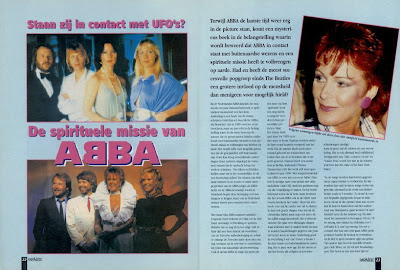
Paravisie, February 1997: ABBA's spiritual mission

In 1997, Dutch magazine Paravisie published this article with a very unusual view on ABBA, to say the least. Mind you, this is a magazine about supernatural phenomena (among others), so it's very exceptional that they pay attention to a pop-group.
Thanks to Karin, for providing the scans of this article!
While ABBA is very much in the picture lately, a mysterious book has come to our attention, in which it is claimed that ABBA is in contact with extraterrestrials and has a spiritual mission to fulfil on earth. Did or does the most successful pop-group since The Beatles have a greater influence on mankind than many would have thought possible?

At the Dutch ABBA-fanclub, that still has a few thousand members, spirituality is a hot item at the moment. The occasion is a book by German writers Görd Kaa and Sasa Merts: ‘ABBA, Die Besucher’, that was published back in 1985, but only recently has grabbed everyone’s attention. In the book, the authors claim that the group is having close connections with extraterrestrials and is having a spiritual mission to fulfil on earth. It’s even claimed to be possible that the group-members are aliens themselves. Görd Kaa received several impulses (others call them visions) in which he was commissioned to write the piece. “They seem like love-songs, but that’s the tricky part: there is a hidden message in there.” The lyrics have been analysed and, among other things, there’s talk of the ABBA-religion, the ABBA-love and the ABBA-lifestyle. Especially in Germany, this movement is starting to gain more and more followers, but in Holland people are increasingly taking these things seriously as well.

Especially ABBA-singer Annifrid Lyngstad, better known as Frida, seems to be the centre of almost endless imagination. Apart from the fact she still sings occasionally, she spends her time as the spokesperson of the Swedish environmental movement, and she recently shocked the Swedish nation by appearing on television with a bucket full of worms, as an example of natural garbage recycling. Although ABBA has stopped recording for some time now, it is said that their ‘spiritual work’ continues in their personal projects. But the German book only leads up to 1985 and is not for sale anymore. That’s why copies of the piece are spread among fans. No one has ever heard of the authors again and attempts by German fans to contact them have not succeeded. That’s why a group of fans from Berlin, one of them being Thomas Zimmerman (30), have updated the piece themselves to 1996. “ABBA’s lyric-book is sort of a Bible to me. I’ve had many quarrels about that with my catholic father. He thinks it’s blasphemous to make such comparisons. And he really looses it when I tell him that the word ABBA is also in the Bible. In there it means ‘father’. But for me, one thing doesn’t necessarily exclude the other. I draw inspiration from the Christian Bible, but even more from ABBA’s lyric-book. It covers everything. They deal about everyday life and provide tools to encounter life in a positive way: ‘Something good in everything I see’ (from ‘I Have A Dream’). And all from an individual point of view. It’s pure new age. And the good thing is, that it transcends all religions and world-views, because there’s no condemnation in any of the lyrics. And it’s all very casual. In the lyrics it doesn’t get any more binding than in ‘Take A Chance On Me’ and ‘Voulez-Vous’. Everyone is able to interpret the lyrics in his or her own way.”

“In the songs, tools are being given to improve your own situation. And often, they elaborate on that in subsequent songs, of course in the shape of love-songs like ‘I Wonder’. At one time I had to make a radical decision in my life. Would I take that new job and leave everything behind by moving to the other end of Germany? Or would I not? Instinctively, I listened to that song. The answer was there to be found: ‘Oh no, I’ll be strong, one chance in a lifetime, yes I will take it, it can’t go wrong. I’m not a coward’. It can’t go wrong. ABBA gives positive powers. I decided to leave and haven’t regretted it for a moment. I’ve heard of other fans having identical experiences. A song like ‘Move On’ is full of messages as well. Life is a trip through time and space. We are commanded not to stay put, because the rhythm of life is a cycle. Earlier on, it was already pointed out in ‘Waterloo’: ‘the history book on the shelf is always repeating itself’.”

But what is the extraterrestrial part in all this? Thomas: “First of all, there are the visions many people have had. It’s also perceivable in ABBA themselves. Their appearance, their album-covers, their lyrics. But it’s all very subtle. Secondly, when you look at certain photographs closely, especially Frida, you can’t reach any other conclusion than that her majestic charisma must come from outer space. But the lyrics are full of references to extraterrestrial, cosmic forces. Like in ‘I’m A Marionette’. It literally says: ‘As if I had come out of space’.”
In the book, the song ‘Eagle’ is named as a distinct example. The lyrics deal with ‘they’ who come from far away, know the answers to everything, speak strangely, but ‘I’ (= ABBA) understand. According to the authors, the importance of the song ‘The Visitors’ becomes clear due to the fact that the book is also titled ‘Die Besucher’. In the title-track of ABBA’s last complete album, the actual meeting with extraterrestrials is believed to be described. The song deals with the excitement, but also the fear of ‘them’ who ring the doorbell. There are parts about ‘secret meetings’. And ‘now they’ve come to take me’.

Has ABBA been abducted by UFO’s? That’s what the authors of the book are wondering about. ABBA should be well-prepared to the arrival of the extraterrestrials, but still be afraid to finally get the answers to so many questions. It makes your earthly existence collapse: ‘My whole world is falling, going crazy. I feel I’m cracking up’. According to Zimmerman the song would be an ideal soundtrack to the better science-fiction movie. “Not just because of its lyrics, but the music itself is a different story as well. Frida’s voice sounds extraterrestrial in this song.” The fact that Frida’s voice has been treated by an electronic harmonizer (sampler) for this song, doesn’t convince Thomas otherwise. “That may be true, but on so many other records harmonizers are being used, and that really doesn’t make a voice sound like this. So either the harmonizer comes from an UFO, or Frida herself.”

According to the book, the subtle references to the cosmos and space are even clear in the Swedish record-label that enjoyed the fruits of ABBA’s success: Polar Music. At first, it was a globe and later on, the stage setting of ABBA’s second world-tour: three pyramids, were printed on the label. “Especially the pyramid is a symbol of cosmic energy in many spiritual movements,” the book says. “Also, the ‘Voulez-Vous’ album cover uses a pyramid, with a photograph of Agnetha and Frida wearing futuristic belts adorned with delicate heavenly bodies, or rather little stars.”

Many fans of the German ‘ABBA-UFO club’ are having meditation-sessions with ABBA-music and claim to reach a certain state of ecstasy. “We just sit together, put on some ABBA-music and open up our souls using yoga-techniques,” says Thomas. “Then we get a marvellous feeling. ABBA is mood-enhancing anyway, but in such a session you really get the feeling you’re contacting the cosmos. It’s like you reach a higher frequency. You’re in a different dimension. Especially songs like ‘I’ve Been Waiting For You’, ‘Move On’, ‘I Let The Music Speak’ and ‘The Visitors’ are perfect for this. But also Frida's Swedish-language solo album, released last year, called ‘Djupa Andetag’ is full of music to reach that state of ecstasy. Especially ‘Älska Mig Alltid’, ‘Även En Blomma’ and the heavenly ‘Lugna Vatten’ are very elevating.”

Anita Nootenboom, president of the Dutch ABBA-fanclub thinks it’s all nonsense. “Those people in Germany have really lost it. And now I notice that a group of fans in Holland is also starting to go crazy, I’m getting worried. When I see that people are forming these meditation-groups or starting to practise yoga at our coming fanclub-day in April, I will throw them out. I don’t want anything to do with that.”

Gerard Hesen (32) from Venlo, ABBA-fan since day one, has his doubts too, but is a bit more open-minded. “The extraterrestrial stuff is a step too far for me. I’m too reserved for that. I do think that German book is very interesting. I’ve read it six times. But primarily to see how they fully analysed those lyrics. I don’t have a problem with people meditating at the fanclub-day. It really doesn’t bother me. I’m just not going to join in.”

According to the authors of the book, the ABBA-members are possibly not even aware of their mission. But what was the reaction when Agnetha and Frida were confronted with the book? Frida made a joke about it. “Didn’t I tell you earlier that I come from Mars?” and she didn’t want to elaborate on that. It’s remarkable that the authors haven’t noticed that Frida has recorded a solo song in 1975 called ‘Liv På Mars’ (Life On Mars). Agnetha only said two words about the book: “How interesting!” Gerard Hesen says the reaction of the two ladies is very sensible. “They leave it up in the air. If they say they indeed have a mission and are in contact with extraterrestrials, people won’t take them seriously anymore and they will be ridiculed. But if they had firmly denied it and discarded the book as pure nonsense, the myth would have been gone. And that doesn’t do their enormous star-standing any favours.”

Still, recently ABBA’s Björn thought it was time to reveal something about the song ‘The Visitors’. For years he firmly refused to say who those visitors were. Insisting wouldn’t help at all. But when the stories of extraterrestrial meetings reached his ears, he said about that song: “’The Visitors’ deals with dissidents in dictatorships who get caught by the secret service, like for example the dissidents in the communistic Soviet Union.” But the German fans who believe the extraterrestrial book think this explanation is too convulsive and hasty too believe. Björn didn’t want to talk about UFO’s either. He just said: “I’ve heard those stories, but I think it’s best not to say anything about it at all.”

In Germany and beyond, the euphoria reached its peak recently when reports appeared in newspapers that ABBA would reconvene to record another album. “Their work is not finished yet. There has to be another album. Especially after all those solo projects, the forces have to be combined again,” Thomas thinks. “That this is possible, has been proven already, because after Frida’s first English-language solo album ‘Something’s Going On’ and Agnetha’s single ‘Never Again’, ABBA went back into the studio to record the songs ‘The Day Before You Came’, ‘Under Attack’, ‘Just Like That’ and ‘I Am The City’. After that, it was over. But now... in the passing of time the separate members all have developed tremendously. If you combine that, the outcome would be the most fantastic album ever.”

The disappointment couldn’t be bigger when Mono Music in Stockholm replied that there wasn’t talk of a reunion at all. “The reports in the media were based on a misunderstanding. For the future, a reunion isn’t ruled out, but there definitely aren’t concrete plans for it. And it’s very questionable if it will ever happen,” says Görel Hanser, spokesperson of the ABBA-headquarters in Sweden. The fans find hope in the fact that the group never officially broke up, due to several business interests. To help matters, the fans in Germany have started meditating to release cosmic powers that will get ABBA back together again. If it will help... time will tell.