Showing posts with label 1978. Show all posts

Sunday, 17 August 2014

Muziek Parade, 1978: The ABBA Story, part 10

Last month, Muziek Parade has made a little sidestep by making Stikkan Anderson as the 'fifth' ABBA the centre of attention. MP gave you an impression of 'a day in the life of Stig'.
A month before that, the story closed with the ongoing, partly unfair, criticism on the successful group from Stockholm. And that negative assault still continues today. For instance, the ABBA movie was critically reviewed in Sweden. The reporters were very inventive in pointing out the film's shortcomings.
Needless to say that everyone working at Polar Film were sour. Thankfully, the good press came from outside Sweden. Especially in Holland and Belgium the film was received with enthusiasm and it gave many ABBA fans the afternoon or evening of their lives.
Although it has become increasingly difficult for ABBA to acquire the number one position in the Netherlands, from a musical point of view friend and especially foe are in agreement that ABBA is getting better and better. And perhaps getting better is at the expense of a quick number one position.
For instance, an avid Queen fan entered the MP offices. Naturally, a discussion started about ABBA and Queen and this fan had to admit: "I've bought the last ABBA album. I think they are excellent now." Perhaps ABBA's music is getting more complex, but one thing is certain: ABBA is still growing musically and it isn't surprising that ABBA is now being compared to the Beatles more than ever. Björn and Benny are the McCartney/Lennon of the seventies. Even though ABBA's records are getting less accesible, take the time to listen to the records carefully. Pay attention to the arrangements, to the beautiful vocal harmonies and you will say: "Yes, that's exquisite." Now back to the story, part 10 already and... there are still at least five to come. Never before has a music magazine in Europe published such an extensive story about an artist or a group. Muziek Parade is proud of that. Thanks to the cooperation of ABBA themselves, of top photographers Barry Levine and Wolfgang Heilemann and not to forget Stockcolor International from charming Monaco, a top achievement like this has been possible. Thank you all. From the piles of mail that we received, MP has concluded that we've done something right.

The 'Arrival' album caused a sensation in the Swedish press. It was rumoured that Polar had decided that only orders exceeding 250 copies would be delivered to record stores. It was all nonsense of course but the damage had been done in the media. Stig Anderson: "Another joke, too ridiculous to even talk about. ABBA doesn't need to force their albums into record stores. Those records will sell like hotcakes anyway."
Things were especially difficult for ABBA in Sweden because they made so much money. A decidedly angry Agnetha says: "I really don't get why people have to moan about this. Everyone is doing well in Sweden and we are doing a little better, but we've worked very, very hard for it. People tend to forget that. And if we had to stop singing tomorrow, there won't be anybody writing: "Can we help ABBA in any way?". Indeed, ABBA's success didn't come easy. As Anni-Frid puts it: "I sometimes get the impression that people seem to think that we got our success on a silver platter." Nothing is further from the truth! A critic went even further by saying: "Shouldn't we warn people for ABBA and their success? The youngster adore ABBA, but the ABBA world is only glitter and plastic, that world doesn't exist." Stikkan is cool about this: "Every sensible human being knows that show business is a world of illusion. The word 'show' says it all. Everyone is able to see through that. If someone is dumb enough to not see through it, there are always magazines to point it out. Show business is a world of pretence. But it's a good thing that such a world of illusion still exists in these hard times. When you watch TV, you get mad of all the trouble. Isn't it wonderful to drift away every now and then with some good music. Because that's what ABBA makes: good music."
Björn concludes by saying: "We are making records for an audience as huge as possible. And not for a couple of critics who slate our records in the paper and then secretly take one of our albums home with them. But critics like this keep bothering us." Why doesn't ABBA leave Sweden and come live in Holland? Benny: "That would be a cowardly act. It would say: critics, we are running away from you. We would never do that. We will stay here and keep resisting unfair criticism."
How does the group feel about politics and taxes in Sweden? Aren't the taxes very high? Benny: "In Sweden, there is a general feeling that songs have to be socially engaged. Sweden is a free country, it's full of American conscientious objectors. That's fine, that we are ahead of everyone. But ABBA has a different opinion about music. We want to make people feel good. That's it. And that's hard enough already. Just let your Cornelis Vreeswijk walk the lead in demonstrations. We will not join in, at least not where our music is concerned. We keep our personal opinion to ourselves. When it comes to taxes: of course, they are very high in Sweden. Sweden has the highest tax rates, together with Holland. I obviously don't think that's very nice but it isn't really annoying either. There's still enough money left to lead a good life. I'm all for it that people like us - who make a lot of money - have to pay a lot of taxes. That's our duty and you could say that's our contribution to being socially engaged. None of us is even considering to leave Sweden because of the money. We don't want to be like Tom Jones, Engelbert Humperdinck, Mick Jagger and Rod Stewart. These money-grubbers have moved safely to America, while the economy in England is shaky. It's exactly people like this that could make a positive contribution to their country."
No, money isn't the driving force with ABBA. Of every penny they earn, ABBA has to hand over 85 percent to the Swedish tax collector. ABBA's most important driving force is and remains: composing good music, recording these ideas in the right way and... making a huge audience happy with their music.

Agnetha has been the object of Swedish criticism as well. In 1975 she released a solo album called 'Eleven Women In A House'. On that album there were some lyrics about feminism. In her way she is fighting for a better place for all females in today's society. That record - her latest solo single - was panned because people were doubting Agnetha's sincerity.
Agnetha wasn't spared in any way. They wrote: "In the old days, Agnetha had a gap between her teeth that made her lisp a little bit. That gap has now disappeared, apparently she had it fixed. She can now laugh abundantly and she thinks she's prettier now." An outraged Agnetha: "Why do people have to write such things? Since I was eleven, I haven't had anything done to my teeth."

Here's another thing! In 1975 the Eurovision Song Contest was held in Stockholm because ABBA had triumphed the year before. Stikkan asked for a couple of extra tickets for the group but Swedish television replied: "There are no Polar artists in the show, that's why we can't supply extra tickets." Likewise, when foreign television broadcasters ask for footage, the steady answer is: "There is no footage of ABBA available. Would you like something else?" And of course the reply is: "No, we only want to buy ABBA footage."
There are people who claim that ABBA doesn't fit in with the social-democratic regime in Sweden. They don't like groups like ABBA. It's all too whimsical, too agreeable and not socially engaged. And Swedish TV has that same attitude. After huge pressure from Stig, Swedish TV had to produce a special with ABBA because Stikkan could actually prove that it would sell worldwide.

However, a highlight in ABBA's career does come from Sweden. In 1976, king Carl Gustav married a 'simple' girl: Silvia Sommerlath. In honour of their wedding, that got the whole country excited, a gala was being held at the Stockholm Opera House. ABBA performed in the big finale, dressed up in French baroque outfits they sang 'Dancing Queen'. "It was our tribute to Silvia, who would be the first queen after the war. The royal couple was overwhelmed. There was even a wonderful television broadcast. But of course there was again criticism aimed at those commercial ABBA people," according to Stikkan.
Stikkan Anderson: "In that same year we recorded another hour-long TV show. We wanted to sing live to show everyone that we weren't afraid of criticism. That programme was called 'The ABBA Story'. But not much did come of those live performances, because the TV sound isn't suitable yet for live performances. You have to understand that an ABBA song takes nights and days of hard work in the studio, where first class equipment is available. You can't recreate this sound just like that. That's why we decided to use a backing track and sing live to that. And it turned out really well. There were people who said that we sounded rather thin and that was justified. In the studio we overdub our vocals, which makes for a full sound. On TV, you can't overdub anything, that's why it sounds thinner. But we'd rather have a thin sound than mime, because ABBA actually isn't that good at miming. They hate it because it's dreary."

In Sweden, where the 'ombudsman' is a dreaded figure, it was decided by that same 'man' not to broadcast the top ten charts anymore because "the listener is being urged to only buy those top ten records". Complete nonsense, but in Sweden things like that are possible. In response ABBA has written an open letter to all the newspapers wherein the headman of the programme Stig Ulin was encouraged to take action against such a brutal decision. Nothing happened and in Sweden there are still no programmes such as Top Thirty, Top Forty or Euro Parade.

Finally something about a boycot in England. Precisely in the place where ABBA won Eurovision, Radio Brighton decided to put 'Waterloo' on their boycot list. Station manager Bob Gunnel said: "That song can be number one one hundred thousand times but that doesn't mean that I have to like the record or that I have to play it. I believe that our listeners don't like the record, that's why I don't play it." And that's how Radio Brighton has never played 'Waterloo'. We are living in a strange world, where other people are telling us what we can and what we can't listen to.

Sunday, 5 January 2014

Monday, 25 November 2013

Pop Foto, 1978: Little Agnetha softened up Agnetha

But our ABBA wanderings not only took us to West-Germany. Pop Foto was also present in ABBA's very own Sweden. Among other things, to witness how a world famous Agnetha gave away prizes to a tiny, yet very speedy little Agnetha!

Although there wasn't any snow on the rooftops, the ski slope was still covered with the white goods, and when you put your nose in the wind, you could be sure that an icicle would be formed within a couple of minutes. Hundreds of little Swedes were gathered around us, looking nervously at the top of the hill, automatically stumping on the frozen ground to keep their feet warm, their blonde little heads tucked away in gigantic turtleneck sweaters and ski helmets. To all those little boy and girl athletes this was the event of the year. Because indeed, it doesn't happen very often that your ski association is being sponsored by the most famous group in the world: ABBA! And now all those little Nils', Per's, Anni's and Kirsten's were waiting nervously for the highlight of the day. Because in just a minute, when the starting shot would sound from up the hill, their Agnetha would show ABBA's Agnetha and Björn Ulvaeus just what is happening with all those Swedish kronor that ABBA had donated to their ski association Djurgärden! In just a minute the pride of the ski slope would come sliding down like a cannonball, and obviously their favourite club member would beat all the other competition!

The children of 'Djurgärden' weren't disappointed, that Saturday. Right before the eyes of her world famous singing namesake and supported by her fiery "Heya! Heya Agnetha!", the 7-year-old Agnetha Hjort was racing to and absolute victory in the slalom competition and later on she obviously received her well-deserved reward, a beautiful silver trophy, a kiss from Agnetha, and a wonderful ABBA poster to put above her bed! The 9-year-old Anders Wiggeryd received kisses and a wonderful souvenir for his victory in the slalom for boys. And when all the seremonial grantings and speeches had been completed, the little Swedish athletes stormed into the only little tent in the ski resort Tabi, where they were selling delicious, sweet anise milk! We waited until even the smallest athlete was sitting behind his steamy mug of sweetness, and then said goodbye, glad that we could return to our own, just a little warmer, home country.

Pop Foto, 1978: Anni-Frid: "My dad should get a little trendier!"

Although ABBA's Anni-Frid may have found her long-lost father recently and although she may be ecstatic that she finally knows who he is, she can't be completely satisfied with him yet. That's what Pop Foto noticed when we followed Anni-Frid in West-Germany, where her father lives. "My dad should get a little trendier!" the pretty Swede declared jokingly, and dad Alfred would know what she meant too!

"It's hard to imagine, but if you have never known that your father was still alive, let alone who he was, then a first meeting with your own father is a complete shock. A tremendously enjoyable event too of course, but still... You don't know each other, you have both lived a completely different life," Anni-Frid told us while we were having a stimulating cup of coffee with her, Benny and her father Alfred Haase. Earlier on, in the luxurious limousine that took us to the expensive hotel in the city centre, Anni-Frid and her father had already been squabbling. And now, with Benny and a couple of 'trendy' pop journalists, as Anni-Frid called them, as extra referees, it all had to be figured out.
"Tell us what's on your mind, dad," Anni-Frid said jokingly to her 'old man' and after clearing his throat and a couple of coughs he commenced in a shy way: "Well... for example, the way you wear your hair with all these crazy little curls, I don't like that half as much as the straight hair that you were wearing a couple of months ago when I met you for the first time (see Pop Foto December '77)!" He looked a little insecure at his daughter, who sniffed in an offended way. "And then," he continued, "you are wearing these wild clothes, I mean, you are not eighteen anymore! You are a grown woman, not a young girl!"
"Now wait a minute, mister Haase," we objected. "But Anni-Frid is an artist as well and artists always look a little extraordinary. That's the way it should be!" Anni-Frid looked at us in pleased way and nudged Benny who had been following the conversation with a smile on his face, apparently glad that he didn't have to share his opinion. "Well, tell us what you think about it," Anni-Frid hissed. "Well yes, I completely agree with that," Benny replied. "And you, dad," Anni-Frid continued, "for you I will buy a couple of cool baseball shirts and some trendy jeans, something modern! And when you come back to Sweden, we are going to buy you some other hip clothes!" Dad Haase paled visibly and we, poor auditors, burst into laughter because of his anxious face, an example that was swiftly followed by Benny and Anni-Frid herself. During the course of the conversation it became clear that Anni-Frid and her father don't agree about a lot of things yet and sometimes this even turned into a heated debate! But still, at the end of the afternoon, when Anni-Frid and her 59-year-old dad had been able to speak their minds, all differences were put aside. Although Anni-Frid obviously had to have the last say in the matter. "But still I think you should get a little trendier, dad! Just wait until I have you with me again in Sweden!"

Sunday, 27 October 2013

Das Freizeit-Magazin, 1978: Benny: this is my life

When Benny was plunking his accordion or his piano in his childhood, it was mostly his own sequence of notes. Already as a little boy he was having fun composing songs and he was successful too. As a seventeen-year-old he tried his luck with the Hep Stars, Sweden's answer to the Beatles, and with these boys he collected eight gold records, four of which were his own songs. Then ABBA came along, and once again it was Benny's task to come up with the melodies for the group, while Björn was responsible for the lyrics. In his private life, Benny is living together with his ABBA colleague Anni-Frid. However, both of his children, Helena and Peter, have been born out of his relationship with Christina, a girlfriend from his Hep Stars days. Since then, Benny's life has changed completely.

Benny is a Sagittarius. He was born on 16 December 1946 in Stockholm. When he was only six years old he tried his hands on the accordion and with a family trio he performed his first small concerts. "I've learned to play the instruments myself," he remembers today, "and I saved up my money to buy a car."

When he was only 13 years old, Benny was a regular guest at a club where young groups performed. Four years later, he persuaded a couple of friends to start playing together as a group. Soon the Hep Stars were the number one group in Sweden.

The engineer's son taught himself how to play the organ too. His sister Eva-Lise remembers: "Benny always sat down at the organ or the piano and simply started playing."

With Brigitta, the hostess of the Gamleby folk park, the Hep Stars always found a listening ear. That's where Benny was able to compose his songs for the group as well. He collected eight gold records together with the boys. But the wrong management led to bankruptcy and the end of the group.

After the Hep Stars broke up, Benny recorded a couple of songs with Björn. They brought in their girlfriends Anni-Frid and Agnetha to do some backing vocals. ABBA was born. But it would take a while before the quartet would see their potential as a group. But then they made their strike: 'Waterloo', the sensational Eurovision victory in 1974 in Brighton.

A comet on the pop scene, that would disappear just like all the others, that's what the international press thought about the Swedish pop group, after their success with 'Waterloo'.

Until today, the collaboration of the quartet has stood the test of time. Benny is the man at the keyboards, who writes the melodies and almost every one of them became a super hit for the quartet.

And once again there are gold records for Benny. Together with the three other ABBA members, he has made it a second time to the top of the ladder of success. After a sold out concert in Hamburg in 1977, the group was presented with four gold discs! For the hit record 'Fernando' and three other albums.

The Hep Stars years were pretty wild for Benny, privately as well. His girldfriend Christina had two of his children. But Maria (picture) was one of his love interests as well. Until he met Anni-Frid.

With the Hep Stars, Benny learned to deal with all the highs and lows of being successful. Then he met Björn Ulvaeus at a party. That's how a long friendship started.

For more than eight years, Benny has been living together with Anni-Frid. "Benny is the best thing that ever happened to me," Frida once confessed. And Benny said sincerely: "We are happy, even without a marriage certificate."

In the past year, the four Swedes tried their luck as show stars and movie actors for the first time. 'The ABBA Story', that's how the show of several hours was called, that the Swedish broadcasting company made together with the world famours stars.

The ABBA film 'ABBA - The Movie' came into being in the summer of 1977 in Australia and it tells the story of a DJ that is dreaming about an encounter with the group. The film came to our cinemas in February.

Saturday, 5 October 2013

February 1978: ABBA, number one sellers in Britain in 1976-77

ABBA has conquered the second global pop market: England. Last year, the quartet that won the Eurovision Song Contest with 'Waterloo' struggled to carry all their profits from the United Kingdom to their own country, Sweden, because the English Treasury prohibited the export of so many millions of pounds, even though they were earned honestly, out of the country. It's a fact that the British people really like the music and the style of ABBA.
In 1976, 'Greatest Hits' was the biggest selling album in England and when 1977 drew to a close recently, ABBA repeated this triumph when 'Arrival' was elected as the biggest album of the year, and still 'Greatest Hits' has remained in the top 5. On top of that, all singles that were released by ABBA in Britain last year have reached number one in the charts.
And so it seems, all of this is still nothing compared with what's going to happen in 1978. The quartet's fifth album 'The Album' has already been released in half the world, but the most important thing is the premiere of their first feature film, 'The Movie' that has been filmed by the prestigious Warner Brothers during their Australian tour in 1977. In January, the film has been released in Sweden with an overwhelming success. This past February, it was heading for London and Warner Spain has scheduled its release in Spain for March or April, provided there won't be a change of plans.
It hasn't happened very often that a festival like the Eurovision Song Contest launched a vocal ensemble whose style is taken from the best beat of the sixties, to the style of the Seekers or the New Seekers.

Saturday, 31 August 2013

Joker, October 1978: Anni-Frid and Benny's secret wedding

Even their best friends were clueless when Benny Andersson and Anni-Frid (Frida) Lyngstad got married on Friday 6 October in the church of Stockholm's luxurious suburb Lidingö.

They had been engaged and living together since 1970. One year earlier they met each other for the first time in Malmö. Frida was still singing with the piano player Charly Norman at that time, Benny played the electric organ with the Hep Stars.
At first no one wanted to confirm the wedding of one half of the ABBA quartet. But in the end their manager Stig Anderson confirmed: "Yes, it's true. But I don't know any more than that. It is a private matter for both of them."
That's when Benny and Anni-Frid's friends also understood why they had been invited to a small party in their mansion on Saturday night. The first well-wishers were Agnetha and Björn. Among the approximately 20 guests was of course Stig Anderson as well. No family members were invited to the party. Even Anni-Frid's father Alfred Haase had to admit a couple of days later: "I'm sorry. I don't know anything about it."
The party guests brought along five colorful signal flags on a leash on October 7. The blue-white-red-yellow rectangles spelled out 'Lycka' (Happiness) and that's really the only thing that both newly wedded (for Anni-Frid it's her second marriage) motorboat owners have left to wish for. Apart from that, they and the younger, since 1971 married, other ABBA half Björn Ulvaeus and Agnetha Fältskog have everything they could long for: a lot of success, money and an unabated joy in their job. However, their private lives are only their concern.
Benny (31) and his dance addicted Frida (33) belong to the 'beautiful people' of Stockholm's fancy discotheques. Agnetha (28) and Björn (33) on the other hand have become even more homely since their second child was born. They weren't even present when ABBA's own art gallery 'Nova' had its opening recently with a lot of show business.
Both couples live in the same luxurious suburb Lidingö in Stockholm but they live far enough from each other so that they don't get annoyed with each other. That's really the requirement in order for the four so different but so complemental characters to cooperate in this manner, despite all those rumours about quarrels and jealousy. And they keep working together with a relaxed sense of purpose: "We will keep working together as long as it's fun and as long as people buy our records."

These records are made at their own 5-million-studio in Stockholm's former sports palace. A lot of people contribute to the specific ABBA sound. In first place, sound engineer Michael Tretow, a bearded roundhead who manages the 3.500 switches of one of the most advanced mixing equipment in the world with ease.
Benny is full of admiration: "I can't explain which switches a technician has to manage to create something that I am looking for. But Micke understands immediately."
To Micke, those switches represent a manageable and fantastic world of sound. "A phaser sounds like a bomber squadron before its landing. An expander sounds like an animated beaver that grinds its teeth and a compressor like a moose that trots through a swamp."
Björn: "Many people think that our success is the result of the use of superior engineering. Of course we would be idiots if we didn't make use of that. But in the end we are the ones who make the music, even when it's coming out of a synthesizer afterwards."
At the end of September Benny and Björn started working on their new album that should be titled 'Dream World' and be released before Christmas. 'Dream World' is a slow rock melody. Björn wrote the lyrics. The melodies were created by Benny and Björn during long, isolated days at the piano and guitar, accordion and drums, music paper always close at hand. At first they record the backing track in the studio with three session musicians and Micke's congenial engineering. When Agnetha and Anni-Frid joined them on the third day of recording, they hadn't even seen the lyrics nor heard the melody. And still the songs were tailor-made for them, as always.

But meanwhile the women haven't been lazy. Every day, Anni-Frid is taking singing lessons with vocal coach Inga Sundström. Agnetha twice a week. Once a week, Anni-Frid is dancing jazz ballet under the guidance of an American instructor. Agnetha is keeping up her stage stamina with cross-country runs. Daughter Linda even thinks she is faster than her daddy because she is back for her shower sooner than he is. But 2.000 metres is enough for Agnetha, who likes black cigarettes. Her husband Björn is running 15.000 metres effortlessly. Recently he even ran 30 kilometres in the Lidingö run of long-distance runners.

In November ABBA will go on tour in Japan. On their way back they will stop over in Los Angeles where they are going to perform on the Dick Clark show. They are also expected for a TV show in France and in January with Mike Leckebusch in Bremen. In February, one or two further TV specials will be filmed in Germany as well.

Monday, 20 May 2013

Das Freizeit-Magazin, 1978: Björn: this is my life

Just like his other three ABBA colleagues, Björn grew up with music. And he had already tasted success in show business as well, before he started his triumph with the Swedish group. "When I was only eleven years old, I started a skiffle group at school," Björn is remembering from the start of his musical career. When he was seventeen - Björn was born on 25 April 1945 in Göteborg - he launched The Hootenanny Singers, a Swedish folk group. Today he has achieved with ABBA what he had always dreamed about as a child. But his private happiness with his family means even more to him than these enormous successes. With his pretty wife Agnetha, little daughter Linda and son Christian.

Because the school wouldn't spend any money on a band for a party, Björn - only 17 years old - took the initiative and founded a folk group, together with three friends. The school party turned out so well that The Hootenanny Singers - that's how the four named themselves - decided to keep playing together in the future. When he was only eleven years old, Björn had already started a very strong skiffle group at school.

Do you recognise the boys from Göteborg on the bottom left? At the beginning of the sixties, Björn achieved the big breakthrough with his group. Here you can see the Singers in a 1964 TV show.

Björn had just started walking when his parents moved from his home town Göteborg an the Swedish southeast coast to Västervik. Björn: "Here I was going to school and I am standing on our old market."

Björn could rarely rest on his laurels in his adolescence. After he had finished highschool he dived headfirst in  a study of law and economics, although he was already very busy as the leading man of The Hootenanny Singers.

Even before his ABBA days, Björn was a popular target for Swedish autograph hunters. "Here I am signing our first record as a Hootenanny Singer for a girl. It was a big hit."

When Björn took this picture of The Hep Stars in 1966, he couldn't imagine that this meeting would actually determine his future. Indeed, that's when he met Benny, his ABBA colleague.

ABBA started with Björn and Benny's friendship. Björn: "We had noticed that we were on the same wavelength musically and tried our luck as a duo in 1970." Later on the two girls joined them.

With 'Waterloo' and ABBA's win at the Eurovision Song Contest in 1974, their string of successes took off. Numerous awards followed, like the Golden Gong that the quartet received at the premiere of the ABBA movie.

And yet another award: the royal couple of Monaco presents the four stars with a music award. In the meantime, ABBA is considered the most successful group of all time.

While both ABBA girls keep themselves fit with daily gymnastics, Björn prefers to swim a few rounds in the water. He was already a great swimmer as a child.

In the 'Waterloo' year 1974, ABBA's headquarter in Stockholm was still a bit modest. Björn and Agnetha's little daughter Linda - only one year old - looks at the camera in wonderment. The little girl doesn't understand anything about success yet.

Björn met blonde Agnetha at a 1969 TV show. The couple got married two years later. This picture was taken in 1977 while shooting the feature film 'ABBA - The Movie'.

Björn and Benny in the studio: when it comes to the music, the both of them won't let anyone butt in. Benny makes sure that the sound is right. Björn is taking care of the lyrics and ABBA's day-to-day business.

Although the four Swedes are not considering to rest on their laurels, live performances like this will become less frequent in the future. Björn: "We need time for our private lives too."

Saturday, 23 March 2013

POP, January 1978: Glorious premiere of ABBA film 'The Movie': this is the music film of the year!

In about two weeks it will finally be our turn as well: ABBA's latest hit, their 90-minute feature film 'The Movie', will be out in the cinemas in Germany and Switzerland. Last year in December, the movie had its world premiere in Stockholm. Apart from the four ABBA members, Pop was there as well...

Sweden's capital Stockholm presents itself to its visitors in sparkling radiance. A sugary white layer of snow that covers houses and streets, and a wonderful Christmas illumination make for a perfect scenery. Candlelight and cosy sofas make sure that there's a celebratory setting inside the cinema. Everyone who is important in the Swedish entertainment industry came to this venue, among them ABBA film director Lasse Hallström and ABBA's manager Stig Anderson. But the centre of attention are obviously Benny Andersson, Björn Ulvaeus, Anni-Frid Lyngstad and above all Agnetha Fältskog who has just become a mother again. Together world famous as ABBA and with more than 50 million record sales in the past few years the most successful group in the world. Visibly excited for the big moment, the four Swedes are talking to the invited guests while sipping their champagne. In the cinema hall the tension is rising to boiling point. All of a sudden there's a stroke of the gong and the lights of the fluttery chandeliers are dimmed. There's a deadly silence, people can hear their own heart beating. A white, vivid flash of lightning, that reveals one of the sides of the stage. In the centre of the light beam there's Stig Anderson in front of a microphone. The ABBA mastermind greets the invited guests in a festive manner and explains the background of the movie. And then 'ABBA - The Movie' takes off!
Breathtaking scenes of the Australian landscape and kangaroos hopping around are the starting point of the movie on the big screen. What follows are 90 minutes of complete ABBA. Hunted by an interview-hungry reporter, Agnetha, Anni-Frid, Benny and Björn are playing and singing their way around the world, meanwhile performing all their big hits blow upon blow.
The lights have barely been turned on when a thunderous applause arises that makes the walls of the vintage theatre tremble. Moved and visibly relieved, the four headliners are taking in the standing ovations. Beaming Agnetha happily reveals to POP afterwards: "I am so happy that I was here tonight. At first, I didn't even want to come, because I was so nervous that I would rather have stayed at home. Now I would actually love to travel to Cannes to the International music fair Midem where 'The Movie' will be presented to the international music world. But the wellbeing of our little son takes precedence. That's why I'm staying at home and that's why there won't be any ABBA concert activities for the time being. By the way, our film will be released in your country in February. I'm curious if our fans in Germany and Switzerland will be just as impressed by 'The Movie' as the guests this evening."
Well, that should be beyond question.

Sunday, 10 February 2013

Das Freizeit-Magazin, 1978: Stig Anderson - the grey eminence

"He is one of the best people that I know. He is incredibly intelligent. I get angry when people are unfair to him," says ABBA's Anni-Frid about Stig Anderson, the dynamic manager of Polar Records and the man behind ABBA's worldwide success.
Anni-Frid has enough reasons to be angry. There probably isn't anyone in the Swedish music business who is exposed more to offenses than Stig Anderson. Roger Wallis from the left-wing record company MVV phrased it like this: "To him, music is a consumer product, like bread or butter. Sometimes like old bread."
Stig's biggest flaw is: he says what he thinks. While others carefully contemplate their words, Stig is so honest that it hurts sometimes. It's not surprising that he has made some enemies with that kind of attitude. But even his biggest opponents must admit: Stig knows the record business like no one else. He has a gut feeling for hits. He is the typical example of a self-made man. From scratch, Stig has worked his way up to one of the most powerful men in the Swedish and international music business.
Stig Erik Leopold Anderson was born on 25 January 1931. He grew up in the Swedish town Hova. His mother worked as a hairdresser, laundrywoman and a kiosk vendor. He never knew his father.
Stig was 13 years old when he left school. But there wasn't any time to enjoy his childhood. The Anderson household was on short commons. That's why Stig worked as a help in a grocery store and apart from that he took a second job with the Hova soccer team. "I patched up the players' shoes and kept the playing field in order. My mother washed their shirts. And I ran the kiosk at the stadium. When the main team played an important match, I made 30 to 35 Swedish kronor. I had to work seven weeks at the grocery store for that kind of money."
From his savings, young Anderson bought himself a guitar and took some lessons. In the following years Stig hired himself out to different bands as an amateur musician. "I was sixteen when I wrote my first song. It was called 'Tiveds Hambo' and it became a classic in dance music." During the next years, Stig started to concentrate more and more on composing and writing lyrics. In 1951, Stig went to education school in Karlstad, he completed his military service and went back to Karlstad. His studies didn't prevent him from composing more songs and writing lyrics.

How hard Stig worked as a lyricist is proven by these statistics: in the sixties he was Sweden's most productive lyricist. He wrote almost 2.000 songs within eleven years.
Stig's big breakthrough came in 1963 when he founded the record company Polar, together with his old friend Bengt Bernhag. Right in the beginning, Stig and Bengt had their big break. A song by The Hootenanny Singers became a big hit and the same thing happened with 'Letkiss'. Stig was in business.
But it would still take a couple of years before ABBA - with the help of Stig Anderson - arrived like a comet on the international pop scene. There will probably never be a prospect of how big Stig's share was and is in this success story. Either way, he is a man who has more than one string to his bow. He is a president, manager, publisher, composer and lyricist, all in one person. He says: "I am the fortunate combination of a bon vivant and an organiser. I listen to the music with the ears of an artist. I am a lyricist, a composer and an amateur musician. Viewed in this light, I have the complete creative background."
That Stig Anderson became a force to be reckoned with not only in Sweden but internationally as well, was proven in 1974. Billboard - America's biggest trade magazine - pronounced him as 'trendsetter of the year'. He received this extraordinary honour for his creativity as a music publisher and producer, that led ABBA to a long string of hits.
On the other hand, to some people Stig became a detested symbol of the commercial music industry. Why exactly Stig was the one to take the blame was understandable. He is successful and he makes a lot of money. And above all, he doesn't mind to lead a flamboyant lifestyle with this money. With his wife Gudrun and his children Marie, Lasse and Anders he has moved to a fantastic nine-room mansion that's within a stone's throw of his office.
Stig: "It often happens that I wake up in the middle of the night and can't get back to sleep. Then I want to get to the office. Now it's just a short walk to get there." Stig also owns a summer house on the ABBA island. He doesn't have a bad conscience because of that. Why would he. He knows that he had to work hard for every penny.
Stig, who often comes across as being aggressive and irrational in televised discussions, has another completely different side. Björn, Benny, Agnetha and Anni-Frid, who all know him better than most other people, know that very well. They have been working together with Stig for years and up till now their close and harmonious partnership hasn't been tarnished by dark clouds.

Sunday, 3 February 2013

Das Freizeit-Magazin, May 1978: That's how ABBA and The Rubettes became friends!

ABBA and The Rubettes have a lot of things in common: many hits, a lot of gold records and millions of fans. Especially in Germany. Still, they had never met each other personally. In France, both European top groups met each other for the first time.

It's funny: here we have two groups, who are with the same record company, who have both sold millions of hits already, who have the biggest fanbase here in Germany and who still hadn't met each other yet. Until now! We are talking about The Rubettes and ABBA. The superstars from England and Sweden met each other for the first time a couple of weeks ago. At the French Riviera in Cannes. Where The Rubettes were distinguished for their successes by the French station Europe 1 and where ABBA was promoting their feature film 'ABBA - The Movie' at the same time. And since they were all staying at the same hotel, it didn't take long for them to run into each other. Rubettes singer Alan Williams was flabbergasted: "When I found myself facing Anni-Frid for the first time, I was getting heart palpitations." But since Benny was there as well, the otherwise so outspoken Englishman had to make do with some polite conversation. Joker John Richardson was very sad that Agnetha hadn't come along. She had to stay at home to take care of baby Christian. "Too bad, I think she is so sweet," he sighed with a whimsical look. But then they quickly started to talk shop. And Mick even fetched the audio tapes from the brand new Rubettes album 'Some Time In Old Church' from his hotel room to play them to the Swedes. And he beamed like a honey cake when Björn made a copy of the soft Rubettes ballads to listen to them again back in Sweden in all peace and quiet. "Perhaps you could write something for us at some point," John said full of hope, "after all the name ABBA means a guaranteed hit. And that's exactly what we need at the moment!"

Sunday, 13 January 2013

1978: Record-breaking interest in ABBA-movie

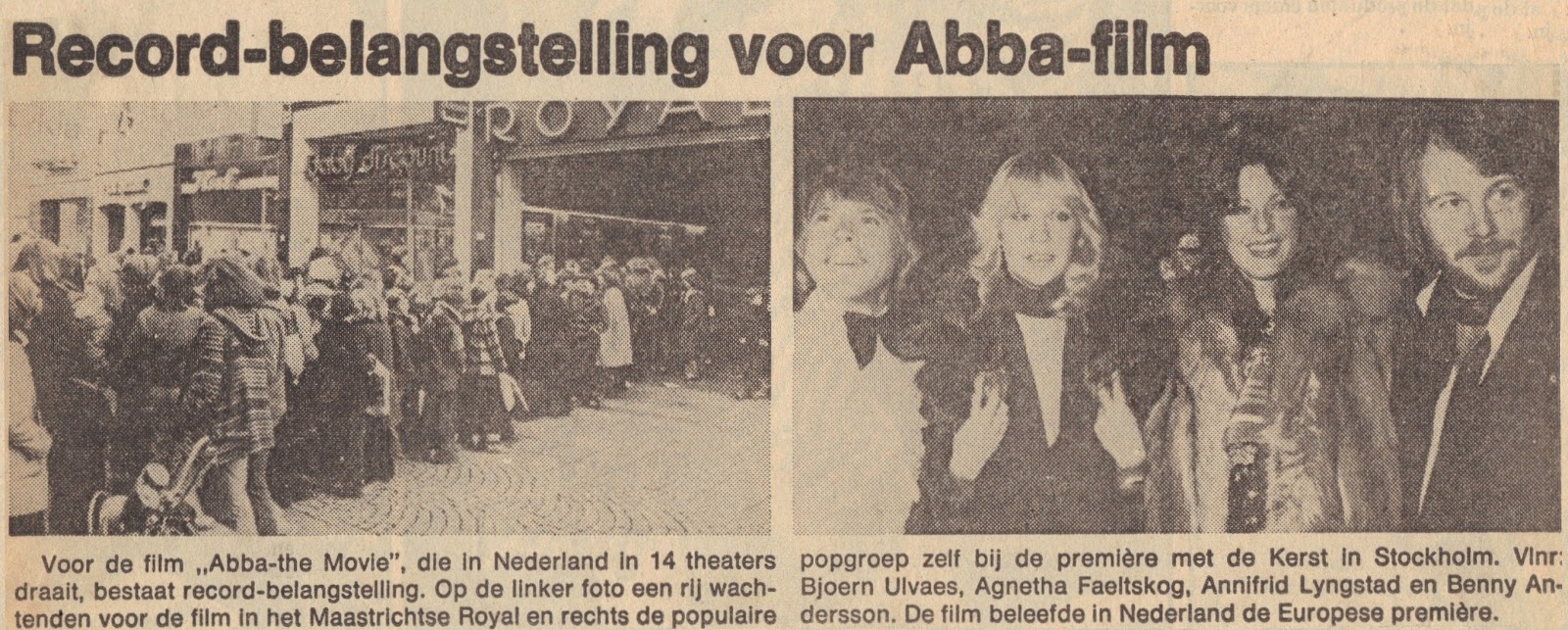
There's a record-breaking interest in the film 'ABBA-The Movie' that is being screened in 14 Dutch cinemas. On the picture on the left you can see people waiting in line for the movie at the Royal cinema in Maastricht and on the right the popular pop group themselves at the Christmas premiere in Stockholm. From left to right: Björn Ulvaeus, Agnetha Fältskog, Anni-Frid Lyngstad and Benny Andersson. The film had its European premiere in The Netherlands.

Sunday, 18 November 2012

Popshop, 1978: ABBA's latest addition

Anna and Björn, the blonde half of the Swedish quartet ABBA, couldn't be happier. But then, they couldn't have imagined the birth of their little baby any better.
"The birth of Linda didn't go very easy," according to Björn. "That's why we weren't one hundred percent at ease. But this time there weren't any problems. You can tell when you are around Anna. It's like she has just returned from a long vacation. Did you know that we didn't realise that we had a little son until a couple of minutes after the delivery? That the ultimate wish had come true? We were so relieved that everything had went so smoothly!"

It's very busy in room 615 of the Danderyd Hospital in Stockholm. A small army of press people and fans are queuing at the door to congratulate the proud parents. The small baby (he doesn't have a name yet) doesn't care about all the attention and keeps on sleeping peacefully.
"It's an extremely calm baby," according to mother Anna. "Compared to our Linda, that is. He sleeps all day and he barely cries when he is hungry. Why we haven't decided on a name yet? Because we were convinced that it would be a girl! Most of the time we aren't that lucky with things like this, but this time we were..."

Monday, 24 September 2012

1978: Why ABBA's Agnetha was pregnant for fourteen months...

Blonde Agnetha from the pop group ABBA couldn't be happier with her young baby. Little daughter Linda, from Agnetha's marriage to the other ABBA star Björn, is quite taken with her little brother as well. There's only one person who has his doubts about this addition to the ABBA family: manager Stig Anderson. But he was also the one who stretched Agnetha's pregnancy to fourteen months.

"Yes, I'm really sorry," ABBA manager Stig Anderson proclaims, "but it's just not possible to do this photo shoot today!" Photographer Barry Levine, the man that took practically all pictures of Sweden's export article number one the past few years, isn't happy about this arrangement at all. He flew in especially from Los Angeles. But he has to deal with the facts no matter what, even more so when Anderson tells him that Agnetha is pregnant. We are talking about October 1976.
In May 1977 Levine travels to Sweden again for a photo session for the inner sleeve of the ABBA album 'The Album'. Agnetha is still pregnant and perhaps because of that a little moody. Barry notices that the atmosphere during the photo shoot is very tense at times. A heavy rivalry between Agnetha and the dark-haired Anni-Frid seems to have evolved. In December 1977 Agnetha gives birth to her little son Christian. So that's a pregnancy of fourteen months, and medically a unique occurance. Or... was there something else going on?

Manager Stig Anderson pretends to the outer world that everything is fine. And that isn't so strange because now that ABBA is about to achieve their big breakthrough in America, a quarrel among the four members would be very inconvenient.
"This is exactly the time that we have to make sure that the money keeps coming in," Stig says. "That's why we have to go after the dollars. Indeed, the girls can't keep on waiting until they have to bounce around on stage as old grandmas..."
It's clearly the vision of a tough businessman and that Anderson surely is. The sexy singers of the group are an important ingredient in the success of ABBA and you can't take advantage of that forever. On top of that, things weren't all well in the ABBA circle between the two singers and now it seems almost certain that Anderson has used Agnetha's pregnancy to calm the group down a bit. That's why it had to take that long. You couldn't come up with a better excuse, and probably Agnetha herself has made good use of it as well. After all, it's a public secret that the dark-haired Anni-Frid has become ever more envious of blonde Agnetha, who mostly steals the show during performances. And it isn't a secret either that Anna has recorded a solo record in the meantime. However, manager Stig Anderson has explicitly banned its release.
"The group has to remain a unity," he exclaims, still in an excited manner, thinking about the dollars that are about to pass him by. In the end, Anni-Frid has given in as well. But for how long? At least for the time being little Christian has subconsciously prevented the group from breaking up. But Anni-Frid isn't pleased at all about the fact that her own fiancé Benny, who's responsible for ABBA's image for the most part, is giving Agnetha so many chances to steal the show on stage.

Tuesday, 4 September 2012

Pop Foto, 1978: Agnetha will not be singing for the time being: "Everything has to make way for my little son!"

Quietly, she's gazing into the distance, the tiny bundle pressed against her. On the white hospital night table beside her, there's an empty bottle of champagne with a couple of half full glasses... The visiting hour at Stockholm's Danderyd Sjukhus is over and Agnetha Ulvaeus is exhausted, just like her one day old little son. She is not as joyful as the other women in the hospital's large maternity ward, but then again, Agnetha has a lot to think about...

She has to make a decision now. Not only about her own future, but about the future of four other people as well. Whatever she decides, the life of her husband Björn, who has just been babbling blissfully to his little son, is going to change radically. And the life of Anni-Frid and Benny, her colleagues and best friends, won't stay the same either... The small human being on her chest, so perfect and yet so helpless, makes such a decision inevitable... But it's difficult to decide if you're going to be a housewife from now on who lives for her children first and only then for herself or... pursuing your own and three other people's career, no matter what! The pink miniature fingers of the baby move against her body for a while. The voices and the relaxed laughter of only moments ago still seem to hang around the room, just like Anni-Frid's perfume and the scent of the flowers she brought along... A nurse enters the room quietly and takes along Agnetha's baby. She should get some sleep herself, just like her little baby, that doesn't even have a name yet. But when Agnetha finally shuts her eyes, it's late in the evening of 6 December 1977...

In the night of 4 to 5 December the new little human being was born, that's going to change everything radically that has to do with the group ABBA. It weighed 3.750 gram, it measured 54 centimetres from head to toe and it had a couple of great lungs.
Still a normal child, like thousands are being born in the world. But this youngest member of the Ulvaeus family is still different from other babies, because his parents make up one half of the world famous group ABBA, and then there's also his sister Linda. As long as Agnetha toured around the world with ABBA she has occupied herself with one thing: the fact that little Linda became a stranger to her. An unpleasant experience with a nanny, whom Linda mistaked for her mother, was a wake-up call for Agnetha. But still Agnetha continued with a brave face, working extra hard, to be able to be with Linda at least a couple of months per year. And then her little son announced himself...
"Actually," Björn told us right after our visit at the hospital that sixth of December, "we haven't dared to think about our future yet. You know that we kept working very hard, despite Agnetha's pregnancy, to complete the ABBA movie and our new album before the delivery. Now the job is done, our baby has been born and... now we don't know what to do. Sorry, guys, but I can't tell you anything about ABBA's future because we just don't know anything yet! Anni-Frid, Benny and I have decided to leave everything up to Agnetha...!"

That was almost a month ago. All this time, the editors of Pop Foto have been waiting anxiously for that one relieving phone call from Sweden, wherein we would finally be told what Agnetha had decided. Just before this issue went to the printing office, the message came through: Agnetha has decided not to do anything at least until the end of February or the beginning of March. Maybe shoot a promotional film for the single that's going to be the follow-up to 'The Name Of The Game' and that's going to be titled 'Take A Chance On Me', but apart from that... There won't be any album recordings, nor any promotional trips to far off countries... Agnetha is going to take it easy for the time being and only in March she is going to decide what ABBA's future will look like. Together with tens of thousands of ABBA fans, Pop Foto is waiting, almost in unbearable tension...

Sunday, 22 July 2012

Das Freizeit-Magazin, 1978: Anni-Frid: this is my life

Because Anni-Frid grew up without a father, she always fantasized about a real family in her childhood. "When I'm grown up I will get married and then I will only care for my husband and children," she once said to her grandmother in the middle of Sweden, where she grew up after her mother had died at a young age. She was singing in the folk parks merely to keep her head above water until she got married. When she was eighteen she already reached the destiny of her dreams. Anni-Frid got married to the musician Ragnar Fredriksson and gave birth to two children. But the family bliss she was hoping for failed to materialize. Only today, with her Benny and the ABBA success, she is truly happy.

Pictures from left to right.
When she was only thirteen she already performed as a singer in parks and halls. Frida: "I had to make money to earn my living." That's what she kept doing after she got married as well.

Frida started concentrating more and more on her success as a solo singer, a pretty girl, constantly radiant and with many different looks.

In a 1967 TV show, Frida sang every competition into the ground. Although the long-desired breakthrough had been achieved, her private happiness was shattered. Because Frida hardly lived with her family anymore.

For 32 years, Anni-Frid had felt like an orphan. But her father had not - as it had been assumed for a long time - died in the turmoil of war in 1945. These days he is living as a pastry cook in Karlsruhe and he only found out about the existence of his daughter after stories about the ABBA girl's fate had appeared in the newspapers. In 1944, the then 26-year-old German sergeant had met Anni-Frid's mother in Norway. The war separated them.

This was the start of a tremendous career: in 1974, four unknown Swedes called ABBA sang a song at the Eurovision Song Contest in Brighton that would become a worldwide hit: 'Waterloo'. One of the girls on stage was Anni-Frid. The three others: Agnetha, Björn and Benny. This line-up remained and they scared the top class of pop musicians stiff. Two years after Brighton, the four Swedes had already sold more than 26 million records, mostly albums. Previously, only the Beatles had achieved such a feat. And that's how the story continued.

No matter what ABBA sang, it always became a worldwide hit, whether it was in the East or in the West. It was also raining gold records from all kinds of different countries. On their trip to Warsaw as well, where they are pictured here.

A happy family: Frida with her husband Ragnar and both of their children Lise-Lotte and Hans. But scenes like this were very rare in Frida's marriage. Frida: "It wasn't what I had always fantasized about."

In this building in Stockholm it all started for ABBA. The first songs of the group were created here. And today, ABBA's office is still located in this building.

The marriage to Ragnar fell apart. But Anni-Frid has found her private happiness: Benny, her partner in ABBA. "Benny is my security, I depend on him completely," Frida declared happily.

Saturday, 21 July 2012

Das Freizeit-Magazin, 1978: Agnetha: this is my life

Blonde, blue-eyed, long-legged: Agnetha embodies the typical Swedish girl. Music is in her blood. After school she earned her living as a singer with a dance band. And when she was only eighteen she recorded her first solo single. The song 'Jag Var Så Kär' became a hit, at least in Sweden. "All of a sudden I was well-known and I appeared in TV shows," remembers Anna, that's how Agnetha likes to be called nowadays. "I also met the Hootenanny Singers there." She was especially smitten with one of the boys from the group: Björn Ulvaeus. "It was love at first sight," both of them affirm these days. After a joint holiday they started living together and a couple of months later - in 1971 - they got married. Their joint success with ABBA has only brought Anna and Björn closer together. But the most important thing to the both of them remains their family, to which - after daughter Linda - a little son was added.

Pictures from top left to bottom right.
The typical Swedish girl: long blonde hair, blue eyes and a lot of naturalness. You wouldn't guess that she is 28 years old and has two children. Up till now she has always had good luck on her side. Her first solo single, that she recorded when she was eighteen, became a big hit in Sweden. When she was twenty, she married the man of her dreams: Björn Ulvaeus. Little daughter Linda (meanwhile five years old) is growing into a lively girl and up till now Anna doesn't have any worries about her now four months old son either.

At the end of November 1967 Agnetha had all the reason in the world to smile. After she had toured through Sweden and Europe for two years with a dance band, she finally achieved her breakthrough as a solo singer with a self written song. Swedish TV shows were tripping over each other for the blonde singer. "I even received offers from Germany," Anna remembers from her first success.

The blonde girl from ABBA was born on April 5, 1950 in Jönköping. Agnetha's father, an organizer of amateur revues, introduced her to the stage when she was still a child. She learned how to play the piano and the organ and she started to write her own lyrics.

Anna always maintained a good relationship with her parents, Ingvar and Birgit Fältskog. Mona is very attached to her older sister as well and she often pays her a visit in her Stockholm home. This family picture was taken in 1968.

In one of these TV shows Anna met Björn, in those days the star of the Hootenanny Singers. The both of them got along right away, they went on a holiday together and got married in July 1971.

Björn and Anna prefer to spend the little spare time they have between their tours, recording sessions and TV shows with their little daughter in their cottage on one of the Swedish isles. This year, their little son Christian will join them as well.

Anna and Benny are getting their make-up done for a TV show. Last year, the Swedish broadcasting company has persuaded the four superstars to chronicle their lives in a TV show. Obviously the ABBA hit 'Waterloo' was featured as well in the big television extravaganza, the song that won the group the Eurovision Song Contest in 1974.

Anna feared that her voice would suffer from a tonsillectomy in 1976. But she recovered from the surgery without scratches and little daughter Linda was enjoying her mother's compulsory break.

The Swedish quartet ABBA was presented to the world for the first time in November 1970 in Göteborg. Years later, the four of them returned to leave their hand prints for the Liseberg park.

Björn and Anna in Germany during the ABBA tour last year. After that, the group took a baby break for the sake of Anna. The family takes precedence for Björn and Anna in 1978 as well.

Already in her childhood, Agnetha took ballet classes. These days, the ABBA girls keep in shape for their tours and TV performances with morning gymnastics.

Last December, ABBA enjoyed a glittering movie premiere in Stockholm. Manager Stikkan Anderson and director Lasse Hallström were congratulating.

Anna's son weighed exactly 3.920 grams. He was born in December after a difficult childbirth. Obviously, Björn was present during the delivery in Stockholm.

Sunday, 20 May 2012

1978: ABBA, to Paris because of love

An old gentleman with a beret is standing still and looking at the four young people who are getting together underneath the Eiffel Tower to pose for a souvenir photo. The dark-haired girl turns to her companion and kisses him on the cheek. The old man is hearing the girl say something in a foreign language and then she prances around the young man and kisses him on the lips.
"Oh, la, la, l'amour," the old gentleman whistles. The man isn't aware of the fact that he has just seen Sweden's most successful pop group under the Eiffel Tower in Paris. He just noticed the youthful happiness of the two couples.
"It's so wonderful to be married and to belong with the man that you love," Anni-Frid says a while after that in a typical French street cafe. "That was also the reason that we still decided to get married after seven years. After all, there isn't much time for romance in the music business. That's why the wedding took place in all secrecy and very quickly."
"But Anni-Frid and I have made one wish of ours come true," Benny interrupts his wife. "We granted ourselves some kind of honeymoon to the city of love, to Paris."
Still, this time the trip wasn't completely free of show business either. None of the four ABBA members can take the liberty of simply wasting too much time. That's why Anni-Frid and Benny mixed business with pleasure. They brought Björn and Agnetha along and turned the trip into a promotional campaign for their new single 'Summer Night City'. An interview at the broadcasting company, a performance in a TV show.
"We have planned everything in such a way that leaves us enough time to see Paris and pamper ourselves," Anni-Frid explains and smilingly she shows a gold necklace that Benny bought her two hours ago during a stroll through the city.
"For Björn and me it was a second honeymoon as well," Agnetha says. "Without the children and without too much fuss. It must be Paris." But there was still some fuss when the four of them showed up in a well-known nightclub in Paris the second evening. It's hard to overlook four ABBA members. And how will the group ABBA continue? "We are going back into the studio. After Christmas there will be a new ABBA album and in the beginning of January we will travel to New York to perform at the Unicef Gala together with the Bee Gees. But other than that we don't want to make too much plans," Benny explains. "In the future, our private life shouldn't take a backseat anymore like it has done up till now."

Saturday, 21 April 2012

Das Freizeit-Magazin, 1978: I brought ABBA gold

Our popularity poll '78: the gold Freizeit-Magazin for ABBA. Reader Bruno Pfister (18) from Switzerland brought the super trophy to the Swedish stars in Stockholm. Björn, Benny, Agnetha and Anni-Frid were impressed: "A big thank you to all Freizeit-Magazin readers. This award is awesome!"

For weeks, Bruno Pfister from Bern couldn't think about anything else but the presentation of the 'Gold Magazine' to ABBA. He had scored this super prize with our popularity poll '78 and - as the only one from thousands of contestants - was allowed to fly to his favourite stars in Stockholm.
This year, you have voted ABBA as your favourite pop group again - in first place! Last year, the pop couples had to settle for the 'Bronze Magazine' - in third place!
"That's right - 1978 has been our most successful year," Benny stated when Bruno presented the newlywed husband with the glittering trophy. Although meanwhile all kinds of awards belong to ABBA's daily routine, they were particularly happy with our 'Gold Magazine'. Frida: "This proves to us that we have a loyal fanbase in Germany. And for us it's good to know that the teens are sticking with us." Bruno has been a loyal fan of the group for years. At home he has collected every newspaper article in a large binder. And it's safe to assume that he knows everything about ABBA by now. Still the shy young chap - who works as an office clerk in Bern - had some burning questions to ask.
Why did Benny and Anni-Frid finally get married?
Benny: "Actually, we have wanted to tie the knot for years. But we simply didn't have the time due to our busy schedule. And apart from that we were happy without a marriage certificate as well. But now we have decided that our private life should be more important than working on the new album. And oh well, now we just got married."
Would you ever consider quitting the music business?
Björn: "Of course it's possible that there won't be an ABBA for the next twenty years. But then we would probably continue as duos or maybe on our own as well. Either way, we will never quit making music. For that matter, there are no plans for us to split up!"
When saying goodbye, Bruno was happy and sad at the same time. Our winner: "It's a pity that everything is over already. But wait until I tell my friends about this..."