Sunday, 28 October 2012

1977: ABBA, Swedish supergroup

The amount of money that ABBA is making at the moment simply can't be estimated any longer. Indeed, this quartet and their manager Stig Anderson have total contral over their own businesses: the production of their records, the publishing of their music, their tours, films, rights to book publishing, you name it. This means that they are making as much money as possible themselves. Not too long ago, the group signed a major deal with the American giant in the record industry WEA and the amount of money they received as an advance payment is not even known by the CIA.
Besides, they just have to make an enormous amount of money to be able to afford themselves so much luxury in a country where the tax collector is claiming up until 93 percent of their yearly income. Among other things, ABBA has invested in houses, apartments, their own production company (and they are about to build a studio that might very well become the most advanced studio in the whole world!).
Among other things, the foursome has a fast sports car, an amazing sailing yacht and an island, where they find the much-needed peace and quiet. But they are obliged to make their most important investment in the Swedish government.

Hitkrant, 1977: ABBA: trading music for oil

ABBA has finally found a solution to the problem of turning the huge sums of money that are being made in Eastern European countries into hard cash. Up until now this wasn't possible, because it isn't allowed to import Eastern European money to Sweden.

To that purpose, ABBA has set up a company, together with a Swedish trading company called Beijerinvest. That company, Sannes Trading, is going to transfer the income from record sales in Eastern European countries into assets from these countries. Then these assets are going to be sold in Western European countries for a lot of money. And where these assets are concerned, they are mainly thinking about oil.

With this set-up, the limitations on import of records that these Eastern European countries are utilizing can be by-passed as well.
"In Poland, only 800.000 records from the West were allowed to be imported last year. That quantity was completely confiscated by ABBA. And to think that we could have sold millions of records over there," according to ABBA manager Stig Anderson.
Except for Poland, ABBA is also very popular in Czecho-Slovakia and East Germany. The shortage on ABBA records over there is such, that there's an enormous black market in ABBA albums.

Stig expects that this project is going to enable a larger distribution of ABBA records in Eastern European countries and on top of that an increase of trading activities for their business partner Beijerinvest. It is expected that this new project is going to make about 25 million Dutch guilders per year. Ka-ching!

Saturday, 27 October 2012

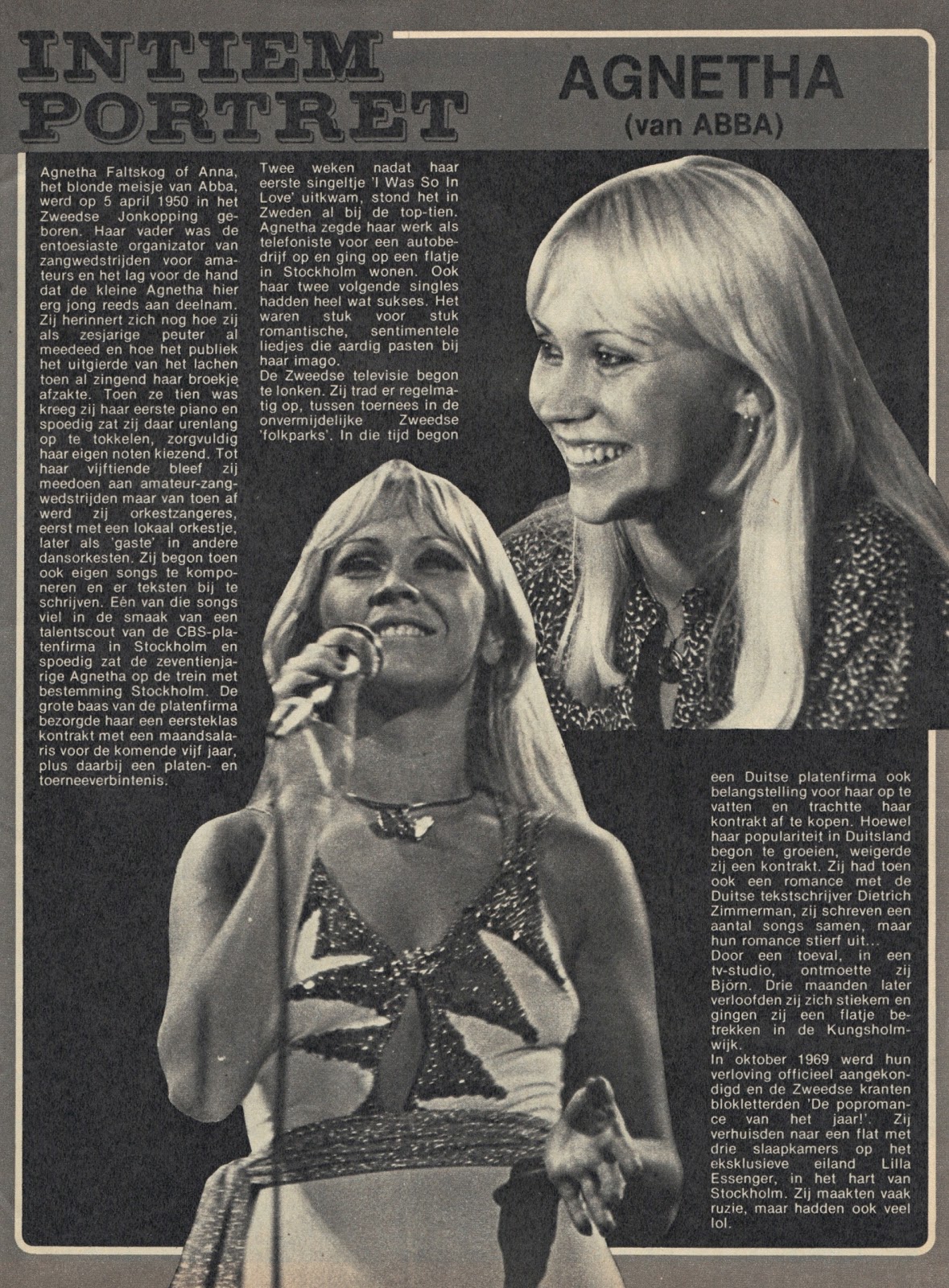
Popshop, June 1977: Intimate portrait, Agnetha (from ABBA)

Agnetha Fältskog or Anna, the blonde girl from ABBA, was born on April 5 1950 in Jönköping Sweden. Her father was the enthusiastic organizer of singing contests for amateurs and it was only natural that little Agnetha started competing in one of these at a very young age. She still remembers how she competed as a six-year-old kid and how the audience was screaming with laughter when her pants fell down while singing. When she was ten she got her first piano and soon she was playing that instrument for hours on end, carefully choosing her own notes. Up until she was fifteen she kept entering amateur singing contests, but from then on she became a singer with a dance band, first with a local orchestra, later on as a 'guest' with other dance orchestras. At that time she also started composing her own songs and writing lyrics. One of these songs caught the attention of a talent scout at the CBS record company in Stockholm and soon the seventeen-year-old found herself on a train to Stockholm. The big boss of the record company got her a first class contract with a monthly salary for the coming five years and a deal for records and tours.

Two weeks after her first single 'I Was So In Love' was released it was already in the Swedish top ten. Agnetha quit her job as a telephone operator with a car firm and moved to a small apartment in Stockholm. Her next two singles were very successful too. They were all romantic, sentimental songs that fitted her image nicely.
The Swedish television started to get interested. She regularly performed on screen, in between her tours in the inevitable folk parks. Around that time, a German record company became interested in her as well and tried to buy off her contract. Although her popularity in Germany started to increase, she refused a contract. She also had a romance with the German lyricist Dietrich Zimmerman. They wrote a couple of songs together, but their romance faded out...
By coincidence, in a television studio, she met Björn. Three months later they secretly got engaged and moved in together in a small apartment in the Kungsholm area.
In October 1969 they announced their engagement officially and the Swedish newspapers headlined 'the pop romance of the year'. They moved to a three-bedroom apartment on the exclusive island Lilla Essenger, in the heart of Stockholm. They argued a lot, but they also had a lot of fun.
On July 6 1971, she married Björn, who had teamed up already with Benny and together they went on a couple of summer tours. But the time wasn't right yet for ABBA and Agnetha kept writing and recording her own songs. 'If Tears Were Gold' became a huge success.
Agnetha also starred as Mary Magdalene in the musical 'Jesus Christ Superstar' and the well-known song 'I Don't Know How To Love Him' was put on record, together with other songs from her folk park repertoire.
In 1973, everyone thought that this would be the year for Benny, Björn, Agnetha and Anni-Frid, who had become Benny's fiancée in the meantime. They entered the Swedish preselection for the Eurovison Song Contest with the song 'Ring Ring'. Agnetha was pregnant at the time and the baby was due in February 1973, around the time of the final. The quartet was prepared for everything and there was even a version of their song to perform as a trio, in case Agnetha would have to miss the final. But she made it through and managed to get to that final, but the song only finished in third place. Four days after the Swedish final, little Linda was born. From then on, Agnetha would devote her time completely to Linda and ABBA, in that order.

Tell us something more about your first love?
"I must have been around seventeen. His name was Björn Lilja, no, not ABBA's Björn, but a local boy from the neighborhood in Jönköping. It was a teenage romance. But after the romance had ended, I remember that I tried to forget about my sorrow behind the piano and that I composed a melody, very sentimental and sad, really something for young girls. The melody didn't put me in a better mood, but it was a very nice and moving piece. And it's exactly that song that gave me a record deal in Stockholm. Now I'm grateful to Björn Lilja because without that romance I probably would never have written that song. Actually we never really argued. We are still friends. And apparently he is very proud because he inspired me to write that song. When it became a hit in Sweden, he came over to congratulate me. He wanted to give me a hug but he couldn't. He had just broken both his arms in a traffic accident and they were healing in a plaster!"
What are your thoughts about your parents?
"Very positive. I owe everything to my dad. To his patience for instance. He spent hours and hours teaching me how to play the piano. He never stopped encouraging me..."
It is said that you can be very candid, but also that you are very shy. So what is it?
"In essence I am shy. I'm the country girl that made it big and the past few years I've had some difficulties with that. I tried to hide that inborn insecurity behind a mask of self-confidence. It was claimed that my behaviour was influenced by that. That I made a lot of mistakes because of that. But people exaggerate too. It was said at the time that I couldn't even handle a spoon in a restaurant and things like that. Just imagine! Of course I have made mistakes. Put yourself in my place. A seventeen, eighteen-year-old girl with all these snobs from the record industry, my language probably wasn't polished all the time. Anyone who got to know me a little better would admit that I always tried to be gentle, honest and soft. Even to journalists. But when they are not to my liking, I keep it short..."
What have been the most exciting moments in your life?
"There are a lot of them! When it comes to intensity I can't put them in any particular order. Chronologically maybe? When I walked into a recording studio in Stockholm for the first time as a seventeen-year-old girl and I heard all those musicians rehearse that first little melody that I had composed, preparing themselves for the actual recording... When I met Björn and we got engaged. I remember an engagement holiday on the sunny island Cyprus where we could do what we wanted without being recognized... The day that I got married, it was lovely!... When Linda was born... And when we won the Eurovision Song Contest with 'Waterloo'! And there are plenty more. I repeat: I've been lucky in life!"
How did you meet Björn? Was he the love of your life right away?
"You bet! I had seen him before with the Hootenanny Singers and at one time we found ourselves in the same TV studio. I walked up to him and said: 'Hello, Björn. I'm glad that I finally get to meet you. I think you are the best and I love your music!'. I really did like their music but I thought that Björn, their lead guitarist and singer was something else. I had never seen him in real life, but I remember that he looked even more handsome than on the little TV screen!"
What was so special about your wedding day?
"Everything! I know that's what every girl says but the entire day was one surprise after the other. As our venue, we had chosen an old, gothic church in a fairy-like little village. In Sweden you can get married wherever you like. In my white wedding gown I was taken to the church in an open carriage, the whole village was cheering me on. Swedish hymns were being sung and while entering the church, Benny was playing Mendelssohn's wedding march on the organ, followed by his own hit 'Wedding'. It was a short ceremony. After we were married there was some kind of uproar when we came out of the church. A police officer lost control over his horse and the animal stepped on my foot. A doctor was even called in but luckily it wasn't all that bad. He put a bandage around my ankle and it was okay. The entourage went to a tavern called White Horse for the wedding dinner. There were 39 guests and one dog - Ada, our French bulldog - and we danced to the music of Benny and his Hep Stars. Outside, hundreds of people were calling out our names, they wanted to see us once again before they headed home. So we decided to wave to them from the balcony, just like royalty. I will keep remembering every minute of that day. Even when I'm an old lady, I won't forget my happiness!"
Is it true that little Linda means everything to you?
"The birth of Linda was the proudest moment of my life. Since then, something has changed in my life. I keep making an effort to be and remain a one hundred percent member of ABBA, but my marriage and Linda now come first. I couldn't care less if the show business would turn its back on us or me. I would simply withdraw and devote myself completely to playing the part of a wife and mother. Especially when we're on tour, I miss Linda terribly. Every second away from her is real torture..."
Are you really as superstitious as is often claimed?
"We really are. Björn's secret weapon is his guitar, designed and shaped as a star. Anni-Frid has her sombrero and I have a stuffed donkey as my good-luck charm. It's very big and inconvenient, but I drag it along everywhere I go. People even make jokes about it, but I don't mind. Agnetha and her donkey, you know..."
Do you never argue: four people who have to work together every day, don't they get tired of each other?
"Benny and Björn get along really well, they are  men and they complement each other musically too. Anni-Frid and I get along fine as well. Until recently we lived quite close to each other, but now we only see each other during tours, rehearsals and performances. But the fact that we still spend our holidays together proves that we are really quite taken with each other. Whenever there are problems in the ABBA camp, we talk about them democratically before decisions are being made. Everything is discussed. Even the outfits that we are going to wear when we perform. My long hair is always a subject of discussion too. Personally, I would like to cut it short, but the other three prefer the long hair. And then I give in. That's democracy!"
People tend to call you the 'beauty' of the group, the sexy one, the girl with the most beautiful legs. How do you respond to that?
"Me, sexy? Come on. I'm actually somewhat prudish, at least according to Swedish values. But that long, blonde hair is making a big impression, especially in Italy and Spain. I don't dare to go out on the streets alone over there! Outsiders may think that's fun, but I don't. I would rather have short and dark hair..."

Sunday, 30 September 2012

Story, September 1977: Dutch kindergarten teacher discovered ABBA's Björn

On his first day, the Swedish little boy at the Amsterdam kindergarten didn't dare to open his mouth. Later on, he sang a St. Nicholas song in perfect Dutch.

23 years ago, a blonde little boy with a timid face stepped into May Borghols' private kindergarten class in the Van Eeghenstreet in Amsterdam at the hand of his mother. He desperately longed to run back to the car with driver, that brought him here and that was now waiting for his mother outside. He himself would have to stay with all these foreign children, who all spoke such a weird language. A couple of days earlier, he had arrived in Holland from his home country Sweden for a stay of approximately one year. His father, who was working in the paper industry in Sweden, wanted to check out the working methods at the company Van Gelder in Velsen. His mother decided it would be the best thing for young Björn to go to school in this foreign country, more particularly to the kindergarten class of singing teacher May Borghols, where more children of different nationalities were accomodated.

All of a sudden, the entrance of little Björn springs to the mind of Mrs. Henny Otten-Hobby from Almere-Haven - at the time the assistant of May Borghols - when the group appears on the television screen when she is watching the Eurovision Song Contest in 1976 with her family. "I know that one!" she exclaims. Her husband starts laughing. "But you have never even been to Sweden," he remarks.
"No," she says. "I've never been to Sweden, but that one ABBA member has been to Holland in the past! He was in my kindergarten class and his name was..." She thinks for a while and then she remembers: "Björn!"
The man on the screen turns into that little boy again, who was having such a rough time those first days at school, because no one could understand him. She even remembers a photograph with Björn on it. Industriously, she starts looking, but the photograph doesn't surface until she moves to a new home.
"Björn was a quick learner," she tells Story later on. "Mrs. Borghols and I paid extra attention to him those first few days. We pointed to all kinds of objects and told him what they were called. Soon he started talking a little and after a few months he spoke Dutch nearly as well as his Dutch friends. But he was a very modest little boy: maybe even too modest."
After she had seen ABBA win successfully with 'Waterloo', even more memories surfaced with Mrs. Otten. She saw little Björn playing in the Vondel park again, that was adjacent to the garden of the kindergarten class. And she remembered again how the blonde little boy ate his sandwiches at school during lunch time, because this was convenient to his parents.

"But my fondest memory is the St. Nicholas party," says Mrs. Otten. Quite some time before the party, we started teaching the children St. Nicholas songs. Since Björn didn't know who that important man was who would come over on his birthday and bring presents, we showed him some pictures and drawings of St. Nicholas. He was great at learning these songs. We were astonished how well he could remember all these (to him) unknown melodies and how well he could sing in tune. When St. Nicholas finally arrived, Björn was allowed to sing a song for him on his own. He was beaming with pride and so were we, because he did a great job. Who could have guessed at that very moment that he would become one of ABBA's B's and would make such beautiful songs himself?

Monday, 24 September 2012

1978: Why ABBA's Agnetha was pregnant for fourteen months...

Blonde Agnetha from the pop group ABBA couldn't be happier with her young baby. Little daughter Linda, from Agnetha's marriage to the other ABBA star Björn, is quite taken with her little brother as well. There's only one person who has his doubts about this addition to the ABBA family: manager Stig Anderson. But he was also the one who stretched Agnetha's pregnancy to fourteen months.

"Yes, I'm really sorry," ABBA manager Stig Anderson proclaims, "but it's just not possible to do this photo shoot today!" Photographer Barry Levine, the man that took practically all pictures of Sweden's export article number one the past few years, isn't happy about this arrangement at all. He flew in especially from Los Angeles. But he has to deal with the facts no matter what, even more so when Anderson tells him that Agnetha is pregnant. We are talking about October 1976.
In May 1977 Levine travels to Sweden again for a photo session for the inner sleeve of the ABBA album 'The Album'. Agnetha is still pregnant and perhaps because of that a little moody. Barry notices that the atmosphere during the photo shoot is very tense at times. A heavy rivalry between Agnetha and the dark-haired Anni-Frid seems to have evolved. In December 1977 Agnetha gives birth to her little son Christian. So that's a pregnancy of fourteen months, and medically a unique occurance. Or... was there something else going on?

Manager Stig Anderson pretends to the outer world that everything is fine. And that isn't so strange because now that ABBA is about to achieve their big breakthrough in America, a quarrel among the four members would be very inconvenient.
"This is exactly the time that we have to make sure that the money keeps coming in," Stig says. "That's why we have to go after the dollars. Indeed, the girls can't keep on waiting until they have to bounce around on stage as old grandmas..."
It's clearly the vision of a tough businessman and that Anderson surely is. The sexy singers of the group are an important ingredient in the success of ABBA and you can't take advantage of that forever. On top of that, things weren't all well in the ABBA circle between the two singers and now it seems almost certain that Anderson has used Agnetha's pregnancy to calm the group down a bit. That's why it had to take that long. You couldn't come up with a better excuse, and probably Agnetha herself has made good use of it as well. After all, it's a public secret that the dark-haired Anni-Frid has become ever more envious of blonde Agnetha, who mostly steals the show during performances. And it isn't a secret either that Anna has recorded a solo record in the meantime. However, manager Stig Anderson has explicitly banned its release.
"The group has to remain a unity," he exclaims, still in an excited manner, thinking about the dollars that are about to pass him by. In the end, Anni-Frid has given in as well. But for how long? At least for the time being little Christian has subconsciously prevented the group from breaking up. But Anni-Frid isn't pleased at all about the fact that her own fiancé Benny, who's responsible for ABBA's image for the most part, is giving Agnetha so many chances to steal the show on stage.

Sunday, 9 September 2012

Story, 1977: Is ABBA going to split up?

What's really true about the rumour that the four members of ABBA don't get along that well anymore? Is it true that blonde Anna, now that's she is expecting a baby, doesn't feel like doing alle these performances any longer? What's true about the rumours that ABBA is going to split up?
Only recently, Björn (the one without the beard and Anna's husband) felt the need to answer all these questions. He said: "Of course we do have arguments from time to time. It so happens that we are four different personalities and we all have our mistakes and flaws. But we are very open, therefore we always talk things out right away. Indeed, Anna is pregnant but we planned that in such a way that no performances will be endangered. Anna is actually the group member who likes to perform most of all. And now the answer to the last question. Of course, ABBA is going to split up eventually. It's just not something for anyone to be concerned about just yet. Because we are only going to split up when people stop buying our records. All four of us know that that time will come eventually, but we hope that won't be any time soon."

Tuesday, 4 September 2012

Pop Foto, 1978: Agnetha will not be singing for the time being: "Everything has to make way for my little son!"

Quietly, she's gazing into the distance, the tiny bundle pressed against her. On the white hospital night table beside her, there's an empty bottle of champagne with a couple of half full glasses... The visiting hour at Stockholm's Danderyd Sjukhus is over and Agnetha Ulvaeus is exhausted, just like her one day old little son. She is not as joyful as the other women in the hospital's large maternity ward, but then again, Agnetha has a lot to think about...

She has to make a decision now. Not only about her own future, but about the future of four other people as well. Whatever she decides, the life of her husband Björn, who has just been babbling blissfully to his little son, is going to change radically. And the life of Anni-Frid and Benny, her colleagues and best friends, won't stay the same either... The small human being on her chest, so perfect and yet so helpless, makes such a decision inevitable... But it's difficult to decide if you're going to be a housewife from now on who lives for her children first and only then for herself or... pursuing your own and three other people's career, no matter what! The pink miniature fingers of the baby move against her body for a while. The voices and the relaxed laughter of only moments ago still seem to hang around the room, just like Anni-Frid's perfume and the scent of the flowers she brought along... A nurse enters the room quietly and takes along Agnetha's baby. She should get some sleep herself, just like her little baby, that doesn't even have a name yet. But when Agnetha finally shuts her eyes, it's late in the evening of 6 December 1977...

In the night of 4 to 5 December the new little human being was born, that's going to change everything radically that has to do with the group ABBA. It weighed 3.750 gram, it measured 54 centimetres from head to toe and it had a couple of great lungs.
Still a normal child, like thousands are being born in the world. But this youngest member of the Ulvaeus family is still different from other babies, because his parents make up one half of the world famous group ABBA, and then there's also his sister Linda. As long as Agnetha toured around the world with ABBA she has occupied herself with one thing: the fact that little Linda became a stranger to her. An unpleasant experience with a nanny, whom Linda mistaked for her mother, was a wake-up call for Agnetha. But still Agnetha continued with a brave face, working extra hard, to be able to be with Linda at least a couple of months per year. And then her little son announced himself...
"Actually," Björn told us right after our visit at the hospital that sixth of December, "we haven't dared to think about our future yet. You know that we kept working very hard, despite Agnetha's pregnancy, to complete the ABBA movie and our new album before the delivery. Now the job is done, our baby has been born and... now we don't know what to do. Sorry, guys, but I can't tell you anything about ABBA's future because we just don't know anything yet! Anni-Frid, Benny and I have decided to leave everything up to Agnetha...!"

That was almost a month ago. All this time, the editors of Pop Foto have been waiting anxiously for that one relieving phone call from Sweden, wherein we would finally be told what Agnetha had decided. Just before this issue went to the printing office, the message came through: Agnetha has decided not to do anything at least until the end of February or the beginning of March. Maybe shoot a promotional film for the single that's going to be the follow-up to 'The Name Of The Game' and that's going to be titled 'Take A Chance On Me', but apart from that... There won't be any album recordings, nor any promotional trips to far off countries... Agnetha is going to take it easy for the time being and only in March she is going to decide what ABBA's future will look like. Together with tens of thousands of ABBA fans, Pop Foto is waiting, almost in unbearable tension...