Sunday, 25 November 2012

Joker, April 1977: ABBA intimate: "We are slaves to our career"

ABBA, the pop miracle of the seventies. A lot has been said already about this group - a lot of nonsense too. The rise of these four Swedes, that has outstripped the Beatles already today, has nurtured rumours often enough. In the glare of the spotlights, no one wanted to believe that doubt, fears, affection, sometimes even hatred has played a part in this fantastic career.
Harry Edington, a British reporter, and his friend and colleague Peter Himmelstrand from Sweden have observed the group when they were taking their first steps on the international scene. They are the ones who really know how everything started and what's going on behind the scenes. Here's the truth about ABBA.

Anni-Frid, the girl with the German father.
The young Norwegian girl had lost all of her friends. Others pointed at her with their fingers or spit on the street before her. Her misdoing? She had fallen in love with a German officer and was expecting his baby. This happened in 1945 in Narvik in northern Norway. The German occupants were hated and feared by the native population. But when Synni Lyngstad, an innocent 19-year-old, met this Alfred Haase, he seemed different from all the others. At the end of the war Alfred was commanded back to Germany. Before he left he promised Synni to come back and marry her. But he never came back.
Her child, a daughter, was born on 15 November 1945 and named Anni-Frid after her grandmother. It was the coldest winter in Europe since years. But even the ice was warmer than the feelings of the inhabitants of Narvik towards Synni and her daughter. For two years, the mother and daughter waited for their loved one and father. Anni-Frid's grandmother had to witness how her daughter withered away in her loneliness. Synni died when she was only 21. The grandmother realised that little Anni-Frid with the abusive name 'German child' was facing a difficult childhood in Narvik. She left Norway and moved to the Swedish town Torshälla, where Anni-Frid grew up. She called her grandmother 'mamma' and she still does today. Anni-Frid: "I've tried to find my father. It was impossible. It is believed that his ship went down in Denmark. Otherwise, he definitely would have returned. It was good that I still had my grandmother. She was always very sweet to me and she encouraged me in everything that I did. On long, cold winter evenings she taught me old folk songs from our home country. She also encouraged me to start singing."
When she was 10, Anni-Frid found herself on stage for the first time. Three years later, she lied to an organizer that she was already 16 and this way she got a job as a singer in a restaurant. Her first band was called 'The Anni-Frid Four'. She was especially fond of the bass player and band leader, Ragnar Frederiksson, who was also a furniture salesman on the side. Things happened as expected: the both of them fell in love, got engaged and started living together.
When she was 16, she gave birth to a son: Hans, they got married and then came the second child: Lise-Lotte. Anni-Frid had to choose between her family and her career. Her career took precedence. Anni-Frid: "Although I had the smiling image of a happy singer, behind the mask I was very unhappy. Unfortunately I have to say today that people who really should have known better were very rude to me. They said that I didn't care about the children. They couldn't have been more wrong. Ragnar was there for them and they could not have been raised better." It was the painful decision between a marriage falling apart and the start of a career that introduced Anni-Frid as a regular visitor of the Swedish bestseller charts, although critics thought that her music was only appealing to a small part of the audience. A performance on the popular Swedish TV show 'Hyland's Corner' guaranteed her increasing popularity and helped her to become one of Sweden's first female singers.

Benny, who is often craving for his children.
Whenever someone wants to ask the friendly, bearded and somewhat chubby Benny Andersson about his education, he has a smile and a reply ready: "I have a driver's licence." It's a polite description of his barely succcessful schooldays. The only subject that he liked more or less was English.
He was born in a suburb of Stockholm on 16 December 1946. Benny got through his schooldays with a drowsy indifference, something that is still apparent today when he has to occupy himself with something that he isn't interested in at all. He left school when he was 15 without any exams or certificate and he concentrated completely on his music.
Benny: "My grandfather and father were exactly like me. They tried every, and I mean every, instrument that they could find." Two years after he had left school Benny was still trying to find out which part of the business world could be of use to him. The time in between was filled with thinking about his future and occasional performances with a band.
One day, the group had to go out of town for a guest appearance, which was unusual. Usually, no one wanted them. Svenne Hedlund, singer of the group Hep Stars, helped out with his truck. Svenne: "Benny is a good musician. When our organ player quit, Benny joined us. He turned up wearing a neck tie, a couple of months later he had long hair and looked like us." The Hep Stars turned into a top group.
A big distress for Benny: "We couldn't show our faces in any restaurant anymore, we were harassed everywhere." Along with their increasing popularity, their income increased as well, but Benny never seemed to be interested in money. The Hep Stars started taking care of their own releases and business matters, to market their songs. But their company 'Hep House' went bankrupt. The biggest flop that ever happened to Benny.
Another problem was waiting for Benny: in the summer of 1966 he broke his four-year-long engagement to Christina Grönvall. A pretty, red-haired girl that he had met in school. They lived together and had two children: Peter and Helena. This romance was kept top secret from the group's fans. A couple of months after the long impending break up, Christina confronted Benny in an interview: "Tell everyone about me and the children. The family that doesn't have a place in his glittering world as a pop idol. The only contact of the children with their father is through the records of the Hep Stars. I once joined them on tour, but I always had to travel separately. And during the show I was hidden away."
Benny was amazed that this story caused so much turmoil. He was also disappointed that strange people wanted to get into his private life. By the way, today he still has the same opinion. He has learned from his experience with Christina. But he often thinks about his children yearningly.

Björn, who forgot to smile on stage.
Björn Ulvaeus was born in the last days of the war on 25 April 1945 on the west coast of Göteborg. When he was 11 his family moved to the east coast town Vastervik - a name that means something like west bay. He got acquainted with guitars, boating and the raw folk music, that was flooding the world around this time.
When he was 17, Björn got together with three of his friends and he said to them that he wanted to start a Dixieland group. The aim was to get public performances in order to increase their pocket money. Today he says: "It wasn't a serious venture, although I gave that impression to some people. I was just bragging when I talked to the boys about jazz and things like that. I didn't know much about it and so our music was more like American folk music in the style of the Kingston Trio." One day, Björn's mother brought home a form to enter the talent competition 'Opportunity Knocks'. The group's name had to be entered as well and since there wasn't any name yet, mother Ulvaeus came up with The West Bay Singers. Björn: "I was astounded when I found out that she had entered us into that competition. At first I wanted to withdraw, but then I thought, why would I?"
A preview of the programme indicated that The West Bay Singers would sing songs in Swedish and English. This was read by Bengt Bernhag, a well-known talent scout. He was a trouper in the music business with a real instinct for up-and-coming talents. He liked the group and especially the simple and honest presentation and he recommended them to the boss of his company, a single-minded and energetic music publisher called Stig Anderson. He asked Björn for a demo tape. Björn: "That was an exciting day for us all." The first thing that Stig Anderson did for the group was change their name. That's how they turned into The Hootenanny Singers. Their first record was perfect: 'I'm Waiting At The Charcoal Kiln', a sad song about the people who were working in the forests. It became a big success.
Stig: "I noticed that there were opportunities for this group. They looked good and the blonde, handsome Björn was the centre of attention on stage. None of us had expected to become so successful this fast."
Stig's trust and Bengt's fatherly advice persuaded Björn how to pursue his future. And the conditions couldn't have been better for him. Bengt was a skilled music technician and he taught him everything that he knew. Bengt always treated Björn as his son. Without this connection, Björn would probably never have turned into a superstar. One of Björn's friends: "Stig was always a business man, and Björn was exactly right for him. Björn is someone who can analyze accurately and meticulously. When you look at him while he is working you can almost hear his brains working as a precision machine. Because he attacks everything with his intellect, he has to force himself on stage to smile at his fans sometimes."

Agnetha, who often fears to get in front of a microphone.
Agnetha Fältskog, born on 5 April 1950 in Jönköping (Sweden), is the daughter of an enterprising father, who produced shows for domestic use at the local cultural centre. Agnetha: "I will never forget my first official performance. In the middle of a show for elderly people, my pants went down and the audience burst into laughter. I was six years old at the time." When she was 15, she got her own piano. Reason enough for the musical offspring to try out her own melodies. She also wrote her own lyrics to these melodies, starting with a first draw about two dwarfs. At 15, Agnetha was a singer in a dance band. Two years later, she joined another band - that's how her voice turned up on the desk of producer Little Gerhard of the record company CBS, whose cousin worked as the second singer in the same band. He asked Agnetha to send him an entire tape.
Her favourite song around this time was 'I Was So In Love', a song about a girl mourning about her lost love.  She was that girl. She wrote the song because she was so unhappy when her romance with Björn Lillia came to an end. "I was sitting at the piano and tried to forget. The melody was ready within half an hour. I didn't feel any better but I had a great song." The producer had the same opinion. Agnetha said goodbye to her family and went on a train to Stockholm to record the song.
"It was the most exciting moment of my life. My heart was beating in my throat. I had to force myself to get inside the studio. On stage I still have that same feeling sometimes. Then I heard that the musicians were practising my melody. Suddenly I was floating on a cloud." Within a week the record was at number one.
Little Gerhard: "Agnetha was very critical from the start - when it came to her job as well." Her straightforward way of dealing with problems made the transition from the country to the city very difficult. Behind her self-confidence, a considerable amount of shyness was hidden. She said things that she didn't mean to say like that and often came across as being impolite. A friend says: "I'm convinced that she sometimes didn't  realize what she was doing and that the words simply came out because she felt insecure. But when she talked to people privately, she was sweet, polite and honest. I understand that she is still driving reporters crazy these days. They don't get anything more out of her than a simple 'yes' or 'no'. I believe that she understands that it's better to say nothing at all than to make a blunder all the time."
But nothing could stop Agnetha's career. She started to perform in TV shows and went on tour in the inevitable folk parks. A German record company tried to get her under contract. She refused, but still her popularity in Germany was increasing - for a short period of time she was engaged to the German lyricist Dietrich Zimmermann. The critics followed all of her moves. Her song 'Gypsy Friend' was called racialistic and heavily criticized. Agnetha: "It's a pity that people see it like that. I just wrote a song, that's all."

Sunday, 18 November 2012

Popshop, 1978: ABBA's latest addition

Anna and Björn, the blonde half of the Swedish quartet ABBA, couldn't be happier. But then, they couldn't have imagined the birth of their little baby any better.
"The birth of Linda didn't go very easy," according to Björn. "That's why we weren't one hundred percent at ease. But this time there weren't any problems. You can tell when you are around Anna. It's like she has just returned from a long vacation. Did you know that we didn't realise that we had a little son until a couple of minutes after the delivery? That the ultimate wish had come true? We were so relieved that everything had went so smoothly!"

It's very busy in room 615 of the Danderyd Hospital in Stockholm. A small army of press people and fans are queuing at the door to congratulate the proud parents. The small baby (he doesn't have a name yet) doesn't care about all the attention and keeps on sleeping peacefully.
"It's an extremely calm baby," according to mother Anna. "Compared to our Linda, that is. He sleeps all day and he barely cries when he is hungry. Why we haven't decided on a name yet? Because we were convinced that it would be a girl! Most of the time we aren't that lucky with things like this, but this time we were..."

Sunday, 4 November 2012

Joepie, 1979: A headquarter in the ambassadors district

There are four nameplates at the gates of the ABBA headoffice in Laerkstaden, the ambassadors district of Stockholm: Polar Music International, Sweden Music, Reuter & Reuter Foerlag and Sannes Trading. These are only four of ABBA's many companies. The group has invested a lot of money. In the headquarter, Stikkan Anderson, seated behind his far too spacious desk, is making all the decisions.

The various properties of the ABBA millionaires in a row. 1. The most capital villa is reserved for the married couple Stikkan Anderson. 2. The headquarter in the ambassadors district of Stockholm. From this location, Stikkan is reigning over the ABBA empire. 3. The villa on the island Lidingö where Agnetha is residing since her divorce. 4. Björn's new home, situated on the island Lidingö as well, that belongs to the fancy district of the Swedish capital. 5. Benny and Anni-Frid are living on the same island too, in this salmon coloured manor-house. 6. For 210 million, ABBA bought this former sports hall at Sankt Eriksgatan in Stockholm, where their state-of-the-art recording studios are now established. 7. The 'Commerce' warehouse in Skövde: supermarkets, boutiques, restaurants, a dry cleaner and a hairdresser. 8. Also in Skövde, they own this office building. The 'Handelsbanken' are the most important tenants. 9. ABBA is also the owner of the ICA-Norrhallen in the same region. 10. In Lidköping, they own this ultra modern shopping mall, called 'Särnmarkshuset'. 11. In this building, their art trading company 'AH Grafik' is located, although it doesn't make them much money yet. But these aren't the only properties of the five ABBAs, as you will read further on in this edition.

Proportionally, the ABBA company is the most profitable company in Sweden and apart from that it's growing faster than any other company. Three years in a row, Polar Music International has made a pure profit of 50 million Swedish Krona (23 million Dutch Guilders) and Anderson is looking for opportunities to expand their turn-over, and especially their profit.
Sannes Trading was one of those possibilities. That company was set up especially for trading activities with the Eastern countries. Stikkan blames it on bureaucracy that the trading isn't running that prosperously yet. As long as he doesn't succeed yet in selling 25 million copies of every ABBA album in Russia, he is setting his sights on other activities: investing in stocks, shares and real estate. He prefers to invest the ABBA money in companies that aren't too labour-intensive, with large profit possibilities.
Real estate is an excellent opportunity. In Skoevde in the south of Sweden, ABBA now owns three large buildings: two big shopping malls and a huge office building. Not far from that area, in Lidköping, ABBA is the owner of an ultra modern, indoor shopping mall with adjoining office building. The ABBA members themselves are living in majestic palaces too. These mansions are being administered by the ABBA empire as well. Fiscally, that's more profitable.

"Relatively speaking, we don't spend a lot of money on ourselves," Stikkan claims. If the ABBA members should decide to spend more money, they would have to pay even more taxes than the 85 percent that the Swedish tax collector is receiving now already. The tax situation in Sweden is unfavourable to huge, multi-million companies like ABBA's. Eluding these taxes would be simple by moving to a tax paradise, like tennis player Björn Borg did.
But according to Stikkan, ABBA isn't even thinking about eluding their taxes. The fear that ABBA's popularity would suffer is playing an important part there. But it seems even more important that the Swedish legislation forbids people living abroad to own a couple of companies and real estate in this country. That would mean that the whole empire would have to be dismantled and that's almost impossible.

But Anderson isn't coping very well with the tax situation. "Nobody wants to work in this country any longer because of these high taxes. And working extra hours is out of the question, because then you have to pay extra taxes. Of course, it's the socialists who make up legislation like that in this country." That's why Stikkan has voted conservatively in the latest Parliamentary elections, just like the other ABBA members. "Do you know what I think about making up legislation like that?" Dumb maybe? "Dumb? Dumb? That's putting it very mildly. It's complete insanity."

Sunday, 28 October 2012

1977: ABBA, Swedish supergroup

The amount of money that ABBA is making at the moment simply can't be estimated any longer. Indeed, this quartet and their manager Stig Anderson have total contral over their own businesses: the production of their records, the publishing of their music, their tours, films, rights to book publishing, you name it. This means that they are making as much money as possible themselves. Not too long ago, the group signed a major deal with the American giant in the record industry WEA and the amount of money they received as an advance payment is not even known by the CIA.
Besides, they just have to make an enormous amount of money to be able to afford themselves so much luxury in a country where the tax collector is claiming up until 93 percent of their yearly income. Among other things, ABBA has invested in houses, apartments, their own production company (and they are about to build a studio that might very well become the most advanced studio in the whole world!).
Among other things, the foursome has a fast sports car, an amazing sailing yacht and an island, where they find the much-needed peace and quiet. But they are obliged to make their most important investment in the Swedish government.

Hitkrant, 1977: ABBA: trading music for oil

ABBA has finally found a solution to the problem of turning the huge sums of money that are being made in Eastern European countries into hard cash. Up until now this wasn't possible, because it isn't allowed to import Eastern European money to Sweden.

To that purpose, ABBA has set up a company, together with a Swedish trading company called Beijerinvest. That company, Sannes Trading, is going to transfer the income from record sales in Eastern European countries into assets from these countries. Then these assets are going to be sold in Western European countries for a lot of money. And where these assets are concerned, they are mainly thinking about oil.

With this set-up, the limitations on import of records that these Eastern European countries are utilizing can be by-passed as well.
"In Poland, only 800.000 records from the West were allowed to be imported last year. That quantity was completely confiscated by ABBA. And to think that we could have sold millions of records over there," according to ABBA manager Stig Anderson.
Except for Poland, ABBA is also very popular in Czecho-Slovakia and East Germany. The shortage on ABBA records over there is such, that there's an enormous black market in ABBA albums.

Stig expects that this project is going to enable a larger distribution of ABBA records in Eastern European countries and on top of that an increase of trading activities for their business partner Beijerinvest. It is expected that this new project is going to make about 25 million Dutch guilders per year. Ka-ching!

Saturday, 27 October 2012

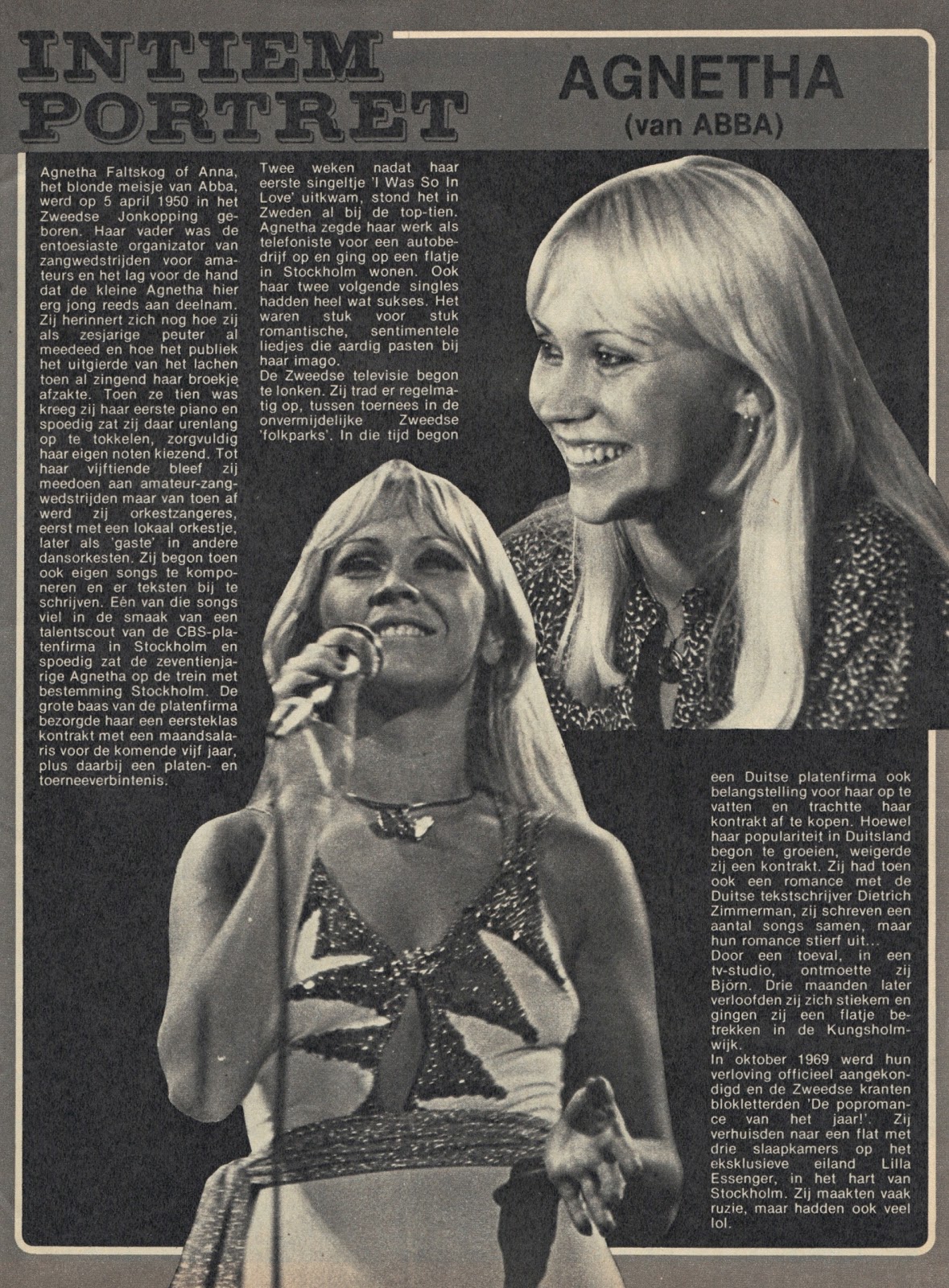
Popshop, June 1977: Intimate portrait, Agnetha (from ABBA)

Agnetha Fältskog or Anna, the blonde girl from ABBA, was born on April 5 1950 in Jönköping Sweden. Her father was the enthusiastic organizer of singing contests for amateurs and it was only natural that little Agnetha started competing in one of these at a very young age. She still remembers how she competed as a six-year-old kid and how the audience was screaming with laughter when her pants fell down while singing. When she was ten she got her first piano and soon she was playing that instrument for hours on end, carefully choosing her own notes. Up until she was fifteen she kept entering amateur singing contests, but from then on she became a singer with a dance band, first with a local orchestra, later on as a 'guest' with other dance orchestras. At that time she also started composing her own songs and writing lyrics. One of these songs caught the attention of a talent scout at the CBS record company in Stockholm and soon the seventeen-year-old found herself on a train to Stockholm. The big boss of the record company got her a first class contract with a monthly salary for the coming five years and a deal for records and tours.

Two weeks after her first single 'I Was So In Love' was released it was already in the Swedish top ten. Agnetha quit her job as a telephone operator with a car firm and moved to a small apartment in Stockholm. Her next two singles were very successful too. They were all romantic, sentimental songs that fitted her image nicely.
The Swedish television started to get interested. She regularly performed on screen, in between her tours in the inevitable folk parks. Around that time, a German record company became interested in her as well and tried to buy off her contract. Although her popularity in Germany started to increase, she refused a contract. She also had a romance with the German lyricist Dietrich Zimmerman. They wrote a couple of songs together, but their romance faded out...
By coincidence, in a television studio, she met Björn. Three months later they secretly got engaged and moved in together in a small apartment in the Kungsholm area.
In October 1969 they announced their engagement officially and the Swedish newspapers headlined 'the pop romance of the year'. They moved to a three-bedroom apartment on the exclusive island Lilla Essenger, in the heart of Stockholm. They argued a lot, but they also had a lot of fun.
On July 6 1971, she married Björn, who had teamed up already with Benny and together they went on a couple of summer tours. But the time wasn't right yet for ABBA and Agnetha kept writing and recording her own songs. 'If Tears Were Gold' became a huge success.
Agnetha also starred as Mary Magdalene in the musical 'Jesus Christ Superstar' and the well-known song 'I Don't Know How To Love Him' was put on record, together with other songs from her folk park repertoire.
In 1973, everyone thought that this would be the year for Benny, Björn, Agnetha and Anni-Frid, who had become Benny's fiancée in the meantime. They entered the Swedish preselection for the Eurovison Song Contest with the song 'Ring Ring'. Agnetha was pregnant at the time and the baby was due in February 1973, around the time of the final. The quartet was prepared for everything and there was even a version of their song to perform as a trio, in case Agnetha would have to miss the final. But she made it through and managed to get to that final, but the song only finished in third place. Four days after the Swedish final, little Linda was born. From then on, Agnetha would devote her time completely to Linda and ABBA, in that order.

Tell us something more about your first love?
"I must have been around seventeen. His name was Björn Lilja, no, not ABBA's Björn, but a local boy from the neighborhood in Jönköping. It was a teenage romance. But after the romance had ended, I remember that I tried to forget about my sorrow behind the piano and that I composed a melody, very sentimental and sad, really something for young girls. The melody didn't put me in a better mood, but it was a very nice and moving piece. And it's exactly that song that gave me a record deal in Stockholm. Now I'm grateful to Björn Lilja because without that romance I probably would never have written that song. Actually we never really argued. We are still friends. And apparently he is very proud because he inspired me to write that song. When it became a hit in Sweden, he came over to congratulate me. He wanted to give me a hug but he couldn't. He had just broken both his arms in a traffic accident and they were healing in a plaster!"
What are your thoughts about your parents?
"Very positive. I owe everything to my dad. To his patience for instance. He spent hours and hours teaching me how to play the piano. He never stopped encouraging me..."
It is said that you can be very candid, but also that you are very shy. So what is it?
"In essence I am shy. I'm the country girl that made it big and the past few years I've had some difficulties with that. I tried to hide that inborn insecurity behind a mask of self-confidence. It was claimed that my behaviour was influenced by that. That I made a lot of mistakes because of that. But people exaggerate too. It was said at the time that I couldn't even handle a spoon in a restaurant and things like that. Just imagine! Of course I have made mistakes. Put yourself in my place. A seventeen, eighteen-year-old girl with all these snobs from the record industry, my language probably wasn't polished all the time. Anyone who got to know me a little better would admit that I always tried to be gentle, honest and soft. Even to journalists. But when they are not to my liking, I keep it short..."
What have been the most exciting moments in your life?
"There are a lot of them! When it comes to intensity I can't put them in any particular order. Chronologically maybe? When I walked into a recording studio in Stockholm for the first time as a seventeen-year-old girl and I heard all those musicians rehearse that first little melody that I had composed, preparing themselves for the actual recording... When I met Björn and we got engaged. I remember an engagement holiday on the sunny island Cyprus where we could do what we wanted without being recognized... The day that I got married, it was lovely!... When Linda was born... And when we won the Eurovision Song Contest with 'Waterloo'! And there are plenty more. I repeat: I've been lucky in life!"
How did you meet Björn? Was he the love of your life right away?
"You bet! I had seen him before with the Hootenanny Singers and at one time we found ourselves in the same TV studio. I walked up to him and said: 'Hello, Björn. I'm glad that I finally get to meet you. I think you are the best and I love your music!'. I really did like their music but I thought that Björn, their lead guitarist and singer was something else. I had never seen him in real life, but I remember that he looked even more handsome than on the little TV screen!"
What was so special about your wedding day?
"Everything! I know that's what every girl says but the entire day was one surprise after the other. As our venue, we had chosen an old, gothic church in a fairy-like little village. In Sweden you can get married wherever you like. In my white wedding gown I was taken to the church in an open carriage, the whole village was cheering me on. Swedish hymns were being sung and while entering the church, Benny was playing Mendelssohn's wedding march on the organ, followed by his own hit 'Wedding'. It was a short ceremony. After we were married there was some kind of uproar when we came out of the church. A police officer lost control over his horse and the animal stepped on my foot. A doctor was even called in but luckily it wasn't all that bad. He put a bandage around my ankle and it was okay. The entourage went to a tavern called White Horse for the wedding dinner. There were 39 guests and one dog - Ada, our French bulldog - and we danced to the music of Benny and his Hep Stars. Outside, hundreds of people were calling out our names, they wanted to see us once again before they headed home. So we decided to wave to them from the balcony, just like royalty. I will keep remembering every minute of that day. Even when I'm an old lady, I won't forget my happiness!"
Is it true that little Linda means everything to you?
"The birth of Linda was the proudest moment of my life. Since then, something has changed in my life. I keep making an effort to be and remain a one hundred percent member of ABBA, but my marriage and Linda now come first. I couldn't care less if the show business would turn its back on us or me. I would simply withdraw and devote myself completely to playing the part of a wife and mother. Especially when we're on tour, I miss Linda terribly. Every second away from her is real torture..."
Are you really as superstitious as is often claimed?
"We really are. Björn's secret weapon is his guitar, designed and shaped as a star. Anni-Frid has her sombrero and I have a stuffed donkey as my good-luck charm. It's very big and inconvenient, but I drag it along everywhere I go. People even make jokes about it, but I don't mind. Agnetha and her donkey, you know..."
Do you never argue: four people who have to work together every day, don't they get tired of each other?
"Benny and Björn get along really well, they are  men and they complement each other musically too. Anni-Frid and I get along fine as well. Until recently we lived quite close to each other, but now we only see each other during tours, rehearsals and performances. But the fact that we still spend our holidays together proves that we are really quite taken with each other. Whenever there are problems in the ABBA camp, we talk about them democratically before decisions are being made. Everything is discussed. Even the outfits that we are going to wear when we perform. My long hair is always a subject of discussion too. Personally, I would like to cut it short, but the other three prefer the long hair. And then I give in. That's democracy!"
People tend to call you the 'beauty' of the group, the sexy one, the girl with the most beautiful legs. How do you respond to that?
"Me, sexy? Come on. I'm actually somewhat prudish, at least according to Swedish values. But that long, blonde hair is making a big impression, especially in Italy and Spain. I don't dare to go out on the streets alone over there! Outsiders may think that's fun, but I don't. I would rather have short and dark hair..."

Sunday, 30 September 2012

Story, September 1977: Dutch kindergarten teacher discovered ABBA's Björn

On his first day, the Swedish little boy at the Amsterdam kindergarten didn't dare to open his mouth. Later on, he sang a St. Nicholas song in perfect Dutch.

23 years ago, a blonde little boy with a timid face stepped into May Borghols' private kindergarten class in the Van Eeghenstreet in Amsterdam at the hand of his mother. He desperately longed to run back to the car with driver, that brought him here and that was now waiting for his mother outside. He himself would have to stay with all these foreign children, who all spoke such a weird language. A couple of days earlier, he had arrived in Holland from his home country Sweden for a stay of approximately one year. His father, who was working in the paper industry in Sweden, wanted to check out the working methods at the company Van Gelder in Velsen. His mother decided it would be the best thing for young Björn to go to school in this foreign country, more particularly to the kindergarten class of singing teacher May Borghols, where more children of different nationalities were accomodated.

All of a sudden, the entrance of little Björn springs to the mind of Mrs. Henny Otten-Hobby from Almere-Haven - at the time the assistant of May Borghols - when the group appears on the television screen when she is watching the Eurovision Song Contest in 1976 with her family. "I know that one!" she exclaims. Her husband starts laughing. "But you have never even been to Sweden," he remarks.
"No," she says. "I've never been to Sweden, but that one ABBA member has been to Holland in the past! He was in my kindergarten class and his name was..." She thinks for a while and then she remembers: "Björn!"
The man on the screen turns into that little boy again, who was having such a rough time those first days at school, because no one could understand him. She even remembers a photograph with Björn on it. Industriously, she starts looking, but the photograph doesn't surface until she moves to a new home.
"Björn was a quick learner," she tells Story later on. "Mrs. Borghols and I paid extra attention to him those first few days. We pointed to all kinds of objects and told him what they were called. Soon he started talking a little and after a few months he spoke Dutch nearly as well as his Dutch friends. But he was a very modest little boy: maybe even too modest."
After she had seen ABBA win successfully with 'Waterloo', even more memories surfaced with Mrs. Otten. She saw little Björn playing in the Vondel park again, that was adjacent to the garden of the kindergarten class. And she remembered again how the blonde little boy ate his sandwiches at school during lunch time, because this was convenient to his parents.

"But my fondest memory is the St. Nicholas party," says Mrs. Otten. Quite some time before the party, we started teaching the children St. Nicholas songs. Since Björn didn't know who that important man was who would come over on his birthday and bring presents, we showed him some pictures and drawings of St. Nicholas. He was great at learning these songs. We were astonished how well he could remember all these (to him) unknown melodies and how well he could sing in tune. When St. Nicholas finally arrived, Björn was allowed to sing a song for him on his own. He was beaming with pride and so were we, because he did a great job. Who could have guessed at that very moment that he would become one of ABBA's B's and would make such beautiful songs himself?