Anni-Frid is the beautiful redhead. A woman who proves that 40 is not the final destination. She sings like an angel and has the body to go with it. British pop critics once described her bottom as the most perfect in show business. Anni-Frid has withdrawn from the world of ABBA for a couple of months. She made use of that time to work on a solo album. The two ABBA men have collaborated as well, so that her solo project doesn't have to give rise to new rumours about the end of the Swedish supergroup. Anni-Frid simply wanted to do something else for a change. A working woman must think about her future.
The album should be released around this time. The title is very appropriate: 'Something's Going On'. And indeed there is. The production of this chunk of studio diligence was in the hands of Phil Collins, not unfamiliar due to his own solo work. For unknown reasons, Anni-Frid didn't keep her ex-husband Benny and the sorcerer's apprentice Björn out of the project. Although the gentlemen's share remains limited and they had to be content with playing second fiddle. As a matter of speaking, because I don't see them playing any fiddle. Collins was the one who wielded the scepter: guys like Bryan Ferry, Russ Ballard and Rod Argent contributed songs to the project. When asked about the when and how about the album, the flaming beauty wants to share with us that she felt the time was right for some solo work, apart from the annual ABBA album.
Meanwhile, Anni-Frid's blonde colleague Agnetha hasn't given up in this unfortunate position either. Since the ABBA men are working for months on end in the studio on one single guitar line these days, both women have time to spare to do some shopping. And even then there's plenty of time left for solo albums and/or other activities. Agnetha has carefully inquired about the working schedule of successful producer Mike Chapman, the man that helped Blondie to achieve worldwide fame. That isn't necessary anymore for Agnetha, but a solo album still remains a leap into the dark to the ladies. Because, what they ask themselves while doing the dishes, does the general public really want to listen to solo work by a group member? That's why the two ladies don't want to work with just anybody. But they do want to work with Phil and Mike. It will cost them some money, but on their salary they could hire Paul McCartney or Stevie Wonder. They probably will for their second album.
The musical sidesteps of the ladies are some kind of therapy as well. Just to take a break for a couple of months from divorces, threats, stories about the end of ABBA and, most importantly, a change of scene. Because for every ABBA album, Anni-Frid and Agnetha have to go into the studio with their ex-husbands. And although manager Stig Anderson may announce that both couples have separated as friends, you can't disregard an experience like that. Agnetha's wounds may have been healed by now, although she isn't in a hurry to get married a second time. Doesn't anyone fancy an attractive millionaire, the quiet type, to spend a holiday together on a private island? Poor Agnetha, whenever she makes small talk with her plumber, it's immediately suggested that she is engaged.
Things are different for Anni-Frid, the pain is more severe. She has her share of scars on her soul. Two life companions have left her after a couple of years of apparent happiness; she met her father only a couple of years ago. Everything seemed to go well with Benny. After an engagement time of more than five years, they got married. An expensive ring for her, a grateful glance for him. But they had barely digested their wedding cake before Benny hopped into the bed of a Swedish television personality. And he didn't reconsider his decision. Anni-Frid was alone again. The psychiatrist probably made the suggestion to sing her troubles away. The most recent ABBA albums are full of lyrics about the downfall of two happy marriages. Indeed, on 'The Visitors' they are merely visitors in each other's worlds. There's a bandage of gold on the wounds, but especially to Anni-Frid the tears are still right behind her eyes.
The ambitions of our beautiful redhead reach even further than singing on multiple albums. Anni-Frid wants to act as well. She has already played a part in movie, filmed in Spain, that will probably never reach the Dutch cinemas. But she is available and open to discuss her salary. There seems to be plenty of talent. She has a personality and the camera loves her. She understands the art of coming across spontaneous and credible, she knows what the audience wants.
In ABBA's feature film she was the least camera shy. Ever since that experience she has never hidden her desire to play a part in a real movie. But since they are making very little films in Sweden, Anni-Frid has to turn her attention abroad. Until recently, there simply wasn't any time to withdraw from ABBA's world for a couple of months. But now there is. ABBA will probably go on for some time to come. And why not? Success is guaranteed and they don't have to be together for more than three months per year. The rest is spare time.
Friday, 25 January 2013
Sunday, 13 January 2013
1979: ABBA came over for just a moment / ABBA at Ahoy
In that city, just as has been the case yesterday afternoon at Zestienhoven airport near Rotterdam on their arrival, the two male and two female singers will be stormed by fans again who are after their autographs.
At the Ahoy sports centre, filled to capacity, the Swedish pop group ABBA has performed a concert yesterday, a concert that wasn't received very well by the critics although the audience enjoyed it very much. Anni-Frid, the dark-haired ABBA singer, took to the stage wearing a Feyenoord shirt with number 14 on the back.
1978: Record-breaking interest in ABBA-movie
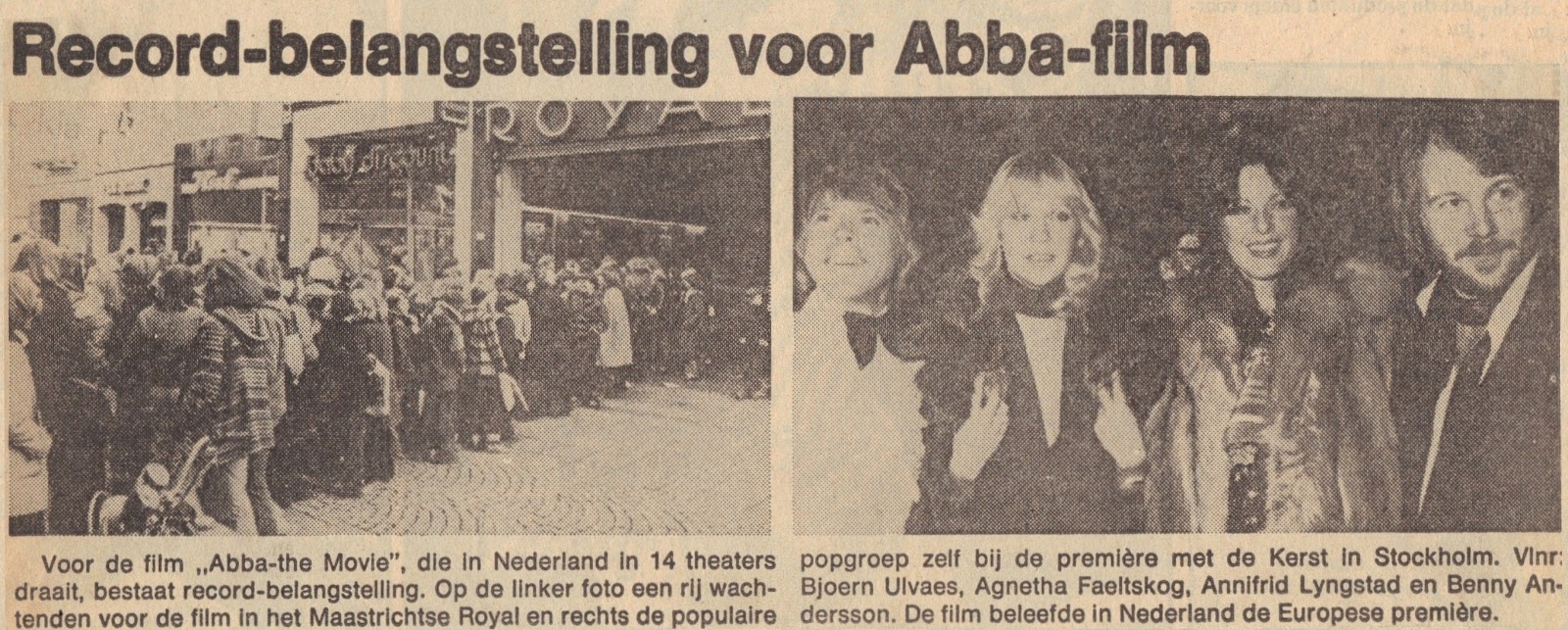
There's a record-breaking interest in the film 'ABBA-The Movie' that is being screened in 14 Dutch cinemas. On the picture on the left you can see people waiting in line for the movie at the Royal cinema in Maastricht and on the right the popular pop group themselves at the Christmas premiere in Stockholm. From left to right: Björn Ulvaeus, Agnetha Fältskog, Anni-Frid Lyngstad and Benny Andersson. The film had its European premiere in The Netherlands.
1977: Swedish movie premiere for ABBA
Sunday, 16 December 2012
Bravo, June 1980: ABBA-fuss concerning Agnetha: new love, eight month break
"We are actually long overdue with the new single," Benny explains. "We've already recorded five songs. But we simply can't decide which one of them should be released. But no worries, in the beginning of July our new record will be out in the shops."
That's why Benny has worked during the nights too the past few days. He is simply a perfectionist. Only when he is completely satisfied, the track will be shared for general approval. "We decide together which song will be released. Our manager Stig Anderson will give his opinion as well," Benny explains.
As soon as the new single is out in the shops, ABBA's holiday starts. Björn will definitely stay in the proximity of Stockholm. Together with his girlfriend Lena, he will go to the deserted small island in the Baltic Sea that ABBA has bought a couple of years ago. Anni-Frid and Benny will go on their holiday together. "But I don't know yet where we will go. I always leave that to Anni-Frid," Benny says. "She always finds the most beautiful travel destinations. Perhaps we will stay in Sweden too or we will fly to the Bahamas again, just like the past few years. Agnetha hasn't made any big travelling plans. In the autumn, her daughter Linda is going to start school. That's why she has insisted on spending time with her the last weeks leading up to the start of this new stage of life."
Because of Agnetha, ABBA will not go on tour the coming eight months. "Agnetha absolutely wants to take care of Linda during the first few months of her schooldays and not leave everything to the nanny," Benny says. However, this compulsory break isn't completely inconvenient to him either. In the middle of August, he wants to get together with Björn again to finally start working on a musical.
"That's an old dream of ours. But we need time and quietness for that. We can't complete a task like that in between two tours," he says. But one thing is for sure: it should have its premiere in the spring of 1981, probably in London. But ABBA themselves will not perform in the musical. "But either way, we will be present at the premiere. After all, a musical is something like your own child, much more substantial than an album."
Benny and Björn will start working on a new album in August. "This time we actually want to be finished around October, so we won't have to let the fans wait as long as with the last album. We already have a couple of songs ready. If we still like them after our summer holiday, they will be on the album. It's crucial too which new ideas we are going to have in the next two months."
Then Benny becomes very serious. He is thinking about the rumours surrounding ABBA, especially the gossip about the divorce. During the Japan tour in March they popped up again. This was due to Agnetha, who mostly isolated herself from the others, went her own way and often looked sad and lonely. Time and time again, there are speculations that Agnetha wants to leave the group and that ABBA will probably never tour again because of her. She still doesn't seem to have overcome her divorce from Björn.
"But that's not true," says Björn. "Agnetha never liked to go on tour and - more like the other three - she suffers from all the travelling. In the old days, there have already been nights that she doubted herself and believed that she wasn't good enough on stage anymore. Often she even burst into tears and at times she even wanted to throw in the towel. At moments like that it's extremely important that we all pull together. Then we should all help each other and it's evident how great it can be to be part of a group. I also know that Agnetha sometimes longs to wake up one morning and be a normal housewife. With everything that comes with it - making dinner, doing the laundry and playing with the kids. All of us will help her get through this small crisis. That's why we have cancelled all official commitments and we hardly show ourselves in public. This way, Agnetha will be able to recover from the stressful period and find herself again. Then she will be eager one day to be on stage with us again."
The cause of Agnetha's crisis is not just the divorce from Björn. The break-up of her relationship with Swedish ice hockey star Lars Eriksson was a factor as well. "He simply didn't want to be in the limelight all the time because of Agnetha, and be hunted by reporters and photographers," Benny thinks. "This can be very nerving for a human being who isn't used to that. Now Agnetha has found a new boyfriend, and she is happy with him. But Agnetha keeps him away from publicity as much as possible. Agnetha simply wants to avoid that her new love gets cracked again."
Agnetha's new boyfriend is 34 years old and he is a fashion designer. His name: Dick Håkansson. "He has been advising us for a long time already on choosing our wardrobe for performances and photo sessions," says Benny. "That's how Agnetha and Dick got acquainted. But the sparks didn't fly between them until the spring this year. Agnetha wants to spend her next holiday with Dick as well."
Saturday, 15 December 2012
Das Freizeit-Magazin, 1977: ABBA is taking a baby break
Since four months, ABBA has retained a mysterious radio silence: after 'Knowing Me, Knowing You', there has been no new hit single by the four Swedes, they didn't do any television shows and no performances. Now, ABBA has made their secret public. "I'm going to have a baby," revealed blonde Agnetha (27) in an exclusive interview with the Freizeit-Magazin. "That's why we are taking a break, that is going to last until November. With my little daughter Linda, the pregnancy was already very difficult. That's why I have to take it easy the coming months."
The baby break is coming exactly at the peak of ABBA's career. Was it a planned child? "We really didn't plan it," Agnetha admits. "Though Björn and I have always wanted a second child, but not so soon. For health reasons, I'm not taking the pill, and that's why it can always happen. I was a little afraid to tell Björn about it. After all we didn't reckon with a baby in our extremely busy schedule. But Björn was overwhelmed with joy from the first moment on and he is really looking forward to our second child. The way that Anni-Frid and Benny are looking after me is touching as well. I believe all four of us are glad to have some peace and quiet for a while."
In the coming four months Agnetha - who has become a little fuller in her face already - still has to be in front of a camera. "In Stockholm, we are shooting the last few scenes for our movie that should be released in the cinemas in December, simultaneously with our new album and single," says Agnetha. "It's going to be a crazy, hilarious movie in which we will be seen during concerts as well as in our private lives."
When will Agnetha's baby be born? "I must have become pregnant somewhere in March and the doctors have calculated that the baby will be born between 10 and 20 November," Agnetha reveals. "Anyhow, Björn and I really hope it's going to be a boy. Then Linda will finally get her long-awaited little brother."
Sunday, 25 November 2012
Joker, April 1977: ABBA intimate: "We are slaves to our career"
ABBA, the pop miracle of the seventies. A lot has been said already about this group - a lot of nonsense too. The rise of these four Swedes, that has outstripped the Beatles already today, has nurtured rumours often enough. In the glare of the spotlights, no one wanted to believe that doubt, fears, affection, sometimes even hatred has played a part in this fantastic career.
Harry Edington, a British reporter, and his friend and colleague Peter Himmelstrand from Sweden have observed the group when they were taking their first steps on the international scene. They are the ones who really know how everything started and what's going on behind the scenes. Here's the truth about ABBA.
Anni-Frid, the girl with the German father.
The young Norwegian girl had lost all of her friends. Others pointed at her with their fingers or spit on the street before her. Her misdoing? She had fallen in love with a German officer and was expecting his baby. This happened in 1945 in Narvik in northern Norway. The German occupants were hated and feared by the native population. But when Synni Lyngstad, an innocent 19-year-old, met this Alfred Haase, he seemed different from all the others. At the end of the war Alfred was commanded back to Germany. Before he left he promised Synni to come back and marry her. But he never came back.
Her child, a daughter, was born on 15 November 1945 and named Anni-Frid after her grandmother. It was the coldest winter in Europe since years. But even the ice was warmer than the feelings of the inhabitants of Narvik towards Synni and her daughter. For two years, the mother and daughter waited for their loved one and father. Anni-Frid's grandmother had to witness how her daughter withered away in her loneliness. Synni died when she was only 21. The grandmother realised that little Anni-Frid with the abusive name 'German child' was facing a difficult childhood in Narvik. She left Norway and moved to the Swedish town Torshälla, where Anni-Frid grew up. She called her grandmother 'mamma' and she still does today. Anni-Frid: "I've tried to find my father. It was impossible. It is believed that his ship went down in Denmark. Otherwise, he definitely would have returned. It was good that I still had my grandmother. She was always very sweet to me and she encouraged me in everything that I did. On long, cold winter evenings she taught me old folk songs from our home country. She also encouraged me to start singing."
When she was 10, Anni-Frid found herself on stage for the first time. Three years later, she lied to an organizer that she was already 16 and this way she got a job as a singer in a restaurant. Her first band was called 'The Anni-Frid Four'. She was especially fond of the bass player and band leader, Ragnar Frederiksson, who was also a furniture salesman on the side. Things happened as expected: the both of them fell in love, got engaged and started living together.
When she was 16, she gave birth to a son: Hans, they got married and then came the second child: Lise-Lotte. Anni-Frid had to choose between her family and her career. Her career took precedence. Anni-Frid: "Although I had the smiling image of a happy singer, behind the mask I was very unhappy. Unfortunately I have to say today that people who really should have known better were very rude to me. They said that I didn't care about the children. They couldn't have been more wrong. Ragnar was there for them and they could not have been raised better." It was the painful decision between a marriage falling apart and the start of a career that introduced Anni-Frid as a regular visitor of the Swedish bestseller charts, although critics thought that her music was only appealing to a small part of the audience. A performance on the popular Swedish TV show 'Hyland's Corner' guaranteed her increasing popularity and helped her to become one of Sweden's first female singers.
Benny, who is often craving for his children.
Whenever someone wants to ask the friendly, bearded and somewhat chubby Benny Andersson about his education, he has a smile and a reply ready: "I have a driver's licence." It's a polite description of his barely succcessful schooldays. The only subject that he liked more or less was English.
He was born in a suburb of Stockholm on 16 December 1946. Benny got through his schooldays with a drowsy indifference, something that is still apparent today when he has to occupy himself with something that he isn't interested in at all. He left school when he was 15 without any exams or certificate and he concentrated completely on his music.
Benny: "My grandfather and father were exactly like me. They tried every, and I mean every, instrument that they could find." Two years after he had left school Benny was still trying to find out which part of the business world could be of use to him. The time in between was filled with thinking about his future and occasional performances with a band.
One day, the group had to go out of town for a guest appearance, which was unusual. Usually, no one wanted them. Svenne Hedlund, singer of the group Hep Stars, helped out with his truck. Svenne: "Benny is a good musician. When our organ player quit, Benny joined us. He turned up wearing a neck tie, a couple of months later he had long hair and looked like us." The Hep Stars turned into a top group.
A big distress for Benny: "We couldn't show our faces in any restaurant anymore, we were harassed everywhere." Along with their increasing popularity, their income increased as well, but Benny never seemed to be interested in money. The Hep Stars started taking care of their own releases and business matters, to market their songs. But their company 'Hep House' went bankrupt. The biggest flop that ever happened to Benny.
Another problem was waiting for Benny: in the summer of 1966 he broke his four-year-long engagement to Christina Grönvall. A pretty, red-haired girl that he had met in school. They lived together and had two children: Peter and Helena. This romance was kept top secret from the group's fans. A couple of months after the long impending break up, Christina confronted Benny in an interview: "Tell everyone about me and the children. The family that doesn't have a place in his glittering world as a pop idol. The only contact of the children with their father is through the records of the Hep Stars. I once joined them on tour, but I always had to travel separately. And during the show I was hidden away."
Benny was amazed that this story caused so much turmoil. He was also disappointed that strange people wanted to get into his private life. By the way, today he still has the same opinion. He has learned from his experience with Christina. But he often thinks about his children yearningly.
Björn, who forgot to smile on stage.
Björn Ulvaeus was born in the last days of the war on 25 April 1945 on the west coast of Göteborg. When he was 11 his family moved to the east coast town Vastervik - a name that means something like west bay. He got acquainted with guitars, boating and the raw folk music, that was flooding the world around this time.
When he was 17, Björn got together with three of his friends and he said to them that he wanted to start a Dixieland group. The aim was to get public performances in order to increase their pocket money. Today he says: "It wasn't a serious venture, although I gave that impression to some people. I was just bragging when I talked to the boys about jazz and things like that. I didn't know much about it and so our music was more like American folk music in the style of the Kingston Trio." One day, Björn's mother brought home a form to enter the talent competition 'Opportunity Knocks'. The group's name had to be entered as well and since there wasn't any name yet, mother Ulvaeus came up with The West Bay Singers. Björn: "I was astounded when I found out that she had entered us into that competition. At first I wanted to withdraw, but then I thought, why would I?"
A preview of the programme indicated that The West Bay Singers would sing songs in Swedish and English. This was read by Bengt Bernhag, a well-known talent scout. He was a trouper in the music business with a real instinct for up-and-coming talents. He liked the group and especially the simple and honest presentation and he recommended them to the boss of his company, a single-minded and energetic music publisher called Stig Anderson. He asked Björn for a demo tape. Björn: "That was an exciting day for us all." The first thing that Stig Anderson did for the group was change their name. That's how they turned into The Hootenanny Singers. Their first record was perfect: 'I'm Waiting At The Charcoal Kiln', a sad song about the people who were working in the forests. It became a big success.
Stig: "I noticed that there were opportunities for this group. They looked good and the blonde, handsome Björn was the centre of attention on stage. None of us had expected to become so successful this fast."
Stig's trust and Bengt's fatherly advice persuaded Björn how to pursue his future. And the conditions couldn't have been better for him. Bengt was a skilled music technician and he taught him everything that he knew. Bengt always treated Björn as his son. Without this connection, Björn would probably never have turned into a superstar. One of Björn's friends: "Stig was always a business man, and Björn was exactly right for him. Björn is someone who can analyze accurately and meticulously. When you look at him while he is working you can almost hear his brains working as a precision machine. Because he attacks everything with his intellect, he has to force himself on stage to smile at his fans sometimes."
Agnetha, who often fears to get in front of a microphone.
Agnetha Fältskog, born on 5 April 1950 in Jönköping (Sweden), is the daughter of an enterprising father, who produced shows for domestic use at the local cultural centre. Agnetha: "I will never forget my first official performance. In the middle of a show for elderly people, my pants went down and the audience burst into laughter. I was six years old at the time." When she was 15, she got her own piano. Reason enough for the musical offspring to try out her own melodies. She also wrote her own lyrics to these melodies, starting with a first draw about two dwarfs. At 15, Agnetha was a singer in a dance band. Two years later, she joined another band - that's how her voice turned up on the desk of producer Little Gerhard of the record company CBS, whose cousin worked as the second singer in the same band. He asked Agnetha to send him an entire tape.
Her favourite song around this time was 'I Was So In Love', a song about a girl mourning about her lost love. She was that girl. She wrote the song because she was so unhappy when her romance with Björn Lillia came to an end. "I was sitting at the piano and tried to forget. The melody was ready within half an hour. I didn't feel any better but I had a great song." The producer had the same opinion. Agnetha said goodbye to her family and went on a train to Stockholm to record the song.
"It was the most exciting moment of my life. My heart was beating in my throat. I had to force myself to get inside the studio. On stage I still have that same feeling sometimes. Then I heard that the musicians were practising my melody. Suddenly I was floating on a cloud." Within a week the record was at number one.
Little Gerhard: "Agnetha was very critical from the start - when it came to her job as well." Her straightforward way of dealing with problems made the transition from the country to the city very difficult. Behind her self-confidence, a considerable amount of shyness was hidden. She said things that she didn't mean to say like that and often came across as being impolite. A friend says: "I'm convinced that she sometimes didn't realize what she was doing and that the words simply came out because she felt insecure. But when she talked to people privately, she was sweet, polite and honest. I understand that she is still driving reporters crazy these days. They don't get anything more out of her than a simple 'yes' or 'no'. I believe that she understands that it's better to say nothing at all than to make a blunder all the time."
But nothing could stop Agnetha's career. She started to perform in TV shows and went on tour in the inevitable folk parks. A German record company tried to get her under contract. She refused, but still her popularity in Germany was increasing - for a short period of time she was engaged to the German lyricist Dietrich Zimmermann. The critics followed all of her moves. Her song 'Gypsy Friend' was called racialistic and heavily criticized. Agnetha: "It's a pity that people see it like that. I just wrote a song, that's all."
Subscribe to:
Posts (Atom)